Many learners feel confused about “never mind” and “nevermind.” Both forms appear in writing, especially online, so it can be hard to know which one is correct. You may see one in a book and the other on social media, which makes the confusion even bigger.
The good news is that this is an easy topic once you understand one key idea. After reading this guide, you will clearly know which form to use and when.
Quick Answer
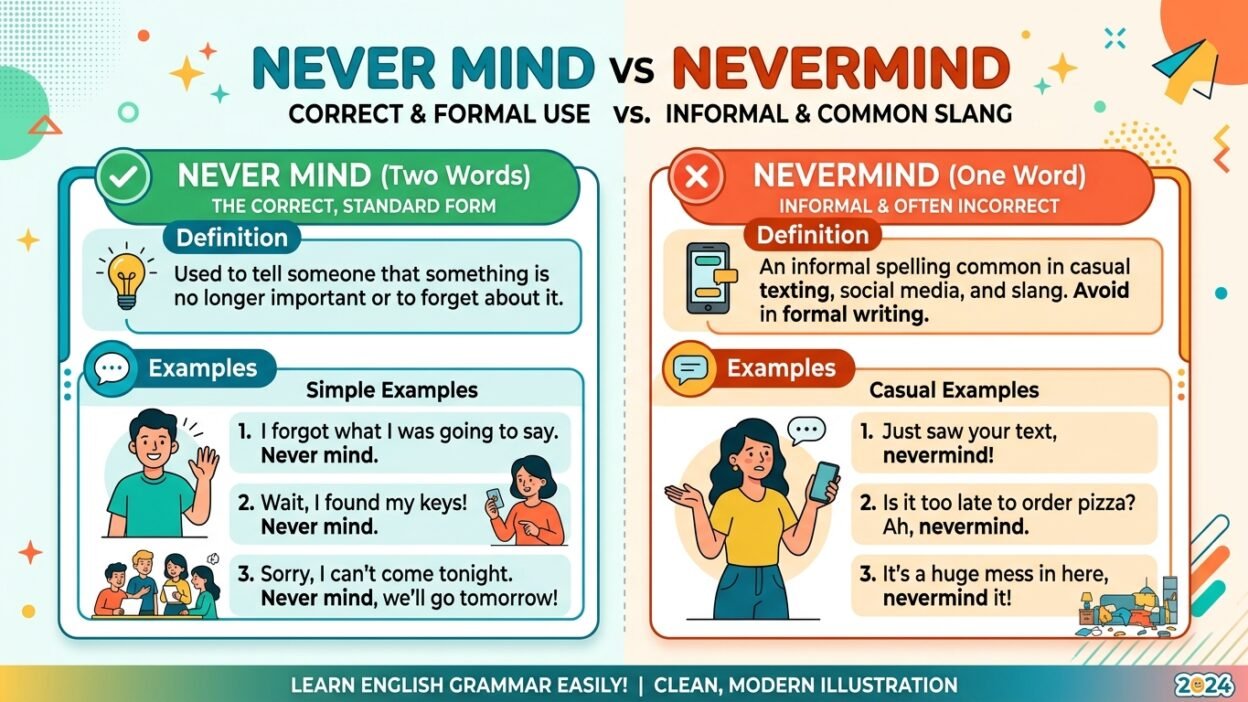
- ✅ Never mind = correct and standard form
- ⚠️ Nevermind = informal and less accepted
- Both can mean the same thing in casual use
- For school and formal writing, always use never mind
Example:
- Never mind, I understand now. ✅
- Nevermind, it’s okay. (informal)
Simple Origin or Background Explanation
The phrase started as two separate words:
- Never (not at any time)
- Mind (to care or worry about something)
So, “never mind” originally meant:
👉 “Do not worry about it” or “Do not think about it”
Over time, especially in fast typing and casual messages, people started writing it as one word: “nevermind.”
This happens in English sometimes, where two words slowly join together. However, not all joined forms become fully accepted in standard writing.
That is the case here:
👉 “Never mind” stayed the correct form
👉 “Nevermind” became informal
Clear Explanation of the Difference
What does “never mind” mean?
“Never mind” is a phrase used to:
- Tell someone not to worry
- Say something is not important anymore
- Cancel what you just said
Examples:
- Never mind, I found my keys.
- Never mind that mistake, let’s continue.
- Oh, never mind, it’s not important.
This form is correct in all types of writing.
What does “nevermind” mean?
“Nevermind” is a single word used mostly in:
- Informal writing
- Text messages
- Social media
It has the same meaning as “never mind,” but it is not preferred in formal English.
Examples:
- Nevermind, I fixed the problem.
- Nevermind, it’s fine 🙂
Key Difference
- Never mind = correct, standard, formal
- Nevermind = informal, casual
👉 The meaning is the same, but the style is different
Comparison Table
| Feature | Never mind ✅ | Nevermind ⚠️ |
|---|---|---|
| Meaning | Same | Same |
| Spelling | Two words | One word |
| Style | Formal + standard | Informal |
| Usage | School, writing | Casual, texting |
| Recommended | Yes | Not for formal use |
Which One to Use and When
Use “never mind” in most cases
You should use “never mind” when:
- Writing essays
- Sending formal emails
- Doing school work
- Writing clearly and correctly
Examples:
- Never mind the delay, we can start now.
- Never mind, I will handle it.
Use “nevermind” only in casual situations
You may use “nevermind” when:
- Chatting with friends
- Posting online
- Sending quick messages
Examples:
- Nevermind, I’ll do it later.
- Nevermind, it’s okay 😄
Final Advice
👉 If you are unsure, always choose “never mind”
It is safe and correct everywhere
Common Mistakes People Make
1. Thinking both forms are equal
Some people think both are equally correct in all situations.
👉 This is not true
“Never mind” is the standard form
2. Using “nevermind” in formal writing
❌ Nevermind, I apologize for the mistake.
This looks too casual.
✅ Better:
- Never mind, I apologize for the mistake.
3. Writing it as one word in exams
Students often write “nevermind” in tests.
👉 This can be marked as incorrect
4. Confusing the meaning
Some learners are not sure what it means.
Remember:
👉 It means “don’t worry” or “it’s not important”
5. Overusing the phrase
Using “never mind” too often can sound unclear.
Try to use it only when needed.
Everyday Real Life Examples
In Emails
- Never mind the earlier message, please follow this one.
- Never mind, the issue has been solved.
In Social Media
- Nevermind, I figured it out!
- Oh nevermind, it’s not a big deal 😅
In Daily Conversation
- Never mind, I can do it myself.
- Never mind, it’s okay.
In School or Study
- Never mind the small mistake, focus on the main idea.
- Never mind, try again.
In Text Messages
- Nevermind, I’ll call you later.
- Never mind, no problem 👍
Short Learning Section for Students and Beginners
Here are simple tips to remember:
Tip 1: Two Words Are Safer
👉 Always write never mind
Tip 2: Think About Formal vs Casual
- Formal → never mind
- Casual → nevermind (optional)
Tip 3: Meaning Trick
👉 “Never mind” = “don’t worry”
Practice Sentences
Fill in the blank:
- ______, I found the answer.
- ______, it’s not important.
- ______, I will try again.
Answers:
- Never mind
- Never mind
- Never mind
Tip 4: Keep It Simple
When in doubt:
👉 Use never mind every time
FAQ
1. Is “nevermind” wrong?
It is not completely wrong, but it is informal and not preferred in formal writing.
2. Which one should I use in exams?
Always use “never mind”
3. Do both mean the same thing?
Yes, both have the same meaning.
4. Can I use “nevermind” in messages?
Yes, it is fine in casual messages and chats.
5. Why do people write it as one word?
Because of fast typing and informal communication.
6. Is “never mind” more correct?
Yes, it is the standard and correct form.
7. Can I use both in the same paragraph?
It is better to use one style. Choose “never mind.”
8. What is the easiest way to remember?
👉 Two words = correct
👉 One word = casual
Conclusion
The difference between “never mind” and “nevermind” is very simple once you understand it clearly.
- Never mind is the correct and standard form
- Nevermind is informal and used in casual writing
👉 Both have the same meaning, but the style is different
If you want to be safe and clear, always use “never mind.” This choice will work in all situations, from school to everyday writing.
With a little practice, you will never feel confused about this again.