Many learners feel confused about “quiet” and “quite.” These two words look very similar, and their pronunciation is also close. Because of this, people often mix them up in writing.
But the meanings are completely different. Once you understand the difference, it becomes very easy to use the right word.
Let’s make it simple and clear.
Quick Answer
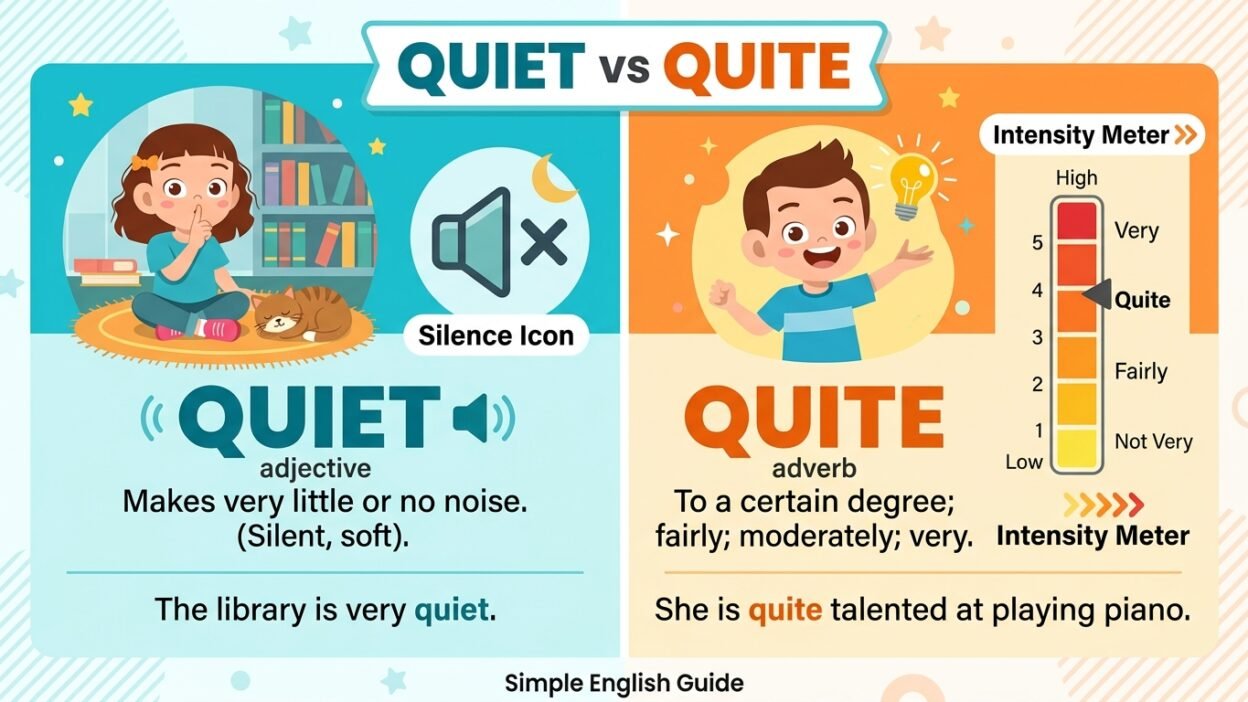
- ✅ Quiet = no noise, calm
- ✅ Quite = very or fairly
- ❌ They do NOT mean the same thing
Examples:
- Please be quiet. ✅
- This is quite easy. ✅
Simple Origin or Background Explanation
Both words come from older forms of English and have been used for a long time.
- Quiet is related to calmness and silence
- Quite is used to add strength to a sentence (like “very”)
Even though they look similar, their meanings developed differently over time.
Clear Explanation of the Difference
What does “quiet” mean?
“Quiet” means:
- No noise
- Calm
- Silent
It is usually used as an adjective (describing word).
Examples:
- The room is quiet.
- Please stay quiet.
- It was a quiet night.
👉 Think: no sound or peaceful
What does “quite” mean?
“Quite” means:
- Very
- Fairly
- To a certain degree
It is an adverb (it describes something else).
Examples:
- The test was quite easy.
- She is quite happy.
- This is quite interesting.
👉 Think: adding strength or degree
Key Idea
- Quiet = silence
- Quite = very
Comparison Table
| Feature | Quiet ✅ | Quite ✅ |
|---|---|---|
| Meaning | No noise | Very / fairly |
| Type | Adjective | Adverb |
| Usage | Describes silence | Describes degree |
| Example | Quiet room | Quite easy |
Which One to Use and When
Use “quiet” when:
- Talking about silence
- Describing calm places or people
Examples:
- Please be quiet in class.
- The park is very quiet.
Use “quite” when:
- You want to say “very” or “fairly”
- You are describing how strong something is
Examples:
- This book is quite good.
- The weather is quite cold.
Simple Rule
👉 No noise → quiet
👉 Very/fairly → quite
Common Mistakes People Make
1. Mixing the two words
❌ Please be quite.
✅ Please be quiet.
2. Using “quiet” instead of “quite”
❌ This is quiet easy.
✅ This is quite easy.
3. Not checking meaning
Always check what you want to say:
- Silence? → quiet
- Degree? → quite
4. Typing too fast
Because the words look similar, small typing errors happen often.
Everyday Real Life Examples
In Emails
- Please keep the room quiet.
- This task is quite simple.
In News
- The area remained quiet overnight.
- The results were quite surprising.
On Social Media
- It’s so quiet here today 😌
- This movie is quite amazing!
In Daily Conversation
- Be quiet, please.
- I’m quite tired today.
Incorrect Examples (for learning)
- ❌ Please be quite.
- ❌ This is quiet interesting.
Correct forms:
✔️ quiet
✔️ quite
Short Learning Section for Students and Beginners
Here are easy tips to remember:
Trick 1: “Quiet” Has “et” (like rest)
👉 Quiet = calm, rest, silence
Trick 2: “Quite” Has “ite” (like intensity)
👉 Quite = strong or very
Trick 3: Simple Memory Line
- Quiet = no noise
- Quite = very
Practice Sentences
Fill in the blank:
- Please be ______ in the library.
- This is ______ easy to understand.
- The street is very ______ at night.
Answers:
- quiet
- quite
- quiet
FAQ
1. Are “quiet” and “quite” the same?
No, they have different meanings.
2. What does “quiet” mean?
It means no noise or calm.
3. What does “quite” mean?
It means very or fairly.
4. Which one is used for silence?
“Quiet” is used for silence.
5. Which one means “very”?
“Quite” means very.
6. Is “Please be quite” correct?
No. Correct: Please be quiet
7. How can I remember the difference?
👉 Quiet = silence
👉 Quite = very
8. What is the safest way to choose?
Check meaning before writing.
Conclusion
The difference between “quiet” and “quite” is simple once you understand it.
- Quiet means no noise
- Quite means very or fairly
👉 Silence → quiet
👉 Degree → quite
With this easy rule, you can avoid mistakes and use both words correctly and confidently.