Many learners feel confused about “seen” and “saw.” Both words come from the verb “see,” and both talk about the past. Because of this, they look similar and are often mixed up.
This is a very common mistake, especially in speaking and informal writing. The good news is that the difference is simple once you understand one small rule.
Let’s break it down in a clear and easy way so you can use both words correctly every time.
Quick Answer
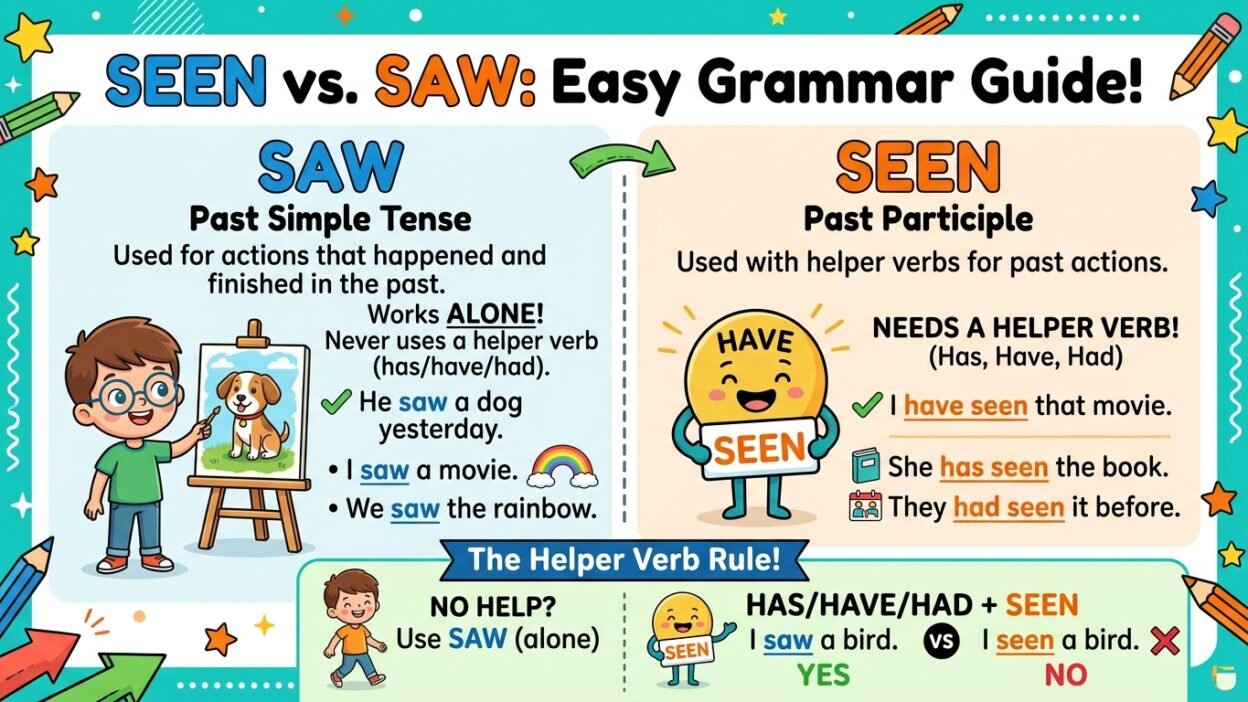
- ✅ Saw = simple past (used alone)
- ✅ Seen = past participle (used with helping verbs)
- ❌ Do not use “seen” without a helping verb
Examples:
- I saw the movie yesterday. ✅
- I have seen the movie. ✅
- I seen the movie yesterday. ❌
Simple Origin or Background Explanation
Both “saw” and “seen” come from the verb “see.”
Here are its main forms:
- Present: see
- Past: saw
- Past participle: seen
English uses different forms of verbs depending on time and sentence structure.
👉 “Saw” is used for a completed action in the past.
👉 “Seen” is used with a helper like have, has, or had.
Clear Explanation of the Difference
What does “saw” mean?
“Saw” is the simple past form of “see.”
It describes something that happened in the past and is finished.
Examples:
- I saw a bird in the sky.
- She saw her friend at school.
- We saw that movie last week.
👉 Use “saw” when you do NOT use a helping verb.
What does “seen” mean?
“Seen” is the past participle form.
It must be used with a helping verb like:
- have
- has
- had
Examples:
- I have seen that film.
- She has seen the results.
- They had seen the problem before.
👉 “Seen” cannot stand alone.
Key Rule
👉 No helping verb → use saw
👉 Helping verb → use seen
Comparison Table
| Feature | Saw ✅ | Seen ✅ |
|---|---|---|
| Verb type | Past tense | Past participle |
| Used alone | Yes | No |
| Needs helper | No | Yes |
| Example | I saw him | I have seen him |
| Common mistake | Rare | Used alone ❌ |
Which One to Use and When
Use “saw” when:
- Talking about a finished action in the past
- No helping verb is used
Examples:
- I saw him yesterday.
- She saw a dog on the road.
Use “seen” when:
- You use helping verbs (have, has, had)
- Talking about experience or past connection
Examples:
- I have seen that show.
- He has seen this before.
Quick Check
Ask yourself:
👉 Is there a helping verb?
- Yes → use seen
- No → use saw
Common Mistakes People Make
1. Using “seen” without a helper
❌ I seen him yesterday.
✅ I saw him yesterday.
This is the most common mistake.
2. Mixing both forms
❌ I have saw that movie.
✅ I have seen that movie.
3. Forgetting helping verbs
❌ She seen the result.
✅ She has seen the result.
4. Using wrong tense
❌ I have saw him last night.
✅ I saw him last night.
Everyday Real Life Examples
In Emails
- I saw your message yesterday.
- I have seen your email and will reply soon.
In News
- The police saw the suspect leaving the area.
- Officials have seen a rise in cases.
On Social Media
- I just saw this video 😂
- I have seen this before!
In Daily Conversation
- Did you see that? I saw it too.
- I have seen that place before.
Incorrect Examples (for learning)
- ❌ I seen that movie.
- ❌ He have saw it.
Correct forms:
✔️ I saw that movie
✔️ He has seen it
Short Learning Section for Students and Beginners
Here are easy tricks to remember:
Trick 1: The Helper Rule
👉 Seen needs a helper (have/has/had)
Trick 2: Simple Past = Saw
👉 If the sentence is simple past, use saw
Trick 3: Memory Pattern
- I saw
- I have seen
Say this again and again to remember.
Practice Sentences
Fill in the blank:
- I ______ him yesterday.
- I have ______ that movie.
- She ______ a bird this morning.
Answers:
- saw
- seen
- saw
FAQ
1. Can I say “I seen him”?
No, this is incorrect. Say “I saw him.”
2. Why is “seen” not used alone?
Because it is a past participle and needs a helping verb.
3. Which is correct: “I have saw” or “I have seen”?
Correct: I have seen
4. When should I use “saw”?
Use it for simple past actions without helping verbs.
5. Is “seen” more formal?
No, it just depends on grammar, not formality.
6. Can I use “seen” with “did”?
No. After “did,” use the base form “see.”
Example:
- Did you see it?
7. What is the easiest way to remember?
👉 Saw = alone
👉 Seen = with helper
8. Which one is safer to use?
If there is no helping verb, always use saw
Conclusion
The difference between “seen” and “saw” is simple once you know the rule.
- Saw = past tense (used alone)
- Seen = used with helping verbs
👉 No helper → saw
👉 With helper → seen
By remembering this one rule, you can avoid a very common mistake and speak and write more clearly.
Practice a little, and soon it will feel natural.