
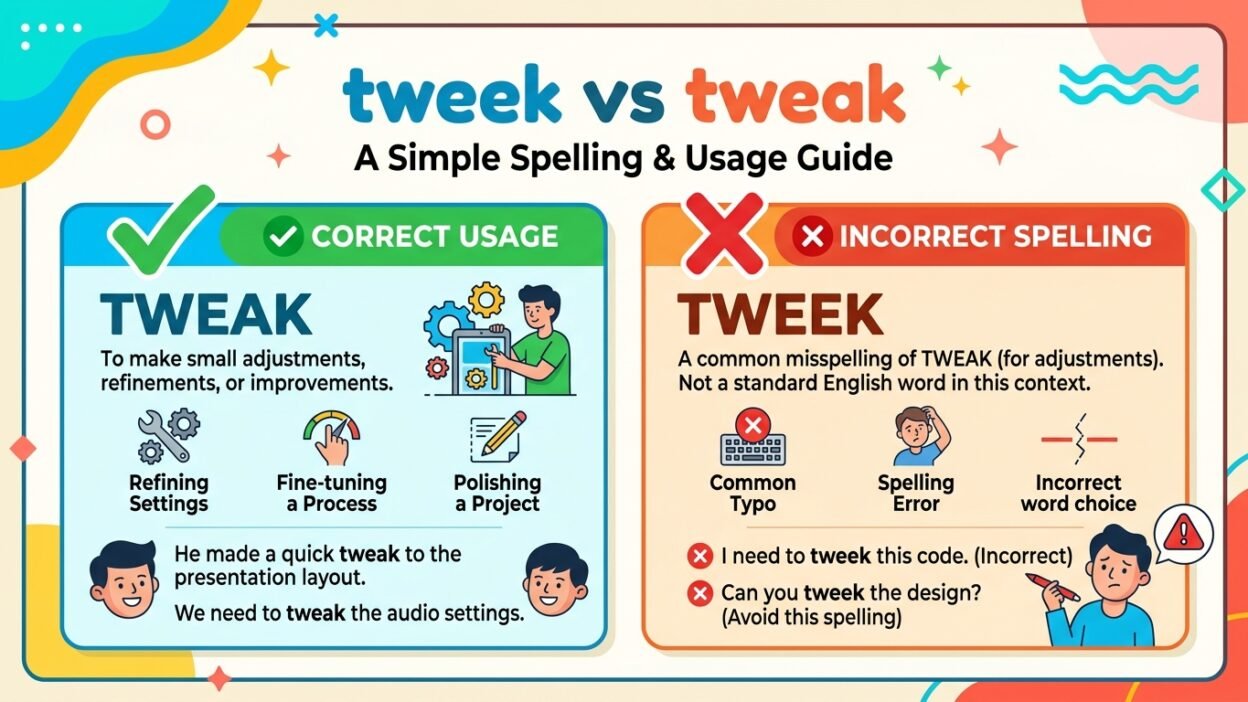
Many learners feel confused about “tweek” and “tweak.” These two words look very similar, but only one of them is correct in standard English.
The confusion usually happens because of spelling. The words sound almost the same, so people often write the wrong one.
Let’s clear this up in a very simple way.
Quick Answer
- ✅ Tweak = correct spelling
- ❌ Tweek = incorrect spelling
- Use tweak in all situations
Examples:
- I need to tweak the design. ✅
- I need to tweek the design. ❌
👉 Always choose tweak
Simple Origin or Background Explanation
The word “tweak” comes from older English and means:
👉 to pull or change something slightly
Over time, its meaning expanded to include:
- Small changes
- Minor improvements
The spelling “tweek” is just a common mistake. It is not a standard English word.
Clear Explanation of the Difference
What does “tweak” mean?
“Tweak” means:
- To change something a little
- To improve something slightly
- To adjust something carefully
Examples:
- She tweaked the settings.
- I will tweak the design.
- He made a small tweak to the plan.
👉 It is used in daily life, work, and technology
What does “tweek” mean?
“Tweek” is:
- Not a correct spelling
- A common mistake
👉 It should not be used in writing
Key Idea
- Tweak = correct
- Tweek = wrong
Comparison Table
| Feature | Tweak ✅ | Tweek ❌ |
|---|---|---|
| Meaning | Small change | No real meaning |
| Spelling | Correct | Incorrect |
| Usage | Common | Not used |
| Recommended | Yes | No |
Which One to Use and When
Use “tweak” when:
- You want to make small changes
- You are improving something
- You are adjusting settings or plans
Examples:
- I need to tweak this sentence.
- She tweaked the design.
- Let’s tweak the plan.
Never use “tweek”
It is not correct in standard English.
👉 Always replace it with tweak
Simple Rule
👉 Only one correct word: tweak
Common Mistakes People Make
1. Writing “tweek”
❌ I will tweek the design.
✅ I will tweak the design.
2. Confusing spelling sounds
“tweak” sounds like “tweek,” which causes mistakes.
3. Not checking spelling
Always double-check your writing.
4. Using “tweek” in formal writing
This can make your writing look incorrect.
Everyday Real Life Examples
In Emails
- I will tweak the report.
- Let me tweak the details.
In Work or Office
- The team tweaked the plan.
- We need to tweak the settings.
On Social Media
- Just tweaked my profile 😄
- Small tweak, big difference!
In Daily Conversation
- I need to tweak this recipe.
- He tweaked the idea.
Incorrect Examples (for learning)
- ❌ I will tweek it.
- ❌ She tweeked the design.
Correct forms:
✔️ tweak
✔️ tweaked
Short Learning Section for Students and Beginners
Trick 1: “EA” Pattern
👉 tweak = has “ea”
Trick 2: One Correct Choice
👉 Always use tweak
Trick 3: Check Before Writing
If you see “tweek,” fix it to “tweak”
Practice Sentences
Fill in the blank:
- I need to ______ the design.
- She ______ the settings.
- Let’s make a small ______.
Answers:
- tweak
- tweaked
- tweak
FAQ
1. Is “tweek” a real word?
No, it is not a correct spelling.
2. Which one is correct: tweak or tweek?
“Tweak” is correct.
3. What does “tweak” mean?
It means to make a small change.
4. Why do people write “tweek”?
Because it sounds similar to “tweak.”
5. Can I use “tweek” in writing?
No, it should be avoided.
6. Is “tweak” formal or informal?
It can be used in both.
7. What is the safest option?
👉 Always use tweak
8. Is “tweak” common in daily use?
Yes, it is widely used.
Conclusion
The difference between “tweek” and “tweak” is very simple.
- Tweak is correct and widely used
- Tweek is incorrect and should be avoided
👉 Always choose tweak
This simple rule will help you write clearly and correctly every time.

Austin Brandon serves as both an author and administrator at GrammerPeak. He manages site operations while creating clear, accurate grammar content that helps readers correct mistakes, understand language rules, and write with confidence, precision, and clarity across academic, professional, and everyday English communication.