
Many students and English learners feel confused about “begun” and “began.” Both words come from the verb “begin.” Both talk about something starting. So why are there two forms?
The confusion happens because English verbs change form depending on time and grammar structure. Some verbs are regular (like walk → walked). But “begin” is an irregular verb. That means it changes in a different way.
The good news is simple:
Both words are correct but they are used in different situations.
Let’s understand the difference clearly.
Quick Answer
- ✅ Began = simple past (used alone)
- ✅ Begun = past participle (used with helping verbs like has, have, had)
- ❌ Do not use “begun” without a helping verb.
Examples:
- I began the project yesterday. ✔
- I have begun the project. ✔
- I begun the project yesterday. ❌
Simple Background: The Verb “Begin”
The base form of the verb is:
begin
This verb means “to start.”
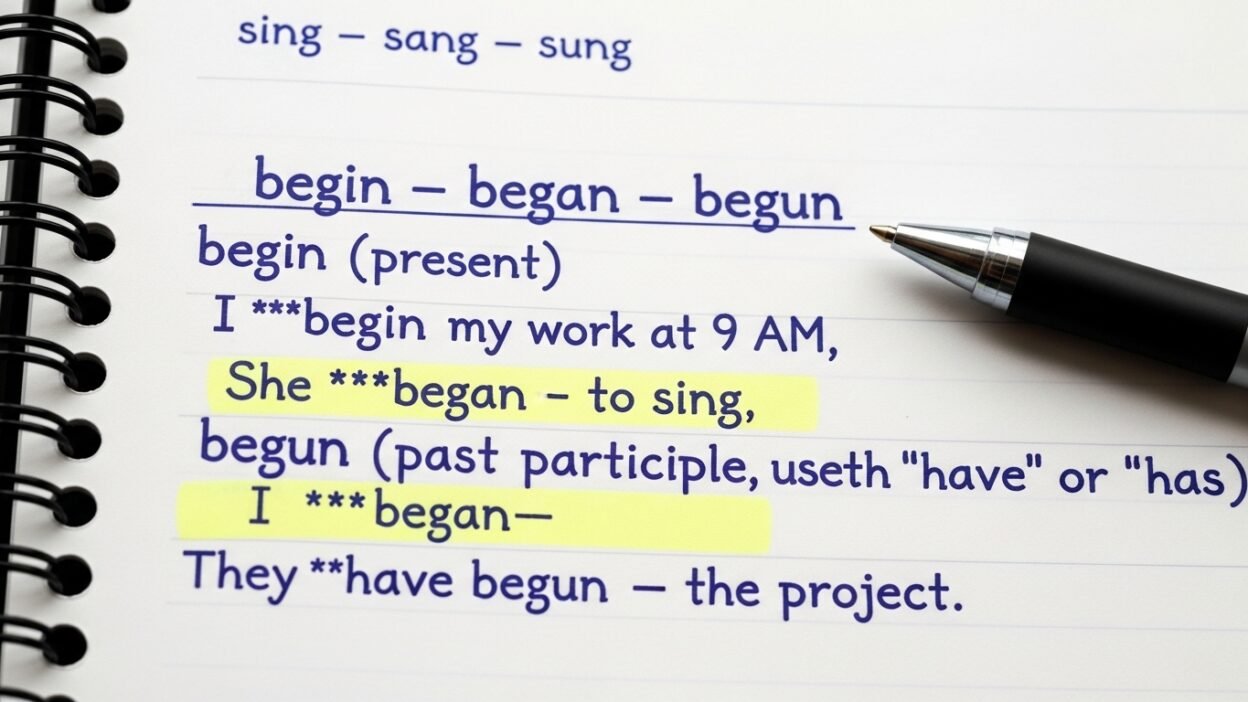
It is an irregular verb. That means it changes like this:
- begin (base form)
- began (past simple)
- begun (past participle)
You just need to remember these three forms.
Clear Explanation of the Difference
1. Began (Simple Past)
We use began to talk about something that started in the past.
It does not need a helping verb.
Examples:
- She began her homework.
- The movie began at 7 p.m.
- They began the meeting late.
Think of “began” as the normal past form.
If you can replace it with “started,” you are usually correct.
2. Begun (Past Participle)
We use begun with helping verbs like:
- has
- have
- had
Examples:
- She has begun her homework.
- The movie has begun.
- They had begun eating before we arrived.
Important rule:
You almost never use “begun” alone.
Wrong:
- She begun her homework. ❌
Correct:
- She has begun her homework. ✔
Comparison Table
| Feature | Began | Begun |
|---|---|---|
| Verb form | Simple past | Past participle |
| Used alone? | Yes | No |
| Needs helping verb? | No | Yes |
| Example | I began. | I have begun. |
| Talks about past? | Yes | Yes |
This table helps you see the difference quickly.
Which One Should You Use and When?
Use began when:
- You talk about a finished action in the past.
- You are not using “has,” “have,” or “had.”
Examples:
- School began in September.
- He began learning English last year.
- The rain began suddenly.
Use begun when:
- You use helping verbs.
- You are forming present perfect or past perfect tense.
Examples:
Present Perfect:
- I have begun a new book.
- She has begun cooking.
Past Perfect:
- They had begun the test before I arrived.
- We had begun working early.
If you see has, have, or had, think:
“Do I need begun?”
Common Mistakes People Make
Mistake 1: Using “begun” Alone
Wrong:
- He begun the race. ❌
Correct:
- He began the race. ✔
Remember: “begun” needs a helper.
Mistake 2: Using “began” After “has” or “have”
Wrong:
- She has began her work. ❌
Correct:
- She has begun her work. ✔
After has/have/had → use begun.
Mistake 3: Mixing Up the Verb Forms
Many learners forget that “begin” is irregular.
It does NOT follow this pattern:
begin → begined ❌
Instead, remember:
begin → began → begun
Mistake 4: Confusing with “Start”
“Start” is regular:
start → started → started
But “begin” changes differently.
Everyday Real Life Examp
On Social Media
- I began my fitness journey today!
- I have begun reading a new novel.
- They had begun celebrating early.
In School Writing
Correct:
- The experiment began at noon.
- Scientists have begun studying the problem.
Incorrect:
- Scientists have began studying the problem. ❌
Short Learning Section for Students and Beginners
Here is a simple memory trick:
If there is NO helping verb → use began
If there IS a helping verb → use begun
Let’s practice:
Fill in the blanks:
- She ______ her speech confidently.
- They have ______ the exam.
- The show ______ late.
- We had ______ eating before he arrived.
Answers:
- began
- begun
- began
- begun
Simple rule. Simple answers.
FAQ:
1. Is “begun” correct English?
Yes, but only with helping verbs like has, have, or had.
2. Can I say “He begun the class”?
No. Say:
- He began the class.
3. Why are there two forms?
Because “begin” is an irregular verb. It changes in different tenses.
4. What are the three forms of begin?
- begin
- began
- begun
5. When do I use “began”?
Use it for simple past without helping verbs.
6. When do I use “begun”?
Use it with has, have, or had.
7. Is “begun” more formal?
No. It is just a different verb form.
8. Can I replace both with “started”?
Often yes. But grammar rules still apply.
Example:
- The meeting started.
- The meeting began.
Both are correct in many cases.
Simple Conclusion
Let’s make it very clear:
- Began = simple past
- Begun = past participle
- Begun needs a helping verb
- Began does not
If you remember just one thing, remember this:
No helper? → began
With helper? → begun
Now you can use both words correctly and confidently in your writing and speaking.