
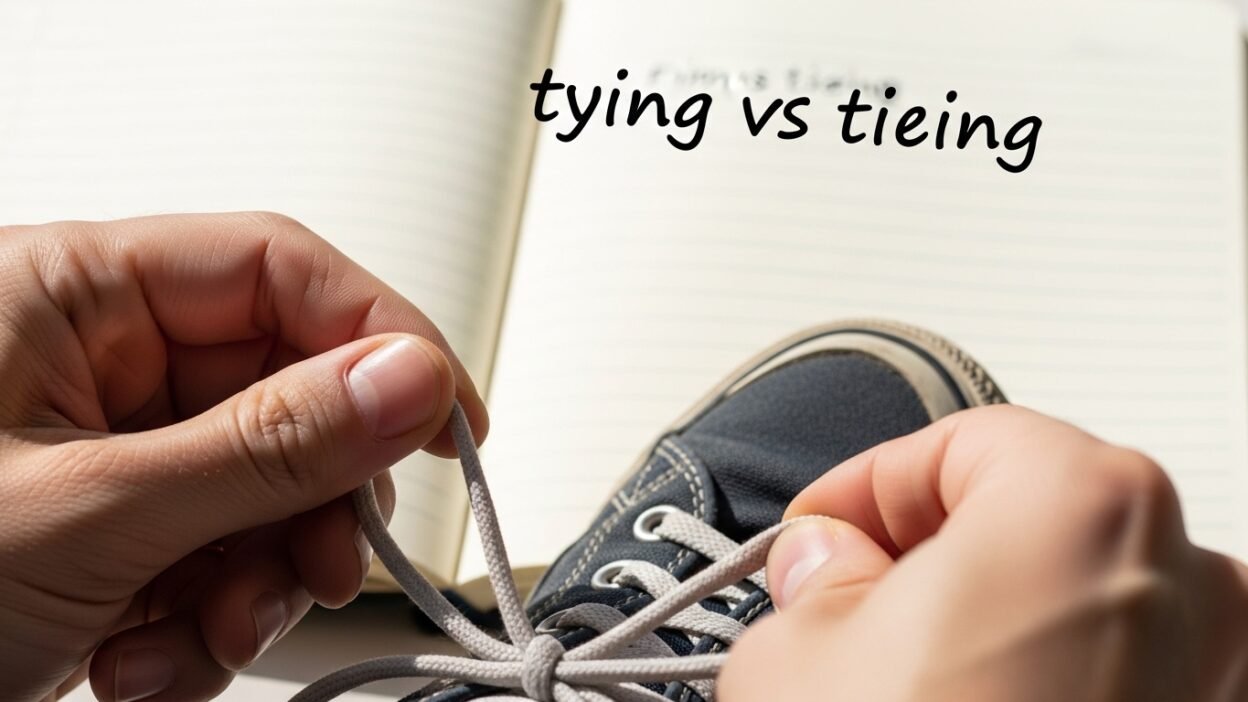
Many students and English learners feel confused about the words “tying” and “tieing.” Both words look possible. Both seem to come from the verb “tie.” So which one is correct?
When we add -ing to verbs in English, sometimes the spelling changes. Sometimes it does not. Because of this, people are not sure what to write.
The good news is simple:
There is only one correct spelling.
Let’s understand it clearly and remove all confusion.
Quick Answer
- ✅ Tying is correct.
- ❌ Tieing is incorrect.
- The correct present participle of tie is tying.
- English spelling rules explain why the “e” disappears and changes to “y.”
That’s it! But let’s look deeper so you understand it fully.
Simple Background: Where Does “Tying” Come From?
The base verb is “tie.”
Examples:
- Tie your shoes.
- Please tie the rope.
- She will tie the ribbon.
When we want to talk about an action happening now, we add -ing.
Example:
- I am tying my shoes.
But here is the important part:
When a verb ends in -ie, we usually:
- Remove ie
- Add y
- Then add -ing
So:
tie → tying
Not tieing
This spelling rule helps make the word easier to pronounce and read.
Clear Explanation of the Difference
Let’s look at both words:
1. Tying (Correct)
- This is the correct spelling.
- It follows English spelling rules.
- It is used in all formal and informal writing.
Example:
- He is tying his shoelaces.
- She is tying her hair back.
- They are tying the boat to the dock.
2. Tieing (Incorrect)
- This spelling is wrong.
- It does not follow English spelling rules.
- It is considered a spelling mistake.
If you write “tieing” in school or in an exam, it will be marked wrong.
So remember:
There is no difference in meaning.
The difference is simple:
One is correct.
One is incorrect.
Comparison Table
| Feature | Tying ✅ | Tieing ❌ |
|---|---|---|
| Correct spelling | Yes | No |
| Used in books | Yes | No |
| Used in exams | Yes | No |
| Follows spelling rule | Yes | No |
| Should you use it? | Yes | Never |
This makes it easy to see the difference quickly.
Which One Should You Use and When?
Always use tying.
Use it whenever you need the -ing form of tie.
Examples:
Present Continuous Tense
- I am tying my shoes.
- She is tying a knot.
- We are tying balloons.
As a Gerund (verb acting like a noun)
- Tying knots is fun.
- Tying your shoes takes practice.
No matter the sentence, the spelling stays the same: tying.
Why Does the Spelling Change?
English has a special rule for verbs ending in -ie.
Here are some examples:
- die → dying
- lie → lying
- tie → tying
Notice something?
We do not write:
- dieing ❌
- lieing ❌
- tieing ❌
We remove ie and add y + ing.
This rule helps pronunciation. If we wrote “tieing,” it would look strange and harder to read.
So the rule makes the word smoother and clearer.
Common Mistakes People Make
Let’s look at some common errors.
Mistake 1: Writing “tieing”
Many learners think:
“Just add -ing to tie.”
So they write:
tie + ing = tieing ❌
But that is not how this word works.
Mistake 2: Forgetting the -ie Rule
Some students forget that:
-ie → y before adding -ing
This rule is important for:
- tie
- die
- lie
Mistake 3: Thinking Both Spellings Are Acceptable
Some people think both spellings are okay.
They are not.
In standard English:
- Only tying is correct.
Mistake 4: Mixing Up with “Trying”
Some learners mix up:
- trying
- tying
They look similar but have different meanings.
- Trying = making an effort
- Tying = making a knot
Example:
- I am trying to learn English.
- I am tying my shoes.
Very different meanings!
Everyday Real Life Examples
Let’s see how “tying” is used in daily life.
In Emails
Correct:
- I am tying up some loose ends before the meeting.
- She is tying the files together.
Incorrect:
- I am tieing up loose ends. ❌
On Social Media
Correct:
- Just finished tying my running shoes!
- He is tying a tie for the first time.
Incorrect:
- Tying my shoes before the game.
- Tieing my shoes before the game. ❌
In News or Articles
Correct:
- The workers are tying the ropes tightly.
- The boy was tying balloons for the party.
You will not see “tieing” in professional writing.
In Daily Conversation
You might say:
- Wait, I am tying my hair.
- She is tying the dog outside.
- He is tying his tie.
All use the same correct spelling.
Short Learning Section for Students and Beginners
Here is a small lesson you can remember easily.
Step 1: Look at the verb
Tie
Step 2: Does it end in -ie?
Yes.
Step 3: Remove -ie
Tie → t
Step 4: Add y + ing
Tying
That’s it!
You can practice with these:
Fill in the blanks:
- She is ______ her shoes.
- He is ______ a knot.
- They are ______ the boat.
Answers:
- tying
- tying
- tying
Simple and clear!
FAQ:
1. Is “tieing” ever correct?
No. In modern English, “tieing” is considered incorrect spelling.
2. Why does “tie” become “tying”?
Because verbs ending in -ie change to y before adding -ing.
3. Is “tying” used in formal writing?
Yes. It is the only correct spelling in formal writing.
4. Is this rule only for “tie”?
No. It also applies to:
- die → dying
- lie → lying
5. Why can’t we just write “tieing”?
Because English spelling rules change -ie to y before adding -ing.
6. How can I remember the correct spelling?
Remember this pattern:
-ie → y + ing
tie → tying
die → dying
lie → lying
If you remember one, you remember all.
7. What does “tying” mean?
It means:
- Making a knot
- Fastening something with string, rope, or ribbon
8. Is “tying” pronounced differently from “tieing”?
Since “tieing” is not correct, we only use and pronounce “tying.”
It sounds like: TIE-ing.
Simple Conclusion
Let’s review everything clearly.
- The correct spelling is tying.
- “Tieing” is incorrect.
- Verbs ending in -ie change to y before adding -ing.
- This rule also works for die → dying and lie → lying.
If you remember just one thing, remember this:
There is no choice between tying or tieing.
Only tying is correct.
Now you can write with confidence and never feel confused again.