
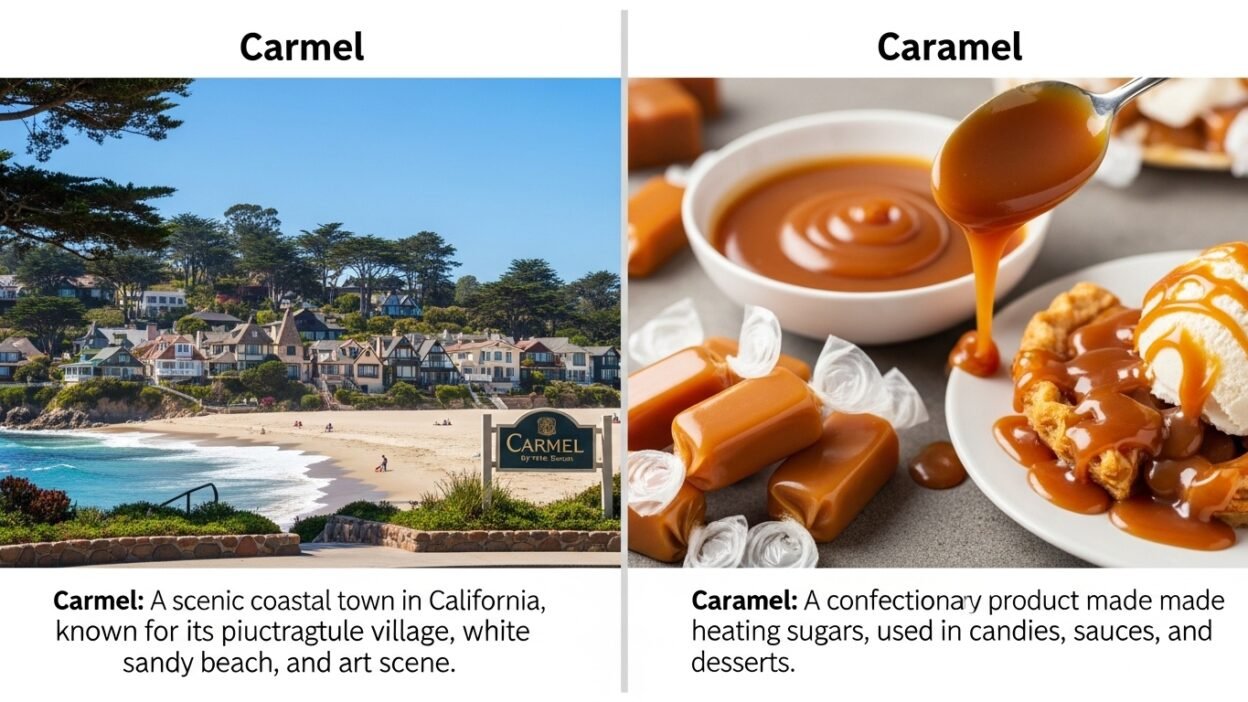
Many people feel confused between Carmel and caramel. The words look very similar. They also sound similar when spoken quickly. Because of this, many students and even adults mix them up.
You may hear someone say, “I love carmel ice cream.”
But is that spelling correct?
This guide will explain the difference in very simple English. After reading, you will clearly understand which word to use and when.
Quick Answer: Carmel or Caramel?
Here is the short and simple answer:
- ✅ Caramel is a sweet food made from heated sugar.
- ✅ Carmel is usually a name (a place or a person).
- ❌ Carmel is NOT the correct spelling for the sweet candy.
So:
- If you are talking about candy or flavor use caramel.
- If you are talking about a place or name use Carmel.
That’s the basic difference.
Simple Background: What Is Caramel?
Caramel is made by heating sugar until it turns brown and sweet. It is used in:
- Candy
- Ice cream
- Cakes
- Coffee drinks
- Sauces
When sugar melts and changes color, it becomes caramel.
The word “caramel” comes from older European languages that described cooked sugar.
What Is Carmel?
Carmel is usually a proper noun (a name).
For example:
- Carmel by the Sea is a famous coastal town.
- Carmel is a city in the U.S.
- Some people also have the name “Carmel.”
There is also a famous biblical place called Mount Carmel.
So, Carmel is normally a name not a food.
Clear Explanation of the Difference
Let’s break it down in the simplest way.
Caramel
- A common noun (a thing).
- A sweet food.
- Made from heated sugar.
- Used as flavor or sauce.
- Spelled with three “a” letters: c-a-r-a-m-e-l.
Example sentences:
- “I ordered a caramel latte.”
- “She likes caramel candy.”
- “The cake has caramel sauce on top.”
Carmel
- A proper noun (a name).
- A place or person’s name.
- Usually capitalized (Carmel).
Example sentences:
- “She lives in Carmel.”
- “We visited Carmel by the Sea.”
- “Carmel is a beautiful town.
Easy Comparison Table
| Feature | Caramel | Carmel |
|---|---|---|
| Type of Word | Common noun | Proper noun (name) |
| Meaning | Sweet made from sugar | Place or person name |
| Used in Food? | Yes | No |
| Capital Letter? | Usually no | Yes |
| Example | Caramel ice cream | Carmel, Indiana |
This table makes it easy to see the difference.
Why Do People Mix Them Up?
There are two main reasons.
1. Pronunciation
In fast speech, some people say:
“car-mel” instead of “care-a-mel.”
So “caramel” may sound like “carmel.”
This happens often in American English.
2. Spelling Mistakes
Because the words sound similar, people sometimes write:
- “carmel popcorn”
- “carmel sauce”
But the correct spelling for the sweet is always caramel.
Which One Should You Use and When?
Use “Caramel” When Talking About:
- Ice cream
- Candy
- Coffee drinks
- Desserts
- Sweet sauces
Example:
“I would like a caramel macchiato.”
Use “Carmel” When Talking About:
- A city
- A town
- A person’s name
Example:
“We took a trip to Carmel last summer.”
Common Mistakes People Make
Let’s look at common errors.
Mistake 1: Writing “Carmel” on a Menu
Wrong:
- Carmel latte
- Carmel candy
Correct:
- Caramel latte
- Caramel candy
Mistake 2: Forgetting Capital Letters
When using Carmel as a place name, it should start with a capital letter.
Correct:
- Carmel is beautiful.
Not:
- carmel is beautiful.
Mistake 3: Thinking Both Spellings Are Acceptable for Food
They are not.
Only caramel is correct for the sweet flavor.
Everyday Real Life Examples
Example 1: Coffee Shop
Correct:
“I’ll have a caramel latte.”
Wrong:
“I’ll have a carmel latte.”
Example 2: Travel Blog
“We visited Carmel-by-the-Sea and enjoyed the ocean view.”
Here, Carmel is a place name.
Example 3: Social Media Post
“Homemade caramel sauce is the best!”
This talks about food.
Example 4: School Writing
“The dessert was covered in caramel.”
Correct spelling for food.
Learning Section for Students and Beginners
Let’s review the key points.
Vocabulary
- Noun = person, place, or thing.
- Proper noun = name of a person or place.
- Common noun = general thing.
- Sauce = liquid added to food.
Simple Practice Questions
- Which word is sweet and made from sugar?
Caramel - Which word is a city name?
Carmel - Should caramel start with a capital letter?
No (unless at the beginning of a sentence) - Is “carmel ice cream” correct?
No
Easy Memory Trick
Think:
- Caramel has an extra “a.”
- That extra “a” stands for “added sugar.”
Caramel = sugar treat.
Carmel = name of a place.
Frequently Asked Questions (FAQ)
1. Are Carmel and caramel pronounced the same?
Sometimes in fast speech they sound similar, but they are spelled differently and mean different things.
2. Is Carmel ever correct for candy?
No. The correct spelling for the sweet is caramel.
3. Why do some people say “car mel”?
It is a common pronunciation style in some regions.
4. Should Carmel always be capitalized?
Yes, when it refers to a place or name.
5. What part of speech is caramel?
It is a common noun.
6. What part of speech is Carmel?
It is a proper noun.
7. Can caramel be used as an adjective?
Yes.
Example:
- “caramel sauce”
- “caramel flavor”
Simple and Clear Conclusion
The difference between Carmel and caramel is very simple:
- Caramel is a sweet made from heated sugar.
- Carmel is a name of a place or person.
If you are talking about food, always use caramel.
If you are talking about a city or name, use Carmel with a capital letter.
Now the confusion is gone. You can spell both words correctly and use them with confidence.

Austin Brandon serves as both an author and administrator at GrammerPeak. He manages site operations while creating clear, accurate grammar content that helps readers correct mistakes, understand language rules, and write with confidence, precision, and clarity across academic, professional, and everyday English communication.