Many students and English learners feel confused between gluing and glueing. Both spellings look possible because they come from the word glue, which ends with the letter e. When we add -ing to verbs, sometimes the spelling changes, and sometimes it does not. This makes learners unsure about the correct form.
The good news is that the rule is simple. Only one spelling is correct in modern English.
This guide will explain everything in very easy English so you can understand the correct spelling and use it confidently.
Quick Answer: Gluing vs Glueing
Here is the simple answer:
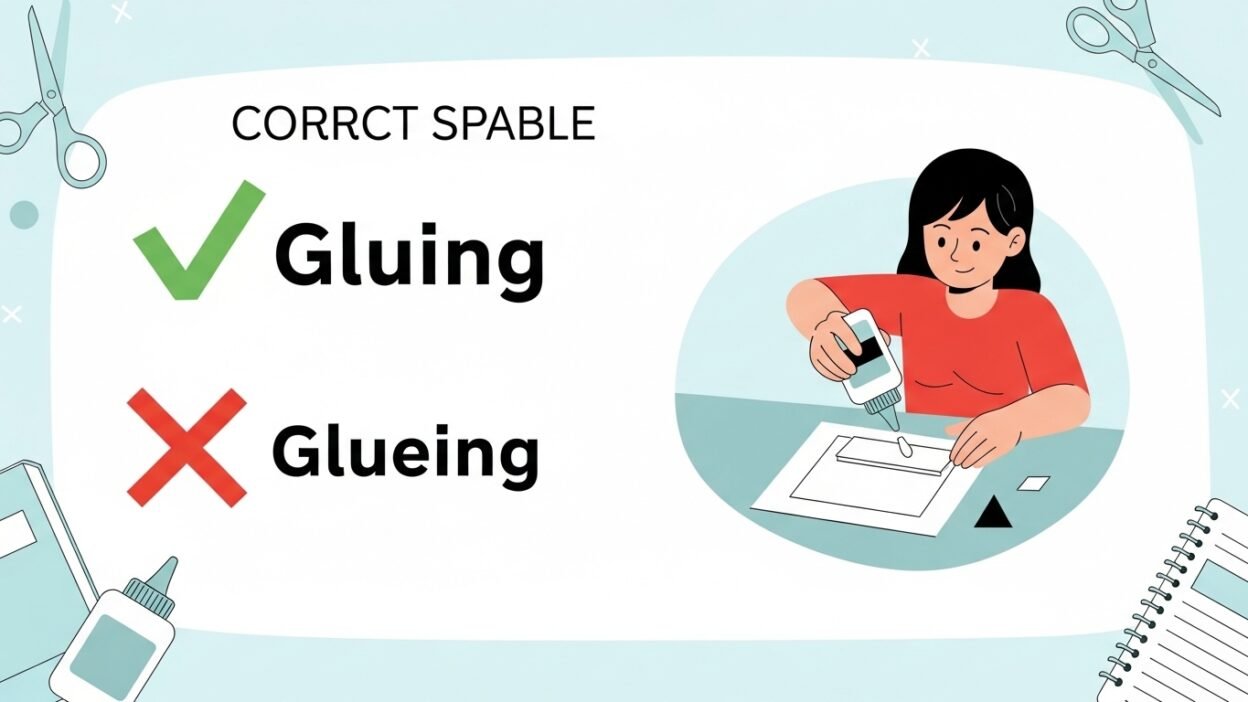
- Gluing ✅ Correct spelling
- Glueing ❌ Incorrect spelling (not standard)
- Gluing means using glue to stick things together
- Always use gluing in school, writing, and daily life
Simple Origin and Background
The base word is glue.
Glue is a noun and a verb.
- As a noun: It is a sticky substance used to join things.
- As a verb: It means to stick things together.
Examples:
- Use glue to fix the paper.
- She will glue the pieces together.
When we want to show the action happening now, we add -ing.
Example:
- glue → gluing
However, English spelling rules say we usually remove the final e before adding -ing.
So:
- glue → gluing ✅
- glue → glueing ❌
Clear Explanation of the Difference
The difference is very simple.
Gluing (Correct Spelling)
Gluing is the correct form.
It means:
- Using glue to join things
- The action of sticking something with glue
Examples:
- She is gluing paper.
- He is gluing the broken toy.
- They are gluing the project pieces.
Glueing (Incorrect Spelling)
Glueing is not the correct standard spelling.
It is usually a mistake.
English spelling rules say:
- Remove the final e
- Then add -ing
So:
- glue → gluing ✅
- glue → glueing ❌
Comparison Table: Gluing vs Glueing
| Feature | Gluing | Glueing |
|---|---|---|
| Correct spelling | Yes | No |
| Standard English | Yes | No |
| Used in school writing | Yes | No |
| Found in dictionaries | Yes | No |
| Recommended usage | Yes | No |
| Should you use it? | Yes | No |
Which One to Use and When
Always use gluing when talking about the action of using glue.
Use gluing in present continuous tense
Examples:
- She is gluing the paper.
- He is gluing the broken chair.
Use gluing in school projects
Examples:
- Students are gluing pictures.
- The child is gluing craft items.
Use gluing in daily conversation
Examples:
- I am gluing the pages.
- They are gluing the box.
Never use glueing in normal writing.
Common Mistakes People Make
Here are common mistakes learners make:
Mistake 1: Keeping the “e”
❌ Wrong: She is glueing the paper.
✅ Correct: She is gluing the paper.
Rule: Remove the final “e” before adding “ing”
Mistake 2: Not knowing the spelling rule
Many verbs follow this rule:
| Base verb | Correct -ing form |
|---|---|
| make | making |
| write | writing |
| use | using |
| glue | gluing |
Remove “e” and add “ing”
Mistake 3: Guessing spelling based on sound
Both gluing and glueing sound similar, but only one is correct.
Everyday Real Life Examples
Here are real-life examples using gluing.
Example 1: School project
“I am gluing pictures in my notebook.”
Example 2: Art and craft
“She is gluing paper flowers.”
Example 3: At home
“He is gluing the broken toy.”
Example 4: Classroom
“Students are gluing their assignments.”
Example 5: Social media
“My child is gluing craft pieces.”
Example 6: Office work
“They are gluing labels on boxes.”
Short Learning Section for Students and Beginners
Simple rule to remember
Remove the final “e” and add “ing”
glue → gluing
Not glueing
Easy memory trick
Think:
glue
remove e
add ing
= gluing
Practice exercise
Fill in the blank:
- She is ______ the paper.
Answer: gluing - He is ______ the broken toy.
Answer: gluing - They are ______ pictures.
Answer: gluing
Quick spelling rule examples
| Verb | Correct -ing form |
|---|---|
| use | using |
| make | making |
| write | writing |
| glue | gluing |
FAQ
Question 1: Which spelling is correct, gluing or glueing?
Gluing is correct. Glueing is incorrect.
Question 2: Why is glueing incorrect?
Because English spelling rules say to remove the final “e” before adding “ing.”
Question 3: What does gluing mean?
It means sticking things together using glue.
Question 4: Is gluing used in daily life?
Yes.
Example:
She is gluing paper.
Question 5: Is gluing used in American and British English?
Yes. Gluing is correct in both.
Question 6: Can glue be used as a verb?
Yes.
Example:
She will glue the paper.
Question 7: Is glueing ever correct?
No. It is not standard modern English.
Question 8: What is the base word of gluing?
The base word is glue.
Conclusion
The difference between gluing and glueing is simple.
Gluing is the correct spelling.
It means using glue to stick things together.
Glueing is incorrect and should not be used.
Remember this simple rule:
Remove the final “e” and add “ing”
glue → gluing
If you follow this rule, you will always use the correct spelling in school, writing, and everyday life.