Many English learners feel confused when they see the words “midday” and “mid day.” At first, both forms look correct. After all, English sometimes uses two words, one word, or even a hyphen for similar expressions.
Because of this, students often ask:
- Is it midday or mid day?
- Are both correct?
- When should I use each one?
The confusion happens because English spelling changes over time. Some words that were once written as two separate words later become one word.
The good news is that the answer is simple. Once you understand the rule, you will feel confident using the correct form in writing and speaking.
Quick Answer
Here is the clear and simple answer:
- Midday (one word) is the correct and standard form.
- Mid day (two words) is not standard and is usually considered incorrect.
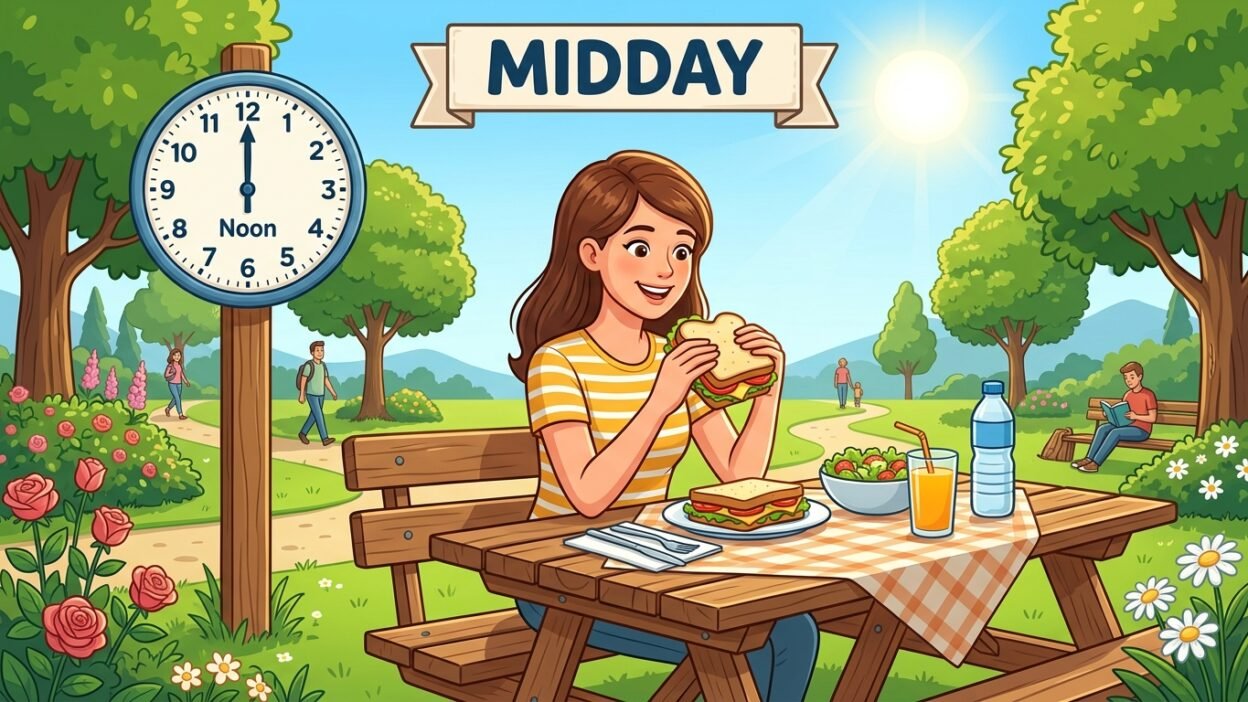
- Midday means around 12:00 noon or the middle of the day.
- Always use midday in writing, exams, and formal communication.
Example:
- Correct: Let’s meet at midday.
- Incorrect: Let’s meet at mid day.
Simple Origin or Background
To understand why midday is written as one word, it helps to look at how English forms words.
How compound words work
English often combines two small words to make a new word. These are called compound words.
For example:
- sun + light → sunlight
- class + room → classroom
- after + noon → afternoon
Over time, these combined words become one single word because people use them often.
How “midday” was formed
The word midday comes from:
- mid (meaning middle)
- day (meaning the daytime period)
At first, people may have written it as mid day. But as the word became more common, it joined into one word:
midday
This is similar to other time words like:
- midday
- midnight
- afternoon
All of these are now written as one word.
Clear Explanation of the Difference
Now let’s clearly explain the difference between the two forms.
What “midday” means
Midday is a noun that means:
- the middle of the day
- around 12:00 noon
- the time when the sun is highest in the sky
Examples:
- We will have lunch at midday.
- The sun is very strong at midday.
- She usually takes a break at midday.
This form is correct and widely used in both formal and informal English.
What “mid day” means
Mid day (two words) is not the standard spelling.
Most modern English writing does not accept “mid day” as correct.
Sometimes, very old texts or informal writing may show mid day, but today it is better to avoid it.
Simple way to remember
- Midday = correct and modern
- Mid day = avoid using
Comparison Table
| Form | Correct or Not | Meaning | Usage |
|---|---|---|---|
| Midday | Correct | Middle of the day (around noon) | Used in all writing |
| Mid day | Not standard | Same meaning, but incorrect form | Should be avoided |
| Midnight | Correct | Middle of the night | Always one word |
| Afternoon | Correct | Time after noon | Always one word |
This table shows that midday follows the same pattern as other time words.
Which One to Use and When
Choosing the right form is very easy.
Always use “midday” when:
- writing essays
- sending emails
- doing school work
- taking exams
- writing formal or informal messages
Examples:
- The meeting is scheduled for midday.
- It gets very hot at midday in summer.
- We usually eat lunch around midday.
Do not use “mid day” because:
- it is not standard English
- it may be marked wrong in exams
- it looks incorrect to readers
Even if someone understands it, it is better to use the correct form.
Common Mistakes People Make
Many learners make small mistakes with this word.
Mistake 1: Writing it as two words
Incorrect:
- I will call you at mid day.
Correct:
- I will call you at midday.
Mistake 2: Adding a hyphen
Incorrect:
- We will meet at mid-day.
Correct:
- We will meet at midday.
Some people think a hyphen is correct, but modern English prefers one word.
Mistake 3: Confusing with “noon”
Some learners think midday and noon are always different.
In many cases, they mean almost the same thing.
- Noon = exactly 12:00
- Midday = around 12:00 (a little flexible)
Mistake 4: Using different forms in the same text
Incorrect:
- We met at mid day, and at midday we had lunch.
Correct:
- We met at midday, and at midday we had lunch.
Always stay consistent.
Everyday Real-Life Examples
Let’s look at how midday is used in daily life.
In emails
Example:
- Let’s schedule the meeting at midday tomorrow.
Another example:
- I will send the report by midday.
In news
Example:
- The temperature rises sharply at midday.
Another example:
- Traffic is usually heavy around midday.
On social media
Example:
- “Too hot to go outside at midday!”
Another example:
- “Lunch time at midday with friends.”
In daily conversation
Example:
- Friend: “When should we meet?”
- You: “Let’s meet at midday.”
Another example:
- Parent: “Come home by midday.”
These examples show that midday is common and natural in everyday English.
Learning Section for Students and Beginners
If you are learning English, here are some easy tips.
Tip 1: Remember it as one word
Think of midday like:
- midnight
- afternoon
All are one word.
Tip 2: Connect it with time
Whenever you think of 12:00 noon, remember the word:
midday
Tip 3: Practice simple sentences
Try writing your own:
- I wake up early and eat lunch at midday.
- The sun is hottest at midday.
- We will meet at midday.
Tip 4: Avoid guessing
If you are unsure, always choose the one-word form.
Tip 5: Read and notice
When you read books or messages, notice how often midday is used.
This helps your brain remember the correct form.
(FAQ)
1. Is it “midday” or “mid day”?
The correct form is midday (one word).
2. Is “mid day” wrong?
Yes, it is not standard in modern English and should be avoided.
3. Can I use “mid-day” with a hyphen?
No, modern usage prefers midday without a hyphen.
4. What does “midday” mean?
It means the middle of the day, usually around 12:00 noon.
5. Is “midday” the same as “noon”?
They are very similar.
Noon is exactly 12:00, while midday can mean around that time.
6. Is “midday” formal or informal?
It can be used in both formal and informal situations.
7. Why is it one word?
Because it is a compound word that joined over time, like midnight.
8. Will I lose marks for writing “mid day”?
In many cases, yes. It may be marked as incorrect spelling.
Conclusion
The difference between midday and mid day is simple but important.
Midday is the correct and standard form. It means the middle of the day, usually around noon, and is used in all types of English.
Mid day, on the other hand, is not standard and should be avoided in writing and exams.
A good way to remember is to think of similar words like midnight and afternoon, which are also written as one word.
Once you remember this simple rule, you will never feel confused again. With practice, using midday will feel natural and easy in both speaking and writing.