Many people feel confused when they see “everyone” and “every one.” They look almost the same, but they are not the same. Even good English learners sometimes mix them up.
The reason for this confusion is simple: both words talk about people or things in a group. But they are used in different ways and have different meanings.
Don’t worry. In this guide, you will learn the difference in very easy English. By the end, you will know exactly which one to use.
Quick Answer
Here is the simplest way to understand:
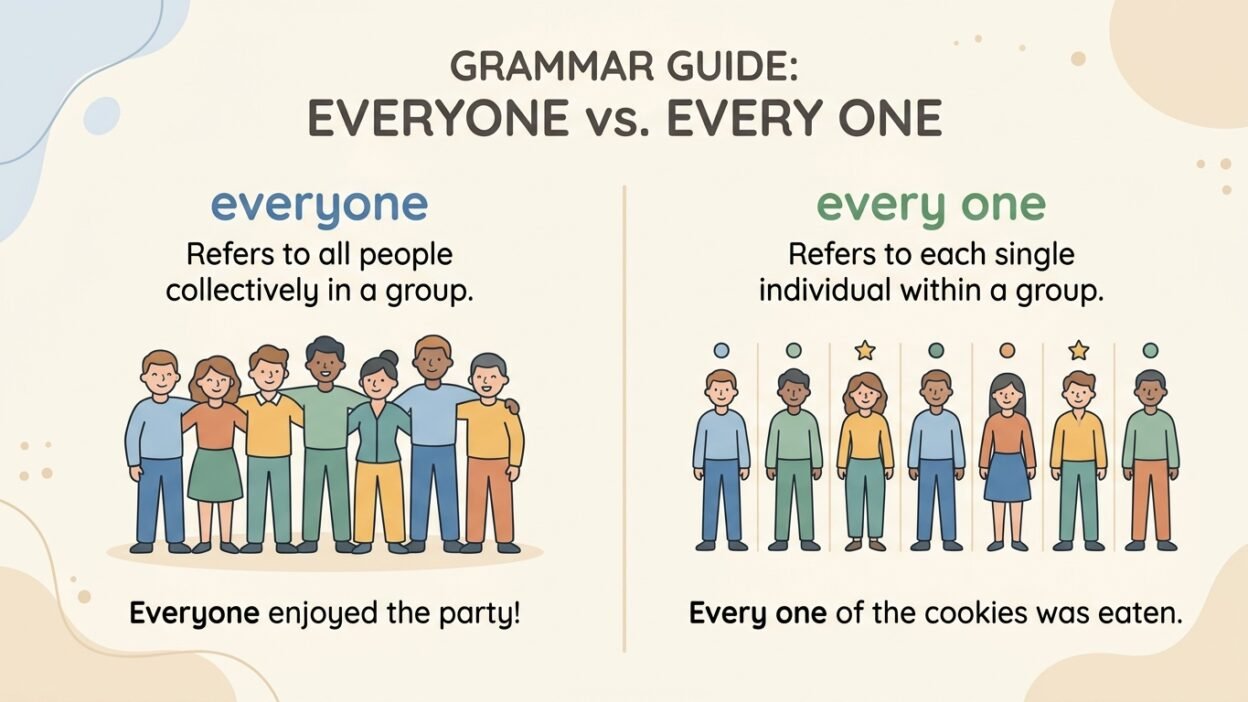
- Everyone = all people in a group
- Every one = each single person or thing in a group
More help:
- Use everyone when you mean all people together
- Use every one when you mean each person or thing one by one
- Everyone is a pronoun (it replaces a noun)
- Every one is two words and often comes before “of”
Simple Background Explanation
English has many words that look similar but have different meanings. This happens because of how the language grew over time.
“Everyone” became one word because people used it often to talk about a whole group of people.
“Every one” stayed as two words because it focuses on each person or thing separately.
So, the difference is not just spelling—it is about meaning.
Clear Explanation of the Difference
What Does “Everyone” Mean?
“Everyone” means all people in a group. It talks about people together, not one by one.
Examples:
- Everyone is here.
- Everyone likes music.
- Everyone should follow the rules.
Important points:
- It is always about people, not things
- It is treated as singular (we say “everyone is,” not “everyone are”)
What Does “Every One” Mean?
“Every one” means each single person or thing in a group.
Examples:
- Every one of the students passed the test.
- I checked every one of the boxes.
- Every one of them was happy.
Important points:
- It can be used for people or things
- It often comes with “of”
- It focuses on each item or person separately
Simple Way to Remember
- If you can replace it with “everybody,” use everyone
- If you are thinking about each individual item, use every one
Comparison Table
| Feature | Everyone | Every One |
|---|---|---|
| Meaning | All people | Each single person or thing |
| Type | One word | Two words |
| Use | Groups of people | Individuals in a group |
| Used for | People only | People and things |
| Grammar | Pronoun | Phrase (determiner + noun idea) |
| Example | Everyone is ready | Every one of the apples is fresh |
Which One to Use and When
Use “Everyone” When:
- You are talking about all people together
- You do not want to focus on individuals
Examples:
- Everyone enjoyed the party.
- Everyone needs rest.
- Everyone is invited.
Use “Every One” When:
- You want to talk about each person or thing separately
- You are often using “of”
Examples:
- Every one of the books is interesting.
- She answered every one of the questions.
- Every one of the players tried their best.
Quick Tip
If your sentence has “of the”, you probably need every one, not everyone.
Common Mistakes People Make
1. Using “Everyone” with “of”
❌ Everyone of the students passed.
✔️ Every one of the students passed.
Why?
Because “everyone” cannot be followed by “of.”
2. Using “Every One” for general groups
❌ Every one is happy today.
✔️ Everyone is happy today.
Why?
Because you are talking about all people together, not each one separately.
3. Thinking both mean the same
Many learners think both are always the same. They are close, but not always correct in the same sentence.
4. Using wrong verb form
❌ Everyone are ready.
✔️ Everyone is ready.
Remember: “everyone” is singular.
Everyday Real-Life Examples
In Emails
- Everyone, please read this message carefully.
- I checked every one of your answers.
In School
- Everyone must complete the homework.
- The teacher reviewed every one of the tests.
In Social Media
- Everyone is talking about this topic.
- I read every one of your comments.
In News
- Everyone is concerned about the weather.
- Officials checked every one of the buildings.
In Daily Life
- Everyone loves good food.
- She cleaned every one of the rooms.
Short Learning Section for Students and Beginners
Let’s make it super easy:
Step 1: Ask yourself
Are you talking about:
- All people together? → use everyone
- Each person or thing one by one? → use every one
Step 2: Look for “of”
- If your sentence has “of”, use every one
Step 3: Try replacing the word
- Replace with “everybody” → correct for everyone
- Replace with “each one” → correct for every one
Practice Sentences
Fill in the blank:
- ______ is ready for the trip.
- I checked ______ of the answers.
- ______ enjoyed the movie.
- She thanked ______ of her friends.
Answers:
- Everyone
- Every one
- Everyone
- Every one
FAQ
1. Is “everyone” one word or two?
“Everyone” is always one word.
2. Can “everyone” be used for things?
No. It is used only for people.
3. Can “every one” be used for things?
Yes. It can be used for people and things.
4. Why do we say “everyone is” and not “everyone are”?
Because “everyone” is treated as singular.
5. Is “everyone of” correct?
No. This is incorrect. Use “every one of.”
6. How can I quickly check my sentence?
Try replacing:
- “everyone” with everybody
- “every one” with each one
7. Which one is more common?
“Everyone” is more common in daily speech.
8. Can both be used in the same sentence?
Yes:
- Everyone liked every one of the gifts.
Conclusion
“Everyone” and “every one” may look similar, but their meanings are different.
- Everyone is simple. It means all people together.
- Every one is more specific. It means each person or thing one by one.
If you remember this one idea, you will never be confused again:
👉 Everyone = all people
👉 Every one = each individual
With a little practice, using these correctly will become easy and natural.