Many learners get confused between “lieing” and “lying.” Since the base word is “lie,” people often think adding “-ing” should create “lieing.”
But English spelling changes slightly in this case, which causes confusion.
The good news is that the rule is simple once you learn it.
Quick Answer
- Lying = correct spelling
→ can mean not telling the truth or resting in a flat position - Lieing = incorrect spelling
→ a common mistake
Simple Background
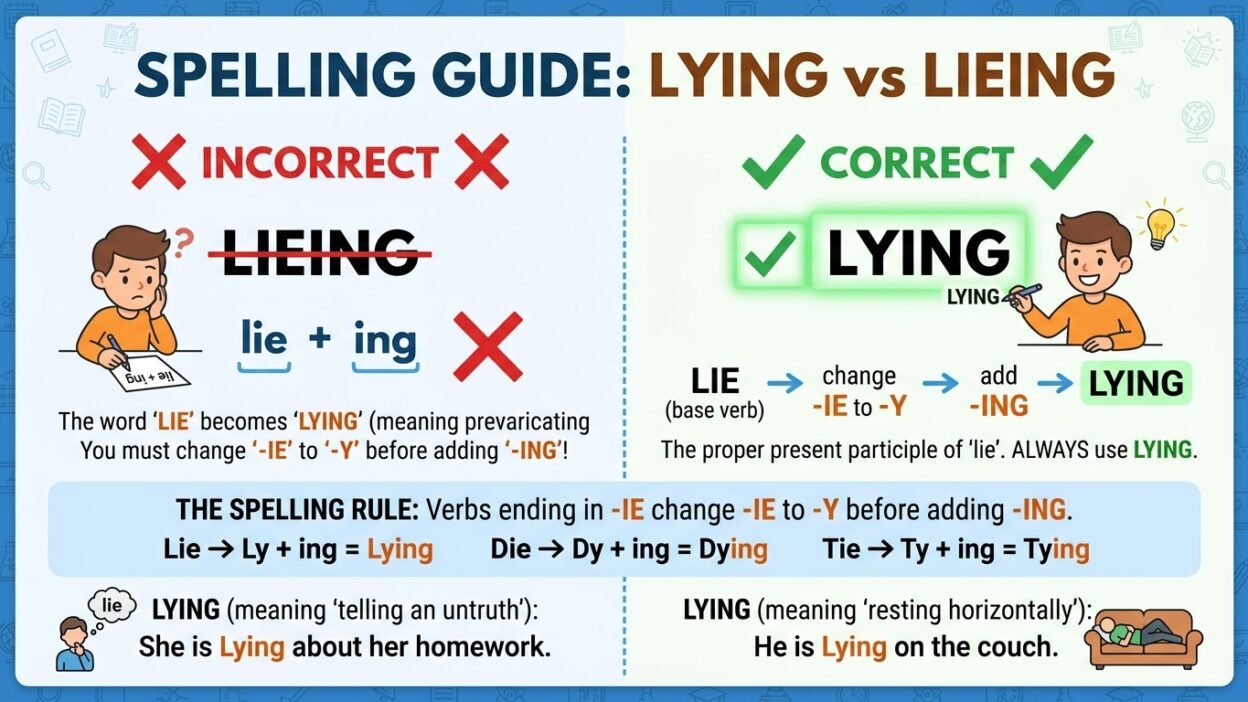
When some English verbs end in -ie, the spelling changes before adding -ing.
The rule is:
- ie → y
So:
- lie → lying
- die → dying
- tie → tying
That is why “lieing” is incorrect.
Clear Explanation of the Difference
What is “Lying”?
Lying is the correct spelling.
It can mean:
- Not telling the truth
- Resting flat
Examples:
- “He is lying about his age.”
- “The cat is lying on the sofa.”
What is “Lieing”?
Lieing is:
- Not correct in standard English
- A spelling mistake
❌ “She is lieing on the bed.”
✔ “She is lying on the bed.”
Comparison Table
| Word | Type | Meaning | Correct Usage |
|---|---|---|---|
| Lying | Verb form | Not telling truth or resting flat | ✅ Yes |
| Lieing | Incorrect | No correct standard meaning | ❌ No |
Which One to Use and When
Always use lying when:
- Talking about dishonesty
- Talking about resting flat
Never use lieing in correct English writing.
Simple Tip to Remember
- ie changes to y before adding -ing
Examples:
- lie → lying
- die → dying
- tie → tying
Common Mistakes People Make
1. Keeping the “ie”
❌ lieing
✔ lying
2. Forgetting spelling-change rules
English often changes letters before adding endings.
3. Confusing pronunciation and spelling
The spoken word sounds simple, but the spelling changes.
Everyday Real Life Examples
In Daily Life
- “The dog is lying under the table.”
- “He was lying to his parents.”
In Messages
- “Are you lying to me?”
On Social Media
- “Just lying in bed today 😴”
In School
- “The books were lying on the desk.”
Short Learning Section for Students
Here is an easy way to remember:
Step 1: Learn the rule
- ie → y before adding ing
Step 2: Practice
- “She is lying down.”
- “He is lying again.”
Step 3: Use memory trick
Think:
- die → dying
- lie → lying
Step 4: Check spelling carefully
Always write:
- l-y-i-n-g
FAQ
Is “lieing” ever correct?
No, it is considered incorrect in standard English.
Why does “lie” become “lying”?
Because verbs ending in “ie” change to “y” before “-ing.”
What does “lying” mean?
It can mean being dishonest or resting flat.
Is this spelling mistake common?
Yes, very common among learners.
How can I remember easily?
Think: die → dying, so lie → lying.
Can “lying” have two meanings?
Yes, dishonesty and resting flat.
Should I use “lying” in formal writing?
Yes, it is the correct spelling in all situations.
Conclusion
The difference between lieing and lying is very simple.
- Lying is the correct spelling.
- Lieing is a spelling mistake and should be avoided.
Remember this easy rule:
Change “ie” to “y” before adding “-ing.”
With this, you can spell “lying” correctly every time.

Austin Brandon serves as both an author and administrator at GrammerPeak. He manages site operations while creating clear, accurate grammar content that helps readers correct mistakes, understand language rules, and write with confidence, precision, and clarity across academic, professional, and everyday English communication.