Many English learners struggle with “a” and “an.” These small words seem simple, but people often choose the wrong one because English spelling and pronunciation do not always match.
The good news is that the rule is actually very easy when you focus on sound instead of spelling.
Quick Answer
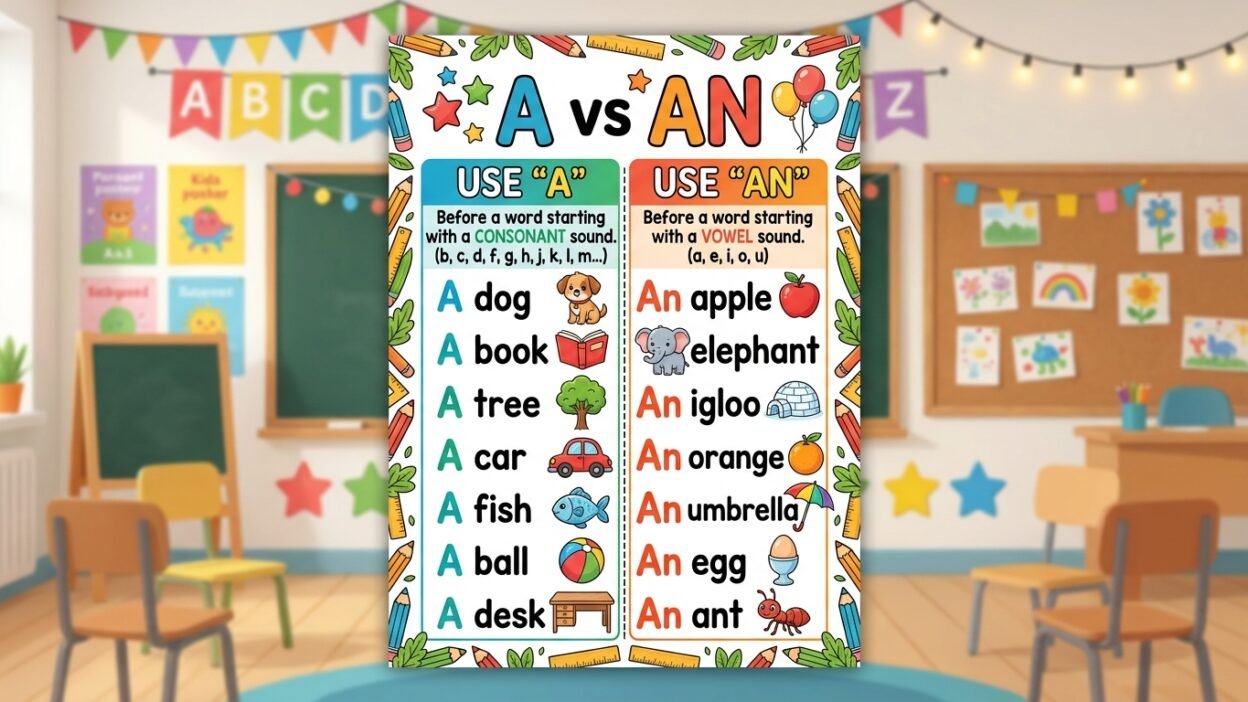
- A = used before consonant sounds
- An = used before vowel sounds
Simple Background
The words “a” and “an” are called articles in English. They are used before singular nouns.
Long ago, English speakers began using:
- an before vowel sounds because it sounded smoother
- a before consonant sounds because it was easier to say
This pronunciation rule is still used today.
Clear Explanation of the Difference
What is “A”?
Use a before words that begin with a consonant sound.
Examples:
- “a cat”
- “a book”
- “a university”
Notice:
- “university” starts with the sound “yoo,” which is a consonant sound.
What is “An”?
Use an before words that begin with a vowel sound.
Examples:
- “an apple”
- “an hour”
- “an elephant”
Notice:
- “hour” starts with a vowel sound because the “h” is silent.
Comparison Table
| Article | Used Before | Example |
|---|---|---|
| A | Consonant sounds | “a dog” |
| An | Vowel sounds | “an orange” |
Which One to Use and When
Use a when the next word begins with:
- b, c, d, f sounds, etc.
Examples:
- a teacher
- a phone
- a house
Use an when the next word begins with:
- a, e, i, o, u sounds
Examples:
- an egg
- an idea
- an umbrella
Simple Tip to Remember
Focus on sound, not spelling.
Examples:
- a university ✔
- an hour ✔
Common Mistakes People Make
1. Looking only at spelling
❌ “an university”
✔ “a university”
2. Forgetting silent letters
❌ “a hour”
✔ “an hour”
3. Ignoring pronunciation
English articles depend on sound.
Everyday Real Life Examples
In School
- “I need a pencil.”
- “She ate an apple.”
In Emails
- “We had a meeting.”
- “He sent an update.”
On Social Media
- “What an amazing day!”
In Daily Life
- “I saw a bird.”
- “She bought an umbrella.”
Short Learning Section for Students
Here is a simple way to remember:
Step 1: Learn the sound rule
- Consonant sound → a
- Vowel sound → an
Step 2: Practice
- a car
- an orange
- a uniform
- an honest person
Step 3: Use memory trick
Think:
An sounds smoother before vowel sounds.
Step 4: Say the word aloud
Hearing the sound helps you choose correctly.
FAQ
Is it based on spelling or sound?
It is based on sound.
Why do we say “an hour”?
Because the “h” is silent.
Why do we say “a university”?
Because it starts with a “yoo” sound.
Are “a” and “an” articles?
Yes, they are indefinite articles.
Is this mistake common?
Yes, especially among learners.
How can I remember easily?
Focus on pronunciation, not letters.
Should I say words aloud when learning?
Yes, pronunciation helps a lot.
Conclusion
The difference between a and an is simple once you focus on sound.
- A comes before consonant sounds.
- An comes before vowel sounds.
Remember this easy rule:
Listen to the sound, not just the spelling.
With this, you can use “a” and “an” correctly in everyday English.