Many English learners feel confused when they see the words “worshiped” and “worshipped.” At first, they look almost the same. The only difference is one extra “p.” Because of this small change, people often wonder:
- Are both correct?
- Is one wrong?
- Which one should I use?
The simple truth is that both spellings are correct, but they are used in different types of English. This can be confusing for students, beginners, and even advanced learners.
In this article, you will learn the clear difference between worshiped and worshipped, when to use each one, and how to avoid common mistakes. Everything is explained in very simple English so you can understand it easily.
Quick Answer
Here is the simple answer:
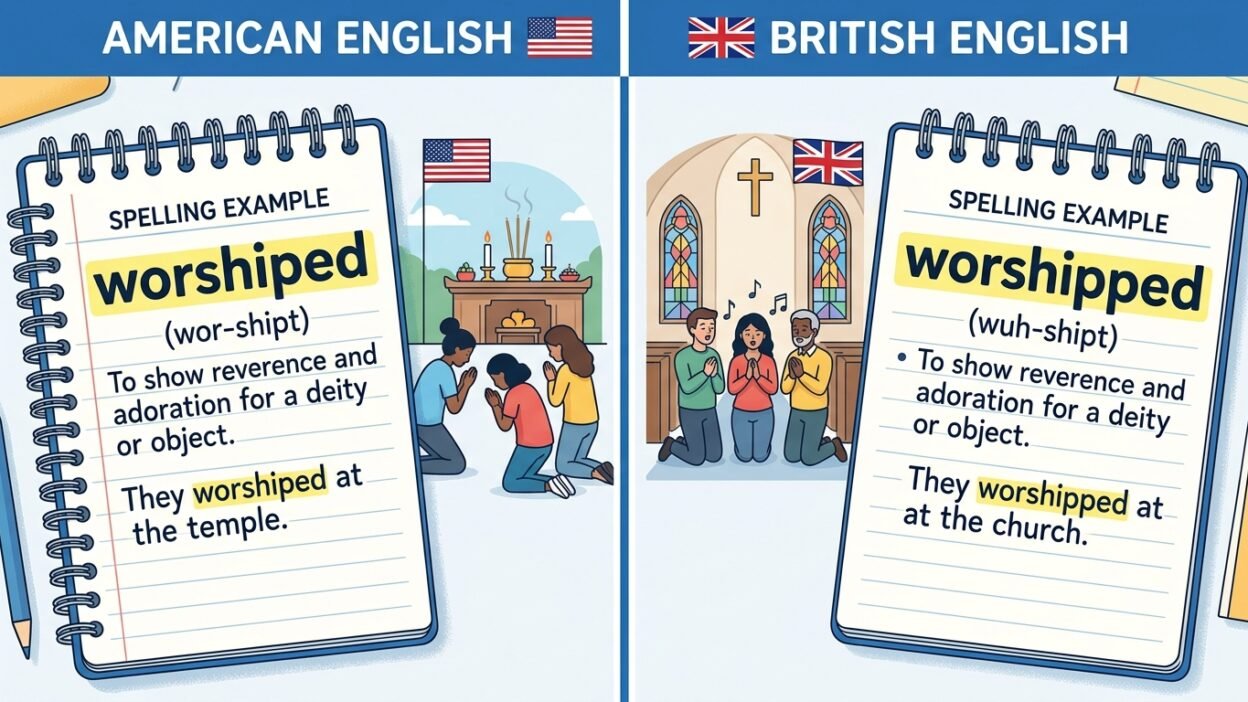
- Worshiped is used in American English.
- Worshipped is used in British English.
- Both words mean the same thing.
- The difference is only in spelling, not meaning.
- You should choose one style and use it consistently.
Example:
- American English: She worshiped the hero.
- British English: She worshipped the hero.
Both sentences are correct.
Simple Origin or Background
To understand this difference, we need to look at how English spelling works.
English has different styles depending on the region. The two most common are:
- American English (used in the United States)
- British English (used in the United Kingdom and many other countries)
Over time, these two styles developed slightly different spelling rules.
The doubling rule
In British English, when a verb ends in a vowel + consonant (like -ip), the final consonant is often doubled before adding -ed.
Example:
- worship → worshipped
- stop → stopped
- plan → planned
In American English, the final consonant is not always doubled.
Example:
- worship → worshiped
- stop → stopped (same here)
- plan → planned (same here)
So, worshiped and worshipped come from different spelling traditions, not different meanings.
Clear Explanation of the Difference
Now let’s explain the difference in a simple way.
What “worshiped” means
Worshiped is the past tense and past participle of the verb worship in American English.
It means:
- to show deep respect
- to love or admire strongly
- to pray to a god
Examples:
- They worshiped in the temple.
- He worshiped his favorite actor.
- People worshiped the sun in ancient times.
What “worshipped” means
Worshipped is also the past tense and past participle of worship, but in British English.
It has the same meaning:
- to show deep respect
- to love or admire strongly
- to pray to a god
Examples:
- They worshipped in the church.
- She worshipped her teacher.
- Ancient people worshipped nature.
Key point
The most important thing to remember is:
👉 The meaning is exactly the same. Only the spelling is different.
Comparison Table
| Feature | Worshiped | Worshipped |
|---|---|---|
| Type of English | American English | British English |
| Meaning | Same | Same |
| Spelling style | Single “p” | Double “p” |
| Usage areas | USA | UK, many other countries |
| Example | She worshiped the idol. | She worshipped the idol. |
This table shows that the difference is only about where the English is used.
Which One to Use and When
Choosing the right spelling depends on your situation.
Use “worshiped” when:
- you are writing in American English
- your school or work follows American style
- you want a simpler spelling
Examples:
- The group worshiped every Sunday.
- He worshiped his parents.
Use “worshipped” when:
- you are writing in British English
- your teacher or system follows British style
- you are in countries that use British spelling (like Pakistan, UK, India)
Examples:
- They worshipped at the temple.
- She worshipped her leader.
Important tip
Do not mix both styles in the same piece of writing.
Wrong:
- He worshiped in the morning and worshipped at night.
Correct (choose one style):
- He worshiped in the morning and worshiped at night.
or - He worshipped in the morning and worshipped at night.
Common Mistakes People Make
Here are some mistakes learners often make.
Mistake 1: Thinking one spelling is wrong
Many people think:
- “Worshipped is correct and worshiped is wrong”
or - “Worshiped is correct and worshipped is wrong”
This is not true.
👉 Both are correct.
Mistake 2: Mixing spelling styles
Incorrect:
- She worshiped her hero and later worshipped another one.
This looks inconsistent.
Mistake 3: Forgetting the doubling rule
Some learners try to guess spelling and make errors like:
- worshippedd ❌
- worshipd ❌
Correct forms:
- worshiped ✔
- worshipped ✔
Mistake 4: Using the wrong tense
Incorrect:
- She worship yesterday. ❌
Correct:
- She worshiped yesterday. ✔
- She worshipped yesterday. ✔
Everyday Real-Life Examples
Let’s see how these words appear in real life.
In emails
Example (American style):
- We worshiped together during the event last week.
Example (British style):
- We worshipped together during the ceremony.
In news writing
Example:
- Ancient people worshiped natural forces like the sun and moon.
Another version:
- Ancient people worshipped natural forces like the sun and moon.
Both are correct depending on style.
In social media
Example:
- “I worshiped this movie when I was a kid!”
Another example:
- “She worshipped that singer growing up.”
In daily conversation
Example:
- He worshiped his coach because he respected him a lot.
Another example:
- She worshipped her grandmother deeply.
These examples show that the word is used both for religion and strong admiration.
Learning Tips for Students and Beginners
Here are some simple tips to help you remember the difference.
Tip 1: Think about location
- American English → worshiped
- British English → worshipped
Tip 2: Look at other similar words
British English often doubles letters:
- travel → travelled
- cancel → cancelled
American English often uses single letters:
- travel → traveled
- cancel → canceled
Tip 3: Be consistent
Always use one style in your writing.
This makes your writing look clean and correct.
Tip 4: Practice with sentences
Try writing your own:
- They worshiped in silence.
- They worshipped in silence.
Both are correct just choose your style.
(FAQ)
1. Are “worshiped” and “worshipped” both correct?
Yes. Both are correct spellings.
2. What is the main difference?
The difference is spelling style:
- American English → worshiped
- British English → worshipped
3. Do they have different meanings?
No. They have exactly the same meaning.
4. Which one should I use in Pakistan?
In Pakistan, British English is more common, so worshipped is usually preferred.
5. Is it wrong to use “worshiped” in British English?
It is not wrong, but it may look unusual. It is better to follow one style.
6. Why does British English double the “p”?
It follows a spelling rule where the final consonant is doubled before adding -ed.
7. Can I use both in one sentence?
No. You should not mix both spellings in the same text.
8. Is this difference important?
Yes. Correct spelling shows clear and careful writing, especially in school and exams.
Conclusion
The words worshiped and worshipped may look confusing at first, but the difference is actually very simple.
Both words have the same meaning. They describe showing deep respect, love, or devotion. The only difference is the spelling style:
- Worshiped is used in American English
- Worshipped is used in British English
The most important thing is to choose one style and stay consistent. This will make your writing clear, correct, and easy to understand.
Once you remember this simple rule, you will never feel confused about these words again.

Austin Brandon serves as both an author and administrator at GrammerPeak. He manages site operations while creating clear, accurate grammar content that helps readers correct mistakes, understand language rules, and write with confidence, precision, and clarity across academic, professional, and everyday English communication.