Many learners confuse “push” and “pull” because both words describe movement. They are often used with doors, objects, carts, and everyday actions. Since the actions are opposite, mixing them up can cause funny or confusing situations.
The good news is that the difference is very easy to understand.
Quick Answer
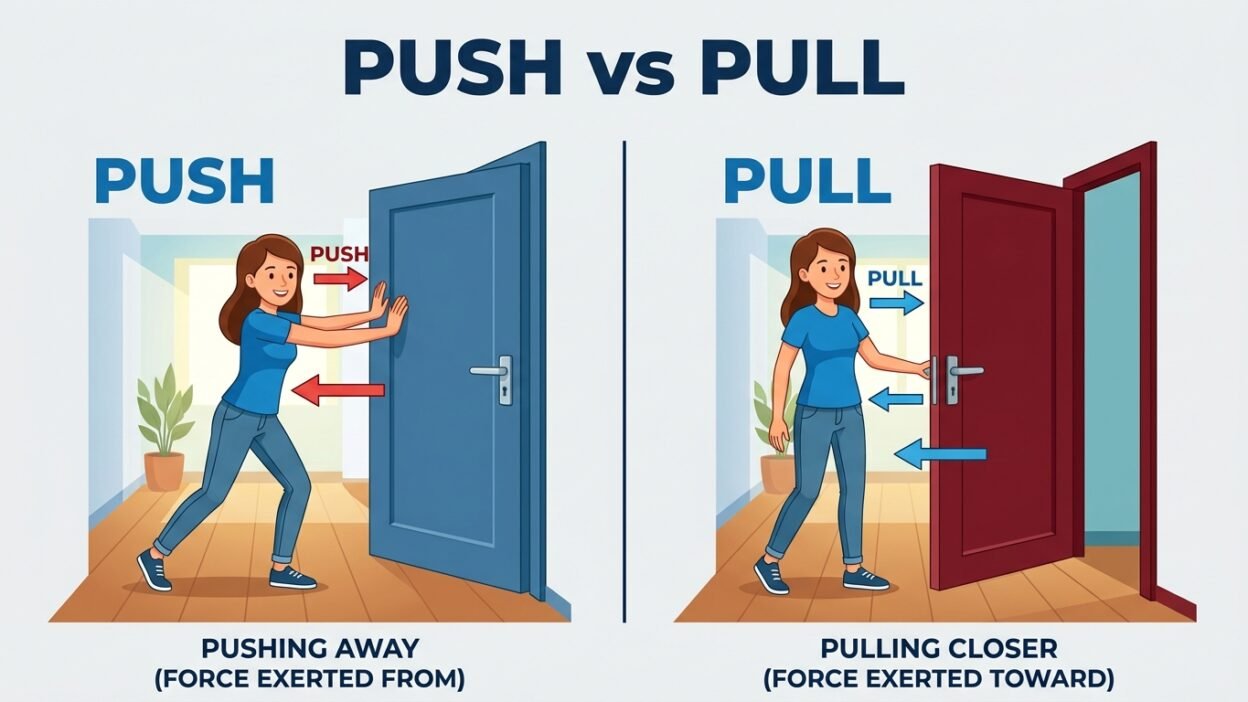
- Push = move something away from you
- Pull = move something toward you
Simple Background
Both words are basic action verbs used in daily English. They describe force and movement.
- Push has the idea of sending something outward
- Pull has the idea of bringing something inward
These words are common in homes, schools, shops, sports, and workplaces.
Clear Explanation of the Difference
What is “Push”?
Push means:
- To move something away from yourself
- To apply force outward
Examples:
- “Push the door to open it.”
- “He pushed the cart.”
What is “Pull”?
Pull means:
- To move something toward yourself
- To bring something closer
Examples:
- “Pull the rope carefully.”
- “She pulled the chair closer.”
Comparison Table
| Word | Meaning | Direction | Example Sentence |
|---|---|---|---|
| Push | Move away from yourself | Outward | “Push the box forward.” |
| Pull | Move toward yourself | Inward | “Pull the handle gently.” |
Which One to Use and When
Use push when:
- Moving something away
- Applying force outward
Use pull when:
- Bringing something closer
- Moving something toward you
Simple Tip to Remember
- Push = away
- Pull = toward
Think about doors:
- If the door moves away → push
- If the door comes closer → pull
Common Mistakes People Make
1. Mixing directions
People often confuse which way the object moves.
2. Forgetting door instructions
Many doors clearly say “push” or “pull,” but learners may still mix them up.
3. Translating directly from another language
Some languages describe these actions differently.
Everyday Real Life Examples
At a Door
- “Push the door open.”
- “Pull the door toward you.”
In School
- “Push your chair under the desk.”
- “Pull your bag closer.”
In Sports
- “Push the ball forward.”
- “Pull the rope hard.”
In Daily Life
- “He pushed the shopping cart.”
- “She pulled the blanket up.”
Short Learning Section for Students
Here is a simple way to remember:
Step 1: Learn the directions
- Push = away
- Pull = toward
Step 2: Practice
- “Push the table.”
- “Pull the drawer.”
Step 3: Use memory trick
Think:
Pull brings things closer to you.
Step 4: Use real objects
Practice with a door or chair.
FAQ
Is push the opposite of pull?
Yes, they are opposite actions.
Which one moves something away?
Push moves something away.
Which one brings something closer?
Pull brings something toward you.
Why do people confuse these words?
Because both involve movement and force.
Are these words common in daily English?
Yes, they are used very often.
Can push and pull be used figuratively?
Yes. Example: “Push yourself harder” or “pull someone into a conversation.”
How can I remember easily?
Think: push = away, pull = toward.
Conclusion
The difference between push and pull is simple.
- Push means moving something away from you.
- Pull means bringing something toward you.
Remember this easy rule:
Push = away, Pull = toward.
With this, you can use both words correctly in everyday situations.