Many learners feel confused about “whomever” and “whoever.” These words sound formal, look similar, and are often difficult to choose between.
The good news is that the difference becomes simple once you understand one small grammar rule.
Quick Answer
- Whoever = used as a subject
- Whomever = used as an object
In modern everyday English, whoever is much more common.
Simple Background
These words come from:
- who / whoever → subject forms
- whom / whomever → object forms
English once used “whom” much more often, but today many people prefer simpler forms in conversation.
That is why whoever is now more common in everyday speech.
Clear Explanation of the Difference
What is “Whoever”?
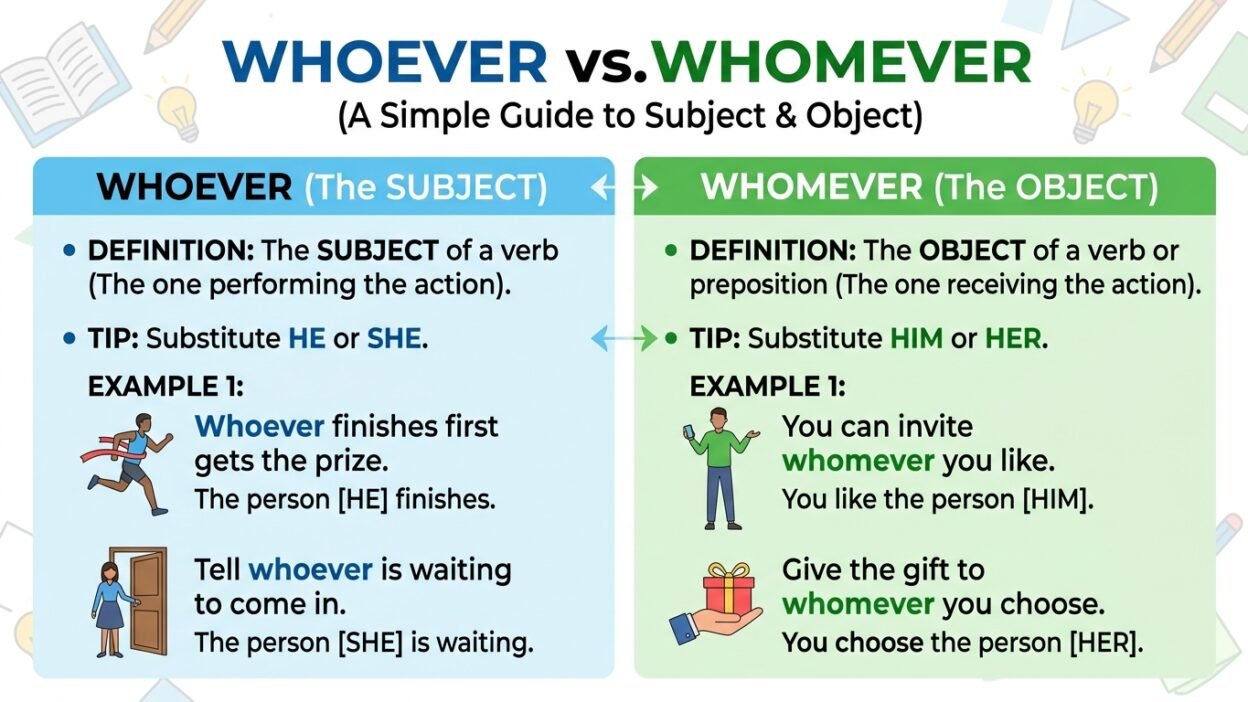
Whoever is used when the word acts as the subject of a verb.
Examples:
- “Whoever arrives first will win.”
- “Give it to whoever wants it.”
In these examples, “whoever” performs the action.
What is “Whomever”?
Whomever is used when the word acts as an object.
Examples:
- “You may invite whomever you like.”
- “Choose whomever you prefer.”
Here, the action happens to the person.
Comparison Table
| Word | Grammar Role | Meaning | Example Sentence |
|---|---|---|---|
| Whoever | Subject | The person who does action | “Whoever calls first wins.” |
| Whomever | Object | The person receiving action | “Invite whomever you want.” |
Which One to Use and When
Use whoever when:
- The person is doing the action
- It works like “he” or “they”
Use whomever when:
- The person receives the action
- It works like “him” or “them”
Simple Tip to Remember
Try replacing the word:
- he/they → whoever
- him/them → whomever
Example:
- “Whoever is ready can start.”
(He is ready → correct)
Common Mistakes People Make
1. Using “whomever” to sound formal
People sometimes use it even when grammar says “whoever.”
2. Avoiding “whomever” completely
In formal writing, “whomever” is still useful sometimes.
3. Confusing subject and object roles
This is the main reason learners struggle.
Everyday Real Life Examples
In Emails
- “Send it to whoever is available.”
- “Contact whomever you trust.”
In Daily Speech
- “Whoever did this did a great job.”
On Social Media
- “Tag whoever wants to join!”
In Daily Life
- “Whomever you choose is fine.”
- “Whoever finishes first can leave.”
Short Learning Section for Students
Here is a simple way to remember:
Step 1: Learn the rule
- Whoever = subject
- Whomever = object
Step 2: Practice
- “Whoever comes early gets seats.”
- “Invite whomever you like.”
Step 3: Use memory trick
Think:
Whom = him
Both end with “m.”
Step 4: Do replacement test
Use he/him to check the sentence.
FAQ
Is “whoever” more common?
Yes, especially in everyday English.
Is “whomever” formal?
Yes, it sounds more formal.
Can I avoid using “whomever”?
In casual speech, many people do.
Why is this confusing?
Because both words sound similar and involve grammar roles.
How can I remember easily?
Think: whom = him.
Which should I use in exams?
Use the grammatically correct form.
Is “whomever” old-fashioned?
It is less common today but still correct.
Conclusion
The difference between whomever and whoever is based on grammar role.
- Whoever is used as the subject.
- Whomever is used as the object.
Remember this easy rule:
Whoever = he, Whomever = him.
With this simple trick, you can choose the correct word confidently.