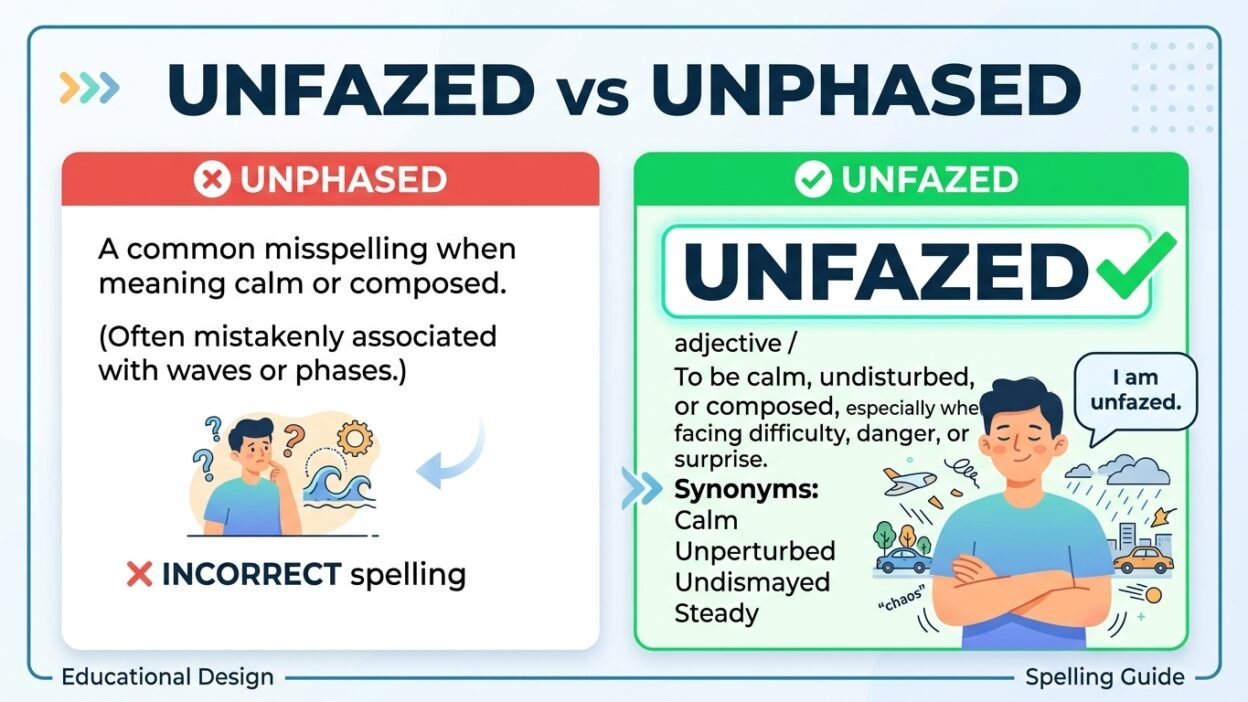
Many learners get confused between “unphased” and “unfazed.” These words sound similar, and because “phase” is a real English word, people often think “unphased” must also be correct.
But in most situations, only one word is correct.
Quick Answer
- Unfazed = correct word
→ means calm, not bothered, or not affected - Unphased = usually incorrect
→ a common spelling mistake
Simple Background
The word “unfazed” comes from the verb “faze,” which means:
- To disturb
- To embarrass
- To make someone nervous or uncomfortable
So:
- unfazed = not disturbed or bothered
People often write “unphased” by mistake because they connect it with the word “phase.”
Clear Explanation of the Difference
What is “Unfazed”?
Unfazed is the correct word.
It means:
- Calm under pressure
- Not affected by something surprising or difficult
Examples:
- “She stayed unfazed during the interview.”
- “He looked completely unfazed by the criticism.”
What is “Unphased”?
Unphased is:
- Usually incorrect in standard English
- A spelling mistake for “unfazed”
❌ “He seemed unphased by the news.”
✔ “He seemed unfazed by the news.”
Comparison Table
| Word | Type | Meaning | Correct Usage |
|---|---|---|---|
| Unfazed | Adjective | Calm or not bothered | ✅ Yes |
| Unphased | Incorrect | Usually no correct meaning | ❌ No |
Which One to Use and When
Use unfazed when:
- Someone stays calm
- A person is not emotionally affected
Do not use unphased in normal English writing.
Simple Tip to Remember
- Unfazed comes from “faze”
- Think:
Nothing can faze them → they are unfazed
Common Mistakes People Make
1. Confusing “faze” with “phase”
These are different words with different meanings.
2. Assuming “unphased” is logical
Because “phase” is common, many people spell it this way.
3. Copying incorrect online spelling
The mistake appears often on social media.
Everyday Real Life Examples
In Emails
- “She remained unfazed despite the pressure.”
In Messages
- “He was totally unfazed 😎”
On Social Media
- “Still unfazed after all the drama.”
In Daily Life
- “The athlete stayed unfazed before the final match.”
- “She looked unfazed by the difficult question.”
Short Learning Section for Students
Here is a simple way to remember:
Step 1: Learn the correct form
- Unfazed = correct
- Unphased = wrong
Step 2: Practice
- “He stayed unfazed.”
- “She was unfazed by the noise.”
Step 3: Use memory trick
Think:
Faze = disturb
Unfazed = not disturbed
Step 4: Watch spelling carefully
Use f, not ph.
FAQ
Is “unphased” ever correct?
Usually no, it is considered a spelling mistake.
What does “unfazed” mean?
It means calm or not bothered.
Why do people write “unphased”?
Because they confuse “faze” with “phase.”
Is “faze” a real word?
Yes, it means to disturb or bother someone.
Is this mistake common?
Yes, especially online.
How can I remember easily?
Think: unfazed = not fazed.
Can I use “unfazed” formally?
Yes, it is correct in all types of writing.
Conclusion
The difference between unphased and unfazed is very simple.
- Unfazed is the correct word and means calm or not bothered.
- Unphased is usually a spelling mistake.
Remember this easy rule:
If someone is not bothered, they are unfazed not unphased.
With this, you can use the correct spelling confidently every time.