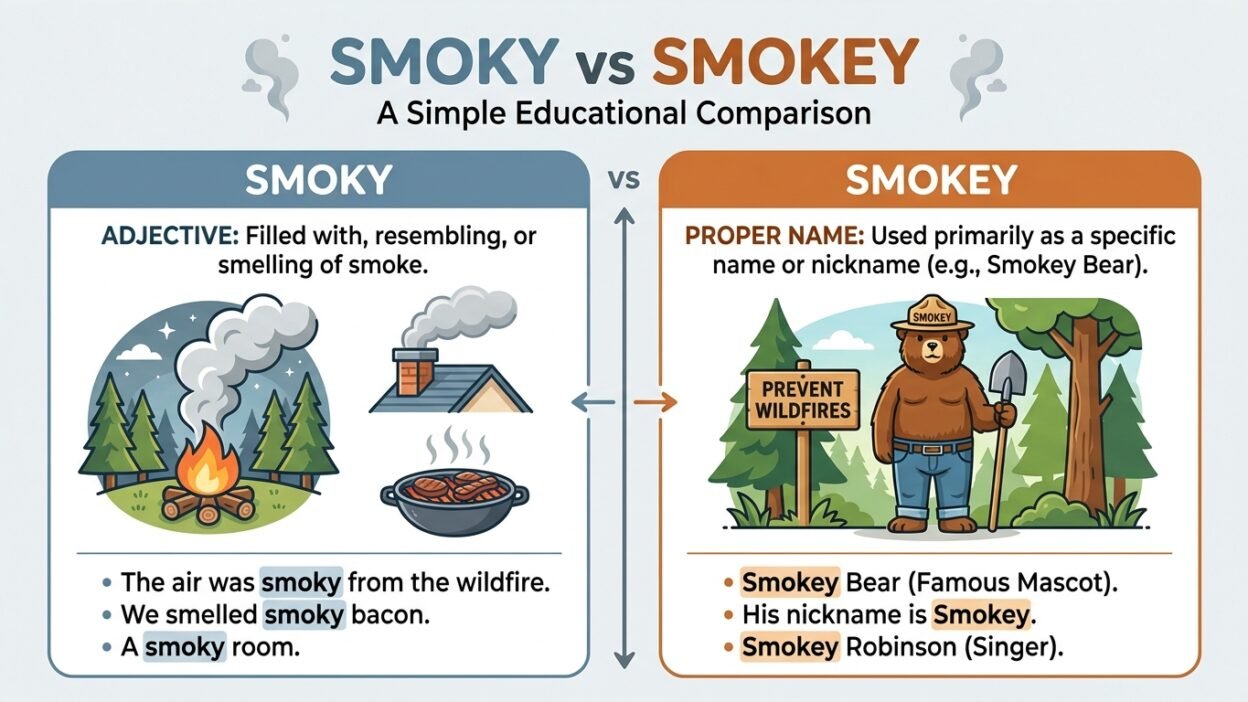
Many learners get confused between “smoky” and “smokey.” Both spellings appear online, in names, and in everyday writing, so it can be difficult to know which one is correct.
The answer depends on if you are using a normal adjective or a special name.
Quick Answer
- Smoky = correct standard adjective
→ means full of smoke or having a smoke-like quality - Smokey = usually a name or special spelling
→ less common in standard writing
Simple Background
The standard English adjective developed as:
- smoke → smoky
This follows a common spelling pattern in English.
However, “Smokey” became popular in names and titles, such as:
- Smokey Bear
- Smokey Robinson
Because of this, many people think “smokey” is always correct.
Clear Explanation of the Difference
What is “Smoky”?
Smoky is the standard adjective.
It means:
- Full of smoke
- Smelling or tasting like smoke
- Hazy because of smoke
Examples:
- “The room looked smoky.”
- “The meat has a smoky flavor.”
What is “Smokey”?
Smokey is usually:
- A name
- A nickname
- A special spelling
Examples:
- Smokey Robinson
- Smokey Bear
In normal English descriptions, “smoky” is preferred.
Comparison Table
| Word | Type | Meaning | Correct Usage |
|---|---|---|---|
| Smoky | Standard adjective | Full of smoke | ✅ Yes |
| Smokey | Name/special spelling | Usually proper names | ⚠️ Sometimes |
Which One to Use and When
Use smoky when:
- Describing air, flavor, rooms, or weather
- Writing normal English sentences
Use Smokey when:
- Referring to names or titles
Simple Tip to Remember
- Smoky = normal adjective
- Smokey = often a name
Think:
- smoke → smoky
just like: - cloud → cloudy
Common Mistakes People Make
1. Using “smokey” for normal descriptions
❌ “The kitchen was smokey.”
✔ “The kitchen was smoky.”
2. Confusing names with standard spelling
Proper names can have unusual spellings.
3. Keeping the “e” from “smoke”
The standard adjective drops the “e.”
Everyday Real Life Examples
In Daily Life
- “The restaurant smelled smoky.”
- “The fire made the air smoky.”
In Food
- “This sauce has a smoky taste.”
In Messages
- “The room looks smoky in this picture.”
In Entertainment
- Smokey Robinson is a famous singer.
Short Learning Section for Students
Here is a simple way to remember:
Step 1: Learn the standard spelling
- Smoky = correct adjective
- Smokey = usually a name
Step 2: Practice
- “The sky looked smoky.”
- “The food tastes smoky.”
Step 3: Use memory trick
Think:
Drop the “e” → smoky
Step 4: Check context
Ask:
- Is it a description? → smoky
- Is it a name? → Smokey
FAQ
Is “smokey” wrong?
Not always. It is often used in names.
Which spelling is standard English?
“Smoky” is the standard adjective.
Why do people use “smokey”?
Because of famous names and nicknames.
What does “smoky” mean?
It means full of smoke or having a smoke-like quality.
Is this mistake common?
Yes, very common.
How can I remember easily?
Think: smoke drops the “e” → smoky.
Can I use “smoky” in formal writing?
Yes, it is the preferred standard spelling.
Conclusion
The difference between smoky and smokey is simple.
- Smoky is the standard adjective used in normal English.
- Smokey is mostly used in names or special spellings.
Remember this easy rule:
For descriptions, use “smoky.”
With this, you can choose the correct spelling confidently every time.