Many learners feel confused about “lie” and “lay.” These two verbs look similar, and their past forms make things even more confusing. Because of this, people often use the wrong word.
But don’t worry the difference becomes clear once you learn one simple rule.
Quick Answer
- Lie = to rest or be in a flat position (no object)
- Lay = to put something down (needs an object)
Simple Background
These two verbs are different, but they are connected:
- Lie does not take an object
- Lay does take an object (something you place)
Their past forms are also different, which causes confusion.
Clear Explanation of the Difference
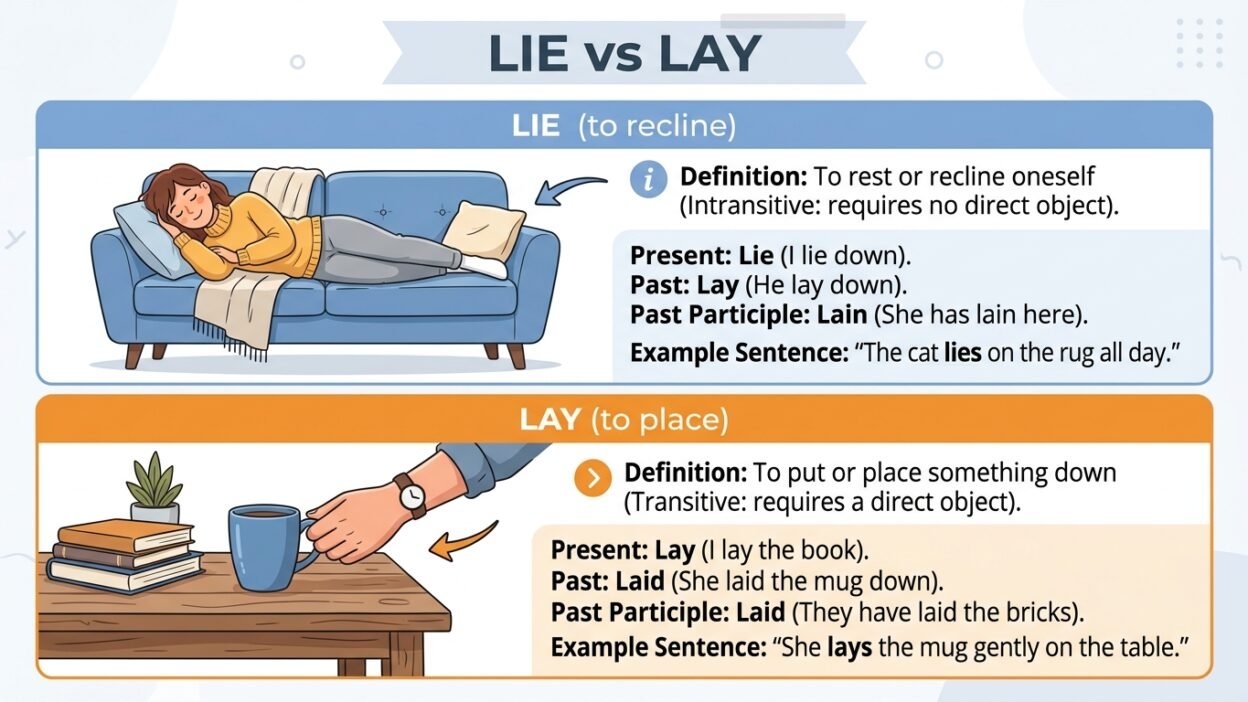
What is “Lie”?
Lie means:
- To rest or be in a position
- No object is needed
Forms:
- Present: lie
- Past: lay
- Past participle: lain
Examples:
- “I want to lie down.”
- “He lay on the bed yesterday.”
What is “Lay”?
Lay means:
- To put something somewhere
- Always needs an object
Forms:
- Present: lay
- Past: laid
- Past participle: laid
Examples:
- “Please lay the book on the table.”
- “She laid the baby in the crib.”
Comparison Table
| Verb | Meaning | Needs Object | Past Form | Example Sentence |
|---|---|---|---|---|
| Lie | To rest or recline | No | Lay | “I lie down to rest.” |
| Lay | To put something down | Yes | Laid | “I lay the book down.” |
Which One to Use and When
Use lie when:
- No object is involved
- You are talking about resting
Use lay when:
- There is an object
- You are placing something
Simple Tip to Remember
- Lie = no object (just you)
- Lay = needs something (you lay something)
Common Mistakes People Make
1. Mixing past forms
❌ “I laid down for a nap.”
✔ “I lay down for a nap.”
2. Forgetting the object
❌ “Please lay down.” (no object)
✔ “Please lie down.”
3. Confusing “lay” as present and past
“Lay” is both:
- Present of “lay”
- Past of “lie”
Everyday Real Life Examples
In Emails
- “Please lay the documents on my desk.”
In Messages
- “I need to lie down.”
In Daily Life
- “The cat is lying on the sofa.”
- “She laid the keys on the table.”
In Instructions
- “Lay the clothes flat to dry.”
Short Learning Section for Students
Here is a simple way to remember:
Step 1: Learn the rule
- Lie = rest (no object)
- Lay = put (needs object)
Step 2: Practice
- “I lie down.”
- “I lay the book down.”
Step 3: Use memory trick
Think:
Lay = place
(Both have “a”)
Step 4: Check your sentence
Ask: Is there an object?
FAQ Section
Is “lie” always without an object?
Yes, it does not need an object.
Does “lay” always need an object?
Yes, you must lay something.
Why is this confusing?
Because “lay” is also the past of “lie.”
What is the past of “lay”?
The past is laid.
What is the past of “lie”?
The past is lay.
Can I use both in one sentence?
Yes. Example: “I lay down after I laid the book aside.”
How can I remember easily?
Think: lay = place something.
Conclusion
The difference between lie and lay is simple when you focus on one key idea:
- Lie = rest (no object)
- Lay = put something (needs object)
Remember this rule:
Lay needs something, lie does not.
With this, you can avoid confusion and use both words correctly every time.

Austin Brandon serves as both an author and administrator at GrammerPeak. He manages site operations while creating clear, accurate grammar content that helps readers correct mistakes, understand language rules, and write with confidence, precision, and clarity across academic, professional, and everyday English communication.