Many learners feel confused about “learnt” and “learned.” Both words look correct, and you may see them used in books, exams, or daily writing. This makes it hard to know which one to choose.
The good news is simple: both are correct but they are used in different styles.
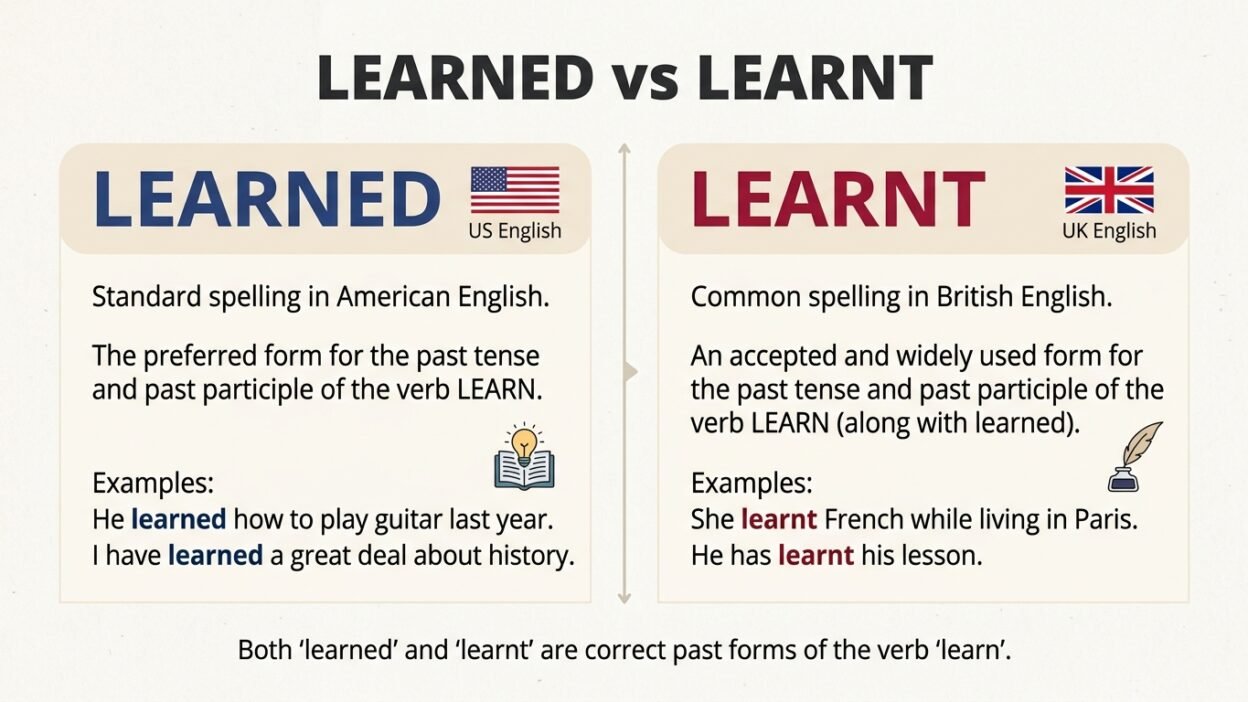
Quick Answer
- Learned = preferred in American English
- Learnt = common in British English
Both mean the same thing: the past of learn.
Simple Background
The verb “learn” has two accepted past forms:
- learned (regular form with -ed)
- learnt (irregular-style form with -t)
Over time:
- American English mostly uses learned
- British English uses both, but learnt is very common
Clear Explanation of the Difference
What is “Learned”?
Learned is:
- The standard form in American English
- Common in formal and everyday writing
Examples:
- “I learned a new skill.”
- “She learned English quickly.”
👉 Note: learned can also be an adjective (pronounced differently), meaning “knowledgeable”
- “He is a learned person.”
What is “Learnt”?
Learnt is:
- Common in British English
- Used in both speaking and writing
Examples:
- “I learnt a new word.”
- “They learnt the lesson.”
Comparison Table
| Word | Region | Meaning | Example Sentence |
|---|---|---|---|
| Learned | American English | Past of learn | “I learned a lot.” |
| Learnt | British English | Same meaning | “I learnt a lot.” |
Which One to Use and When
Use learned when:
- Writing in American English
- Writing formal texts or exams (safe choice)
Use learnt when:
- Writing in British English
- Following UK style
Simple Tip to Remember
- Learned = longer → American style
- Learnt = shorter → British style
Common Mistakes People Make
1. Thinking one is wrong
Both forms are correct.
2. Mixing both in one text
Choose one style and stay consistent.
3. Forgetting the adjective meaning
“Learned” can also describe a knowledgeable person.
Everyday Real-Life Examples
In Emails
- American: “I learned something new.”
- British: “I learnt something new.”
In School
- “We learned about science.”
- “We learnt about history.”
On Social Media
- “Today I learned a fun fact!”
- “Today I learnt something interesting!”
In Daily Life
- “She learned to cook.”
- “He learnt to drive.”
Short Learning Section for Students
Here is a simple way to remember:
Step 1: Learn the rule
- Learned = American
- Learnt = British
Step 2: Practice
- “I learned English.”
- “I learnt English.”
Step 3: Use memory trick
Think:
-ed = standard form (safe choice)
Step 4: Be consistent
Use one style in your writing.
FAQ Section
Is “learnt” wrong?
No, it is correct in British English.
Which one is more common?
“Learned” is more common globally.
Which should I use in exams?
“Learned” is the safest choice unless told otherwise.
Do they have different meanings?
No, both mean the same.
Can “learned” be an adjective?
Yes, it can mean knowledgeable.
Why are there two forms?
Because of differences between American and British English.
How can I remember easily?
Think: learned = standard, learnt = British style.
Conclusion
The difference between learnt and learned is simple.
- Both are correct and mean the same thing.
- Learned is preferred in American and formal writing.
- Learnt is common in British English.
If you remember one rule, remember this:
Use “learned” as a safe choice, and “learnt” for British style.
With this, you can use both forms confidently and correctly.