Many learners feel confused about “judgement” and “judgment.” These words look almost the same, and both appear in books and online writing. Because of this, it can be hard to know which one is correct.
The good news is simple: both are correct but used differently depending on style and situation.
Quick Answer
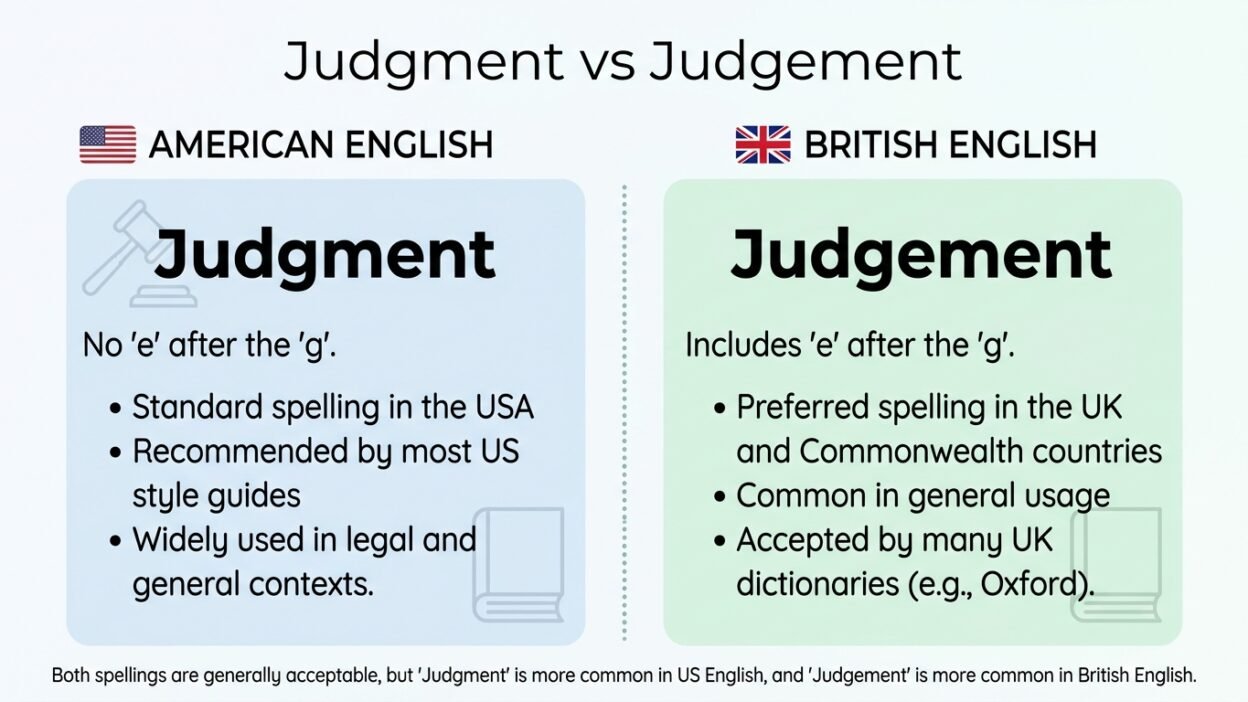
- Judgment = preferred in American English and formal writing
- Judgement = common in British English
Both words mean the same thing.
Simple Background
The word comes from the verb “judge.” When the noun form developed, two spellings appeared:
- One without “e” → judgment
- One with “e” → judgement
Over time, different regions chose different styles.
Clear Explanation of the Difference
What is “Judgment”?
Judgment is:
- The preferred spelling in American English
- Often used in legal and formal writing
Examples:
- “The court gave its final judgment.”
- “Use your best judgment.”
What is “Judgement”?
Judgement is:
- Common in British English
- Used in general writing in many countries
Examples:
- “She showed good judgement.”
- “That was a wise judgement.”
Comparison Table
| Word | Region | Meaning | Example Sentence |
|---|---|---|---|
| Judgment | American English | Decision or opinion | “Trust your judgment.” |
| Judgement | British English | Same meaning | “He used good judgement.” |
Which One to Use and When
Use judgment when:
- Writing in American English
- Writing legal or formal documents
Use judgement when:
- Writing in British English
- Following UK or international style
Simple Tip to Remember
- Judgment = shorter (used in U.S.)
- Judgement = longer (used in UK)
Common Mistakes People Make
1. Thinking one is wrong
Both are correct, but depend on region.
2. Mixing both spellings
Try to use one style consistently in your writing.
3. Using the wrong form in exams
Follow the style your school or exam requires.
Everyday Real Life Examples
In Emails
- American: “Please use your judgment.”
- British: “Please use your judgement.”
In News
- “The court announced its judgment.”
On Social Media
- “Trust your judgment!”
- “That was poor judgement.”
In Daily Life
- “Good judgment is important.”
- “She has strong judgement skills.”
Short Learning Section for Students
Here is an easy way to remember:
Step 1: Learn the rule
- Judgment = American
- Judgement = British
Step 2: Practice
- “Use your judgment.”
- “Use your judgement.”
Step 3: Use memory trick
Think:
US = shorter spelling (judgment)
Step 4: Be consistent
Choose one style and stick to it.
FAQ
Is “judgement” wrong?
No, it is correct in British English.
Which one is more common?
“Judgment” is more common globally, especially in formal writing.
Which should I use in exams?
Follow your school’s style (American or British English).
Is there a difference in meaning?
No, both words mean the same thing.
Why are there two spellings?
Because of different regional language styles.
Is “judgment” used in law?
Yes, it is the preferred spelling in legal contexts.
How can I remember easily?
Think: shorter spelling (judgment) is more formal.
Conclusion
The difference between judgement and judgment is simple.
- Both words are correct and mean the same thing.
- Judgment is preferred in American and formal writing.
- Judgement is common in British English.
If you remember one rule, remember this:
Use “judgment” for formal or American English, and “judgement” for British style.
With this, you can write clearly and confidently.