Many learners feel confused about “chose” and “choose.” These two words look very similar and come from the same base verb. Because of this, people often use the wrong one in sentences.
The good news is that the difference is very simple. It is all about time whether something is happening now or already happened.
Let’s make it clear in the easiest way.
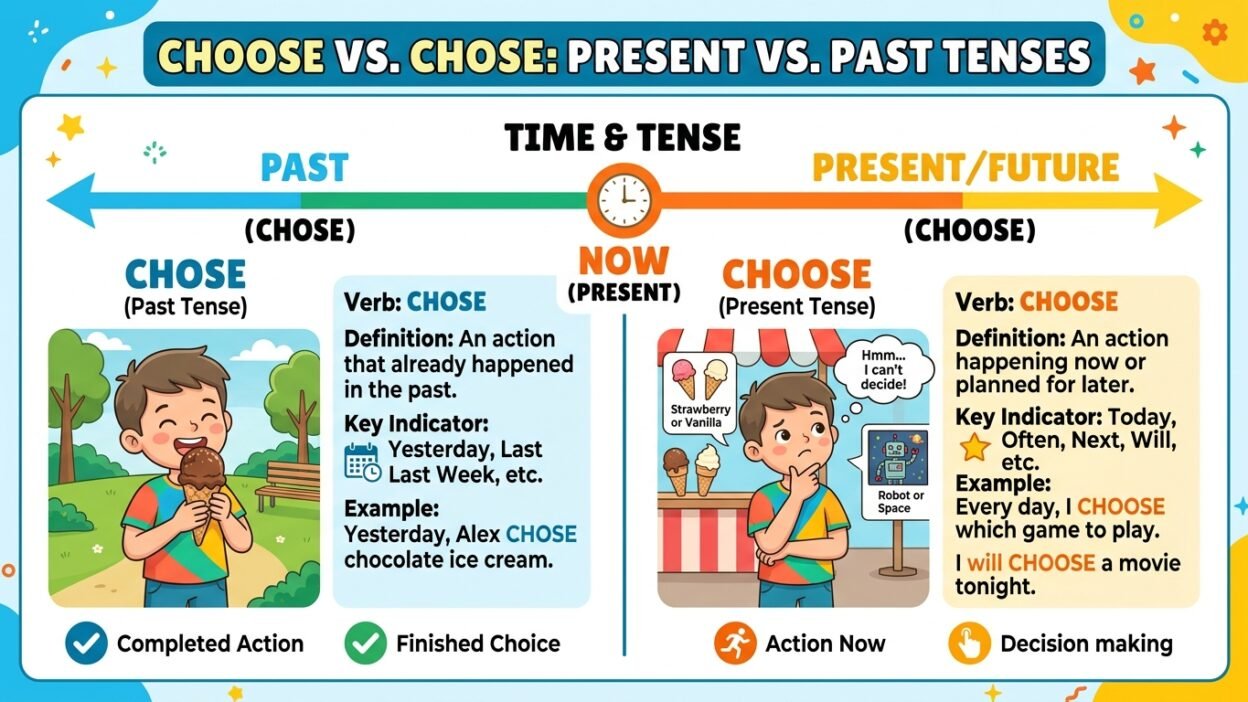
Quick Answer
- ✅ Choose present or future (now)
- ✅ Chose past (already happened)
- ❌ They are not the same
Examples:
- I choose this option. ✅
- I chose this option yesterday. ✅
👉 Now choose
👉 Past chose
Simple Origin or Background Explanation
The base verb is “choose,” which means:
👉 to pick or select something
English changes verbs to show time:
- Present form choose
- Past form chose
This is similar to:
- speak spoke
- break broke
👉 The spelling changes to show when the action happens
Clear Explanation of the Difference
What does “choose” mean?
“Choose” is the present tense form. It is used when:
- Talking about now
- Talking about the future
- Giving instructions
Examples:
- I choose coffee.
- Please choose a seat.
- You can choose any option.
👉 Think: happening now or soon
What does “chose” mean?
“Chose” is the past tense form. It is used when:
- Talking about something already done
Examples:
- I chose coffee yesterday.
- She chose the red dress.
- They chose the best plan.
👉 Think: already finished
Key Idea
- Choose present
- Chose past
Comparison Table
| Feature | Choose ✅ | Chose ✅ |
|---|---|---|
| Meaning | Select (now) | Selected (before) |
| Time | Present / future | Past |
| Verb form | Base form | Past tense |
| Example | I choose | I chose |
Which One to Use and When
Use “choose” when:
- Talking about now
- Giving options or instructions
- Talking about future choices
Examples:
- I choose tea.
- Please choose wisely.
- You will choose later.
Use “chose” when:
- Talking about the past
- Describing a finished decision
Examples:
- I chose tea this morning.
- She chose the blue dress.
Simple Rule
👉 Now or future choose
👉 Past chose
Common Mistakes People Make
1. Using “choose” for the past
❌ I choose it yesterday.
✅ I chose it yesterday.
2. Using “chose” for the present
❌ I chose this now.
✅ I choose this now.
3. Ignoring time words
Words like “yesterday,” “today,” or “now” help you decide
4. Spelling confusion
Both words look similar—check carefully
Everyday Real Life Examples
In Emails
- Please choose one option.
- I chose the first plan.
In School
- Students choose subjects.
- She chose science last year.
On Social Media
- I choose happiness 😊
- I chose this outfit today
In Daily Conversation
- You can choose anything.
- He chose the best one.
Incorrect Examples (for learning)
- ❌ I choose yesterday
- ❌ I chose now
Correct forms:
✔️ choose (present)
✔️ chose (past)
Short Learning Section for Students and Beginners
Trick 1: Time Words
👉 Yesterday chose
👉 Today/now choose
Trick 2: Sound Tip
- choose long “oo” sound
- chose short “o” sound
Trick 3: Easy Memory
👉 choose now
👉 chose done
Practice Sentences
Fill in the blank:
- I this yesterday.
- Please a number.
- She the best option last week.
Answers:
- chose
- choose
- chose
FAQ Section
1. Are “choose” and “chose” the same?
No, they show different time.
2. What does “choose” mean?
It means to select something now or in the future.
3. What does “chose” mean?
It means selected in the past.
4. How can I remember the difference?
Think about time: now or before.
5. Is “I choose yesterday” correct?
No. Correct: I chose yesterday
6. Which one is present tense?
Choose
7. Which one is past tense?
Chose
8. What is the easiest way to decide?
Check if the action is happening now or already happened.
Conclusion
The difference between “choose” and “chose” is very simple.
- Choose present or future
- Chose past
👉 Now choose
👉 Past chose
With this simple rule, you can use both words correctly and confidently every time.