Many people feel confused about “useable” and “usable.” Both words look correct, and you may even see both in books or online. So which one should you use?
The answer is simple: both exist, but one is much more common and preferred. This guide will explain everything in very easy English so you can choose the right word with confidence.
Quick Answer
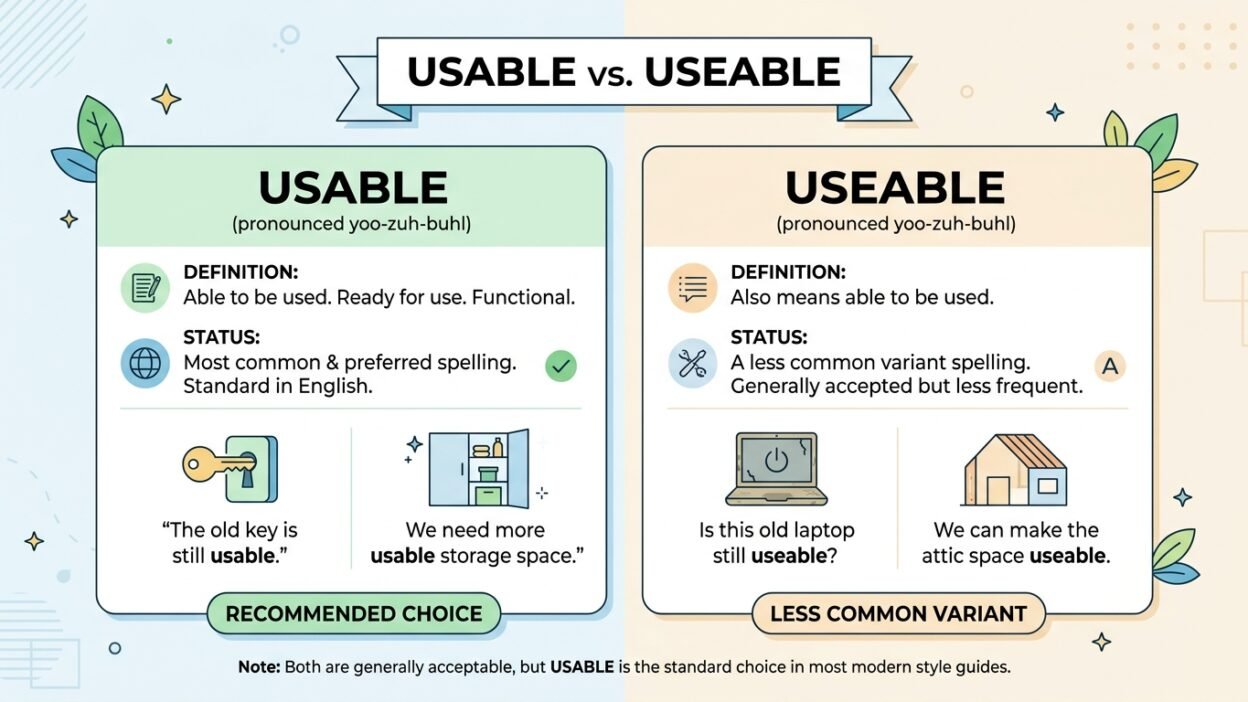
- ✅ Usable → correct and preferred spelling
- ⚠️ Useable → less common, but still accepted
Easy tip:
👉 Use “usable” in almost all situations
Simple Background
The word comes from “use” + “able.”
When we add “-able” to many words, the spelling often changes slightly to make it easier to read and pronounce.
Over time, “usable” became the standard spelling because it looks cleaner and is easier to write. That is why most people and modern writing prefer “usable.”
Clear Explanation of the Difference
Let’s understand it simply.
“Usable”
- Most common spelling
- Used in modern English
- Preferred in writing
Examples:
- This tool is very usable.
- The system is simple and usable.
“Useable”
- Less common spelling
- Still correct, but not preferred
- Looks longer and less natural
Examples:
- This tool is useable. (correct, but uncommon)
Important Note
Both words have the same meaning:
👉 something that can be used
Comparison Table
| Feature | Usable | Useable |
|---|---|---|
| Correct | Yes | Yes |
| Usage | Very common | Rare |
| Preference | Strongly preferred | Not preferred |
| Meaning | Can be used | Can be used |
| Example | Usable product | Useable product |
Which One to Use and When
Here is the simple rule:
Use “usable” when:
- You are writing anything (emails, essays, posts)
- You want correct and modern English
- You want to avoid mistakes
Examples:
- This app is very usable.
- We need a usable solution.
- The design is simple and usable.
Use “useable” when:
- Rarely needed
- Only if you choose that style
But in most cases, it is better to avoid it.
Best Advice
👉 Always choose “usable”
Common Mistakes People Make
Mistake 1: Thinking “useable” is better
❌ This tool is useable (better)
✔ This tool is usable
Mistake 2: Using both forms together
❌ The system is usable and useable
✔ The system is usable
Mistake 3: Overthinking spelling
Some learners worry too much.
Remember:
👉 Just use usable
Everyday Real Life Examples
In Emails
- “We need a more usable design.”
In Work or Office
- “This software is not very usable.”
In Technology
- “The app is simple and usable.”
In Daily Conversation
- “Is this tool usable?”
In Social Media
- “Finally a usable interface!”
Short Learning Section for Students and Beginners
Here is an easy way to remember:
👉 Usable = correct choice
Step by step
- Think of the word “use”
- Add “-able”
- Drop the extra “e” → usable
Practice
Fill in the blanks:
- This product is very _______.
- We need a _______ solution.
- The system is easy and _______.
Answers:
- usable
- usable
- usable
FAQ
1. Is “useable” correct?
Yes, but it is rare and not commonly used.
2. Which is better: usable or useable?
“Usable” is better and preferred.
3. Do they have different meanings?
No, both mean the same thing.
4. Why is “usable” more common?
Because it is shorter and easier to read.
5. Should I ever use “useable”?
It is better to avoid it in most cases.
6. Is “usable” formal or informal?
It is used in both formal and informal English.
7. Do native speakers use “useable”?
Rarely. Most people use “usable.”
8. Is this mistake important?
Not very serious, but using “usable” is safer.
Conclusion
The difference between “useable” and “usable” is very simple:
- Both are correct
- But one is clearly better
👉 Usable → common and preferred
👉 Useable → rare and not recommended
To stay safe and clear in your writing, always choose “usable.”