Many learners feel confused about “whos” and “whose.” These words look similar and sound the same, so it is easy to mix them up.
The confusion happens because one is correct and the other is not used in standard English. Once you learn a simple rule, you will never make this mistake again.
Quick Answer
- ❌ Whos = incorrect spelling
- ✅ Whose = correct word (shows ownership)
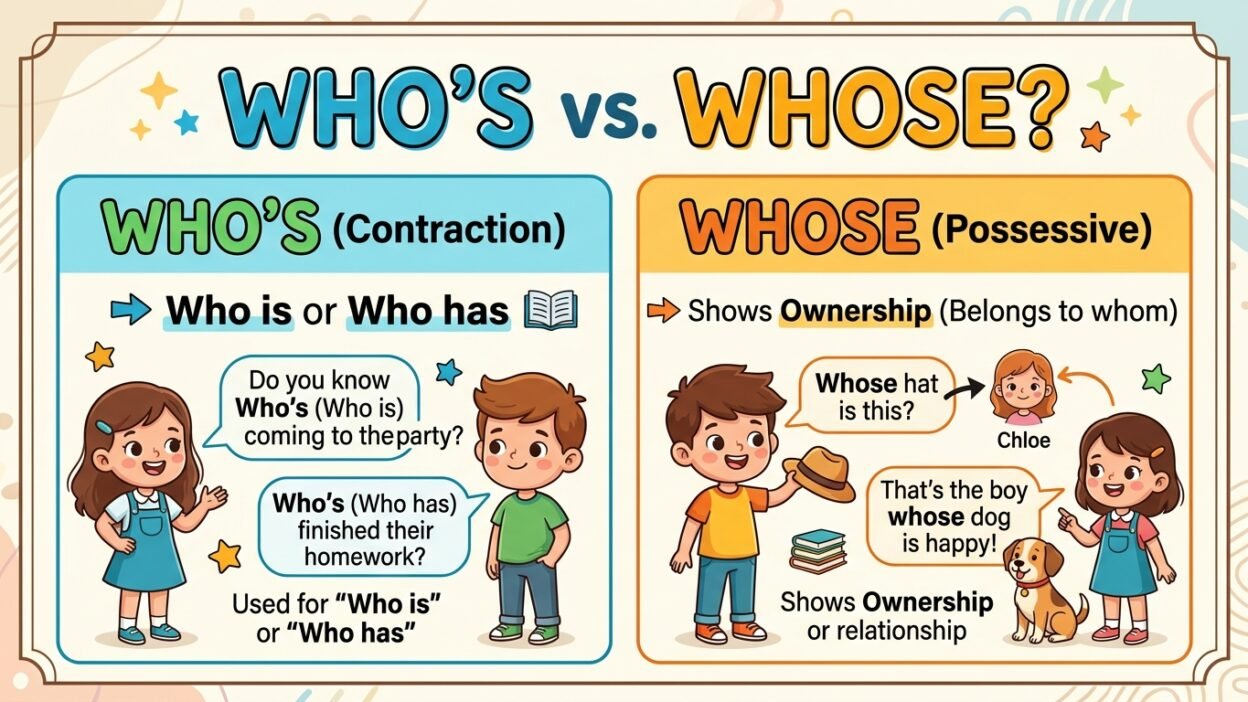
- ✅ Who’s = means “who is” or “who has”
Examples:
- Whose bag is this? ✅
- Who’s coming today? ✅
- Whos bag is this? ❌
👉 Use whose for belonging
👉 Use who’s for “who is”
Simple Origin or Background Explanation
The word “whose” comes from “who.” It is used to ask about ownership, just like:
- his
- her
- their
Later, English created a short form:
👉 who’s = who is / who has
The form “whos” (without an apostrophe) is just a common spelling mistake.
Clear Explanation of the Difference
What does “whose” mean?
“Whose” is used to show:
- Ownership
- Belonging
Examples:
- Whose phone is this?
- Do you know whose book this is?
👉 Think: something belongs to someone
What does “who’s” mean?
“Who’s” is a short form of:
- who is
- who has
Examples:
- Who’s at the door? (= Who is at the door?)
- Who’s finished the work? (= Who has finished the work?)
👉 You can expand it to check
What about “whos”?
“Whos” is:
- Not correct
- Not used in proper English
👉 Always replace it with whose or who’s
Key Idea
- Whose = ownership
- Who’s = who is / who has
- Whos = wrong
Comparison Table
| Feature | Whose ✅ | Who’s ✅ | Whos ❌ |
|---|---|---|---|
| Meaning | Ownership | Who is / who has | No meaning |
| Type | Possessive word | Contraction | Incorrect spelling |
| Example | Whose book? | Who’s there? | ❌ Not used |
| Recommended | Yes | Yes | No |
Which One to Use and When
Use “whose” when:
- Asking about ownership
- Talking about something that belongs to someone
Examples:
- Whose shoes are these?
- Whose idea was this?
Use “who’s” when:
- You mean “who is” or “who has”
- You can replace it with the full form
Examples:
- Who’s ready? (= Who is ready?)
- Who’s taken my pen? (= Who has taken my pen?)
Never use “whos”
👉 It is incorrect
Simple Rule
👉 Ownership → whose
👉 Who is/has → who’s
Common Mistakes People Make
1. Writing “whos”
❌ Whos car is this?
✅ Whose car is this?
2. Using “who’s” for ownership
❌ Who’s book is this?
✅ Whose book is this?
3. Forgetting the apostrophe
“Who’s” must have an apostrophe
4. Not checking meaning
Always check if it shows ownership or “who is”
Everyday Real Life Examples
In Messages
- Whose phone is this?
- Who’s online?
In Emails
- Do you know whose file this is?
- Who’s responsible for this task?
On Social Media
- Whose idea was this? 😄
- Who’s coming tonight?
In Daily Conversation
- Whose bag is that?
- Who’s calling me?
Short Learning Section for Students and Beginners
Trick 1: Ownership = Whose
👉 Like his, her, their
Trick 2: Expand Who’s
👉 who’s = who is / who has
Trick 3: Quick Test
Replace with “who is”
- If it works → who’s
- If not → whose
Practice Sentences
- ______ book is this?
- ______ coming today?
- Do you know ______ bag this is?
Answers:
- whose
- who’s
- whose
FAQ Section
1. Is “whos” correct?
No, it is not correct.
2. What does “whose” mean?
It shows ownership.
3. What does “who’s” mean?
It means “who is” or “who has.”
4. How can I remember the difference?
Check if “who is” fits the sentence.
5. Is “who’s book” correct?
No. Correct: whose book
6. Why does “who’s” have an apostrophe?
Because it is a short form.
7. Which is safest to use?
Use whose for ownership.
8. Do they sound the same?
Yes, but their meanings are different.
Conclusion
The difference between “whos” and “whose” is very simple.
- Whose is correct and shows ownership
- Who’s means “who is”
- Whos is incorrect
👉 Ownership → whose
👉 Who is → who’s
Remember this simple rule, and you will never be confused again.

Austin Brandon serves as both an author and administrator at GrammerPeak. He manages site operations while creating clear, accurate grammar content that helps readers correct mistakes, understand language rules, and write with confidence, precision, and clarity across academic, professional, and everyday English communication.