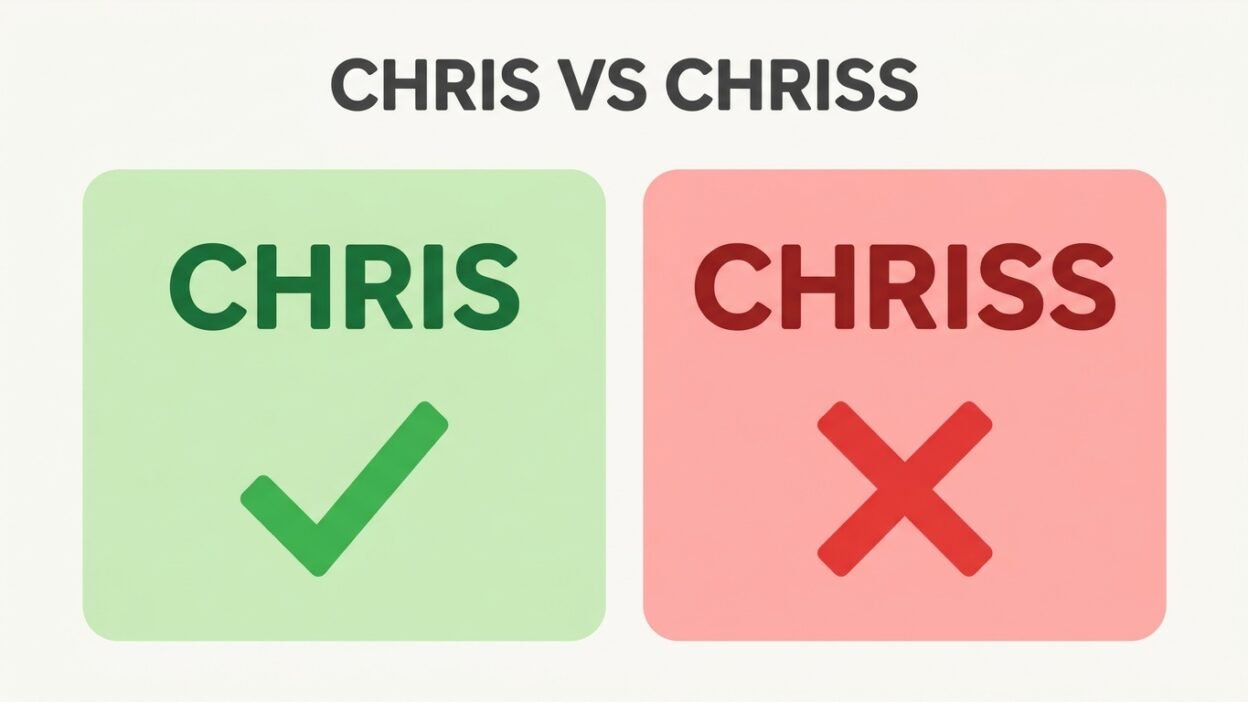
Many learners feel confused about “Chris” and “Chriss.” The words sound the same, so it is easy to think both spellings are correct. This confusion often happens when writing names or messages quickly.
The truth is simple: one spelling is standard and widely used, while the other is usually a mistake.
Quick Answer
- Chris = correct and common spelling
→ a short form of names like Christopher or Christina - Chriss = usually incorrect
→ rarely used, mostly a spelling mistake
Simple Background
The name Chris comes from longer names such as:
- Christopher
- Christian
- Christina
- Christine
Over time, people started using Chris as a short and easy version of these names.
The spelling Chriss is not standard. English names usually do not add an extra “s” at the end in this case.
Clear Explanation of the Difference
What is “Chris”?
Chris is a proper name. It is:
- Very common
- Used for both males and females
- Easy to recognize
Examples:
- “Chris is my friend.”
- “I spoke to Chris yesterday.”
What is “Chriss”?
Chriss is:
- Not a standard spelling
- Rarely used
- Often a typing or spelling mistake
❌ “Chriss will join the meeting.”
✔ “Chris will join the meeting.”
Comparison Table
| Word | Type | Meaning | Correct Usage |
|---|---|---|---|
| Chris | Proper Noun | A common personal name | ✅ Yes |
| Chriss | Non-standard | Usually a spelling mistake | ❌ No |
Which One to Use and When
Use Chris when:
- You are writing someone’s name
- You are using a short form of longer names
Use Chriss only if:
- A person’s official name is spelled that way (very rare)
Simple Tip to Remember
- Chris = correct and common
- One “s” is enough
Common Mistakes People Make
1. Adding an extra “s”
❌ “Chriss is here.”
✔ “Chris is here.”
2. Thinking both spellings are okay
They are not. Only Chris is standard.
3. Typing too fast
Many people accidentally add an extra “s” when typing quickly.
Everyday Real Life Examples
In Emails
- “Hi Chris, please check the report.”
In Messages
- “Chris, are you coming today?”
On Social Media
- “Happy birthday, Chris!” 🎉
In Daily Life
- “Chris is my neighbor.”
- “I met Chris at school.”
Short Learning Section for Students
Here is a simple way to remember:
Step 1: Learn the correct form
- Chris = correct
- Chriss = wrong
Step 2: Practice writing
- “Chris is my friend.”
- “I called Chris.”
Step 3: Use a memory trick
Think:
Chris has one s, just like “is.”
Step 4: Double check names
Always check spelling when writing someone’s name.
FAQ
Is “Chriss” ever correct?
Only if it is someone’s real name, but this is very rare.
What does “Chris” stand for?
It is a short form of names like Christopher or Christina.
Is “Chris” used for both genders?
Yes, it can be used for males and females.
Why do people write “Chriss”?
Because of typing mistakes or confusion in spelling.
Which spelling is more common?
Chris is the standard and common spelling.
Can I use “Chris” in formal writing?
Yes, if it is a person’s name.
How can I remember the correct spelling?
Think: one name, one “s” at the end.
Conclusion
The difference between Chris and Chriss is very simple.
- Chris is the correct and widely used spelling.
- Chriss is usually a mistake and should be avoided.
If you remember one simple rule, you will never get confused again:
Use “Chris” with one “s.”
With practice, this will become easy and natural.