Many learners get confused between “won’t” and “wont.” The only visible difference is the apostrophe (’), but that small mark completely changes the meaning.
Because they sound similar in fast speech, people often use the wrong one in writing.
Quick Answer
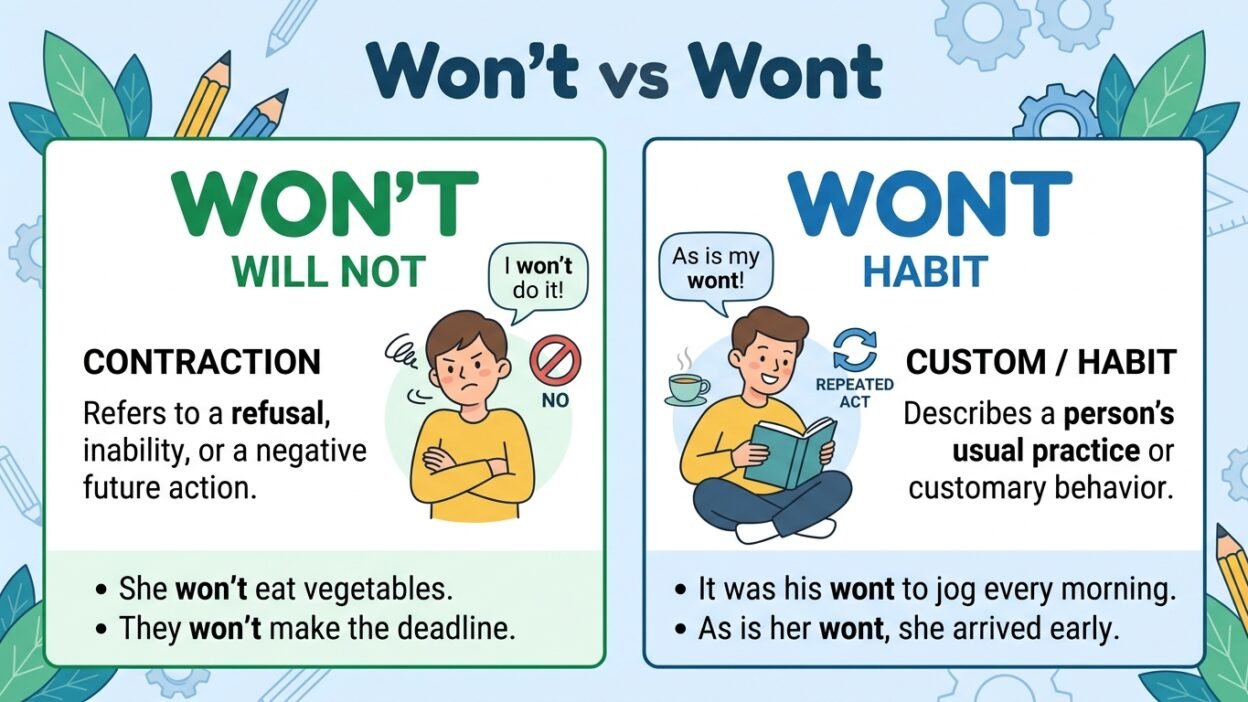
- Won’t = contraction of “will not”
- Wont = a formal word meaning “habit” or “used to”
Simple Background
The word won’t comes from combining “will” + “not.” Over time, English shortened it to “won’t.”
The word wont (without the apostrophe) is an old-style word. It is not very common in everyday English today.
Clear Explanation of the Difference
What is “Won’t”?
Won’t means will not. It is used to talk about the future.
Examples:
- “I won’t go there.”
- “She won’t help us.”
What is “Wont”?
Wont is a formal and less common word. It means:
- Something you usually do (habit)
- Something you are used to
Examples:
- “He is wont to wake up early.”
- “She was wont to visit her grandmother.”
Comparison Table
| Word | Type | Meaning | Example Sentence |
|---|---|---|---|
| Won’t | Contraction | Will not | “I won’t do it.” |
| Wont | Noun/Adj | Habit or usual behavior | “He is wont to complain.” |
Which One to Use and When
Use won’t when:
- You mean will not
- You are talking about the future
Use wont when:
- You are writing formal English
- You mean habit or “used to”
Simple Tip to Remember
- Won’t = will not (future)
- Wont = habit (rare word)
Common Mistakes People Make
1. Forgetting the apostrophe
❌ “I wont go.”
✔ “I won’t go.”
2. Using “wont” in normal conversation
“Wont” sounds too formal and is rarely used in daily speech.
3. Thinking both words are the same
They are completely different in meaning.
Everyday Real Life Examples
In Emails
- “I won’t be available tomorrow.”
In Messages
- “Don’t worry, I won’t forget.”
In Books or Formal Writing
- “He was wont to speak his mind.”
In Daily Life
- “I won’t eat spicy food.”
- “She is wont to arrive early.”
Short Learning Section for Students
Here is a simple way to remember:
Step 1: Learn the common word
- Won’t = very common
- Wont = rare
Step 2: Practice
- “I won’t go.”
- “He is wont to smile.”
Step 3: Use memory trick
Think:
Won’t = will not (has apostrophe)
Step 4: Check your writing
If you mean “will not,” always use won’t.
FAQ
Is “wont” a mistake?
No, but it is rare and formal.
Which word is more common?
Won’t is much more common.
Can I use “wont” in daily speaking?
It is not natural in normal conversation.
Why is “won’t” spelled this way?
It is a short form of “will not,” even though the spelling looks unusual.
What happens if I forget the apostrophe?
The meaning changes completely.
Is “won’t” informal?
It is common in both spoken and informal writing.
How can I remember easily?
If you mean “will not,” always use won’t.
Conclusion
The difference between won’t and wont is very important but easy to understand.
- Won’t means “will not” and is used every day.
- Wont means habit and is rarely used.
Remember this simple rule:
If you mean “will not,” always use “won’t.”
With this, you will avoid a very common mistake in English.