Many learners get confused between “meantime” and “mean time.” They look almost the same and sound the same when spoken. Because of this, people often use them incorrectly in writing.
The good news is that the difference is simple once you understand it.
Quick Answer
- Meantime = correct and common word
→ means “while something else is happening” - Mean time = usually incorrect in this context
→ only used in special situations (not common)
Simple Background
The word meantime developed as a single word in English to describe a short period between two events.
Over time, it became the standard way to express this idea.
The form “mean time” (two words) exists, but it is not used in everyday situations with the same meaning.
Clear Explanation of the Difference
What is “Meantime”?
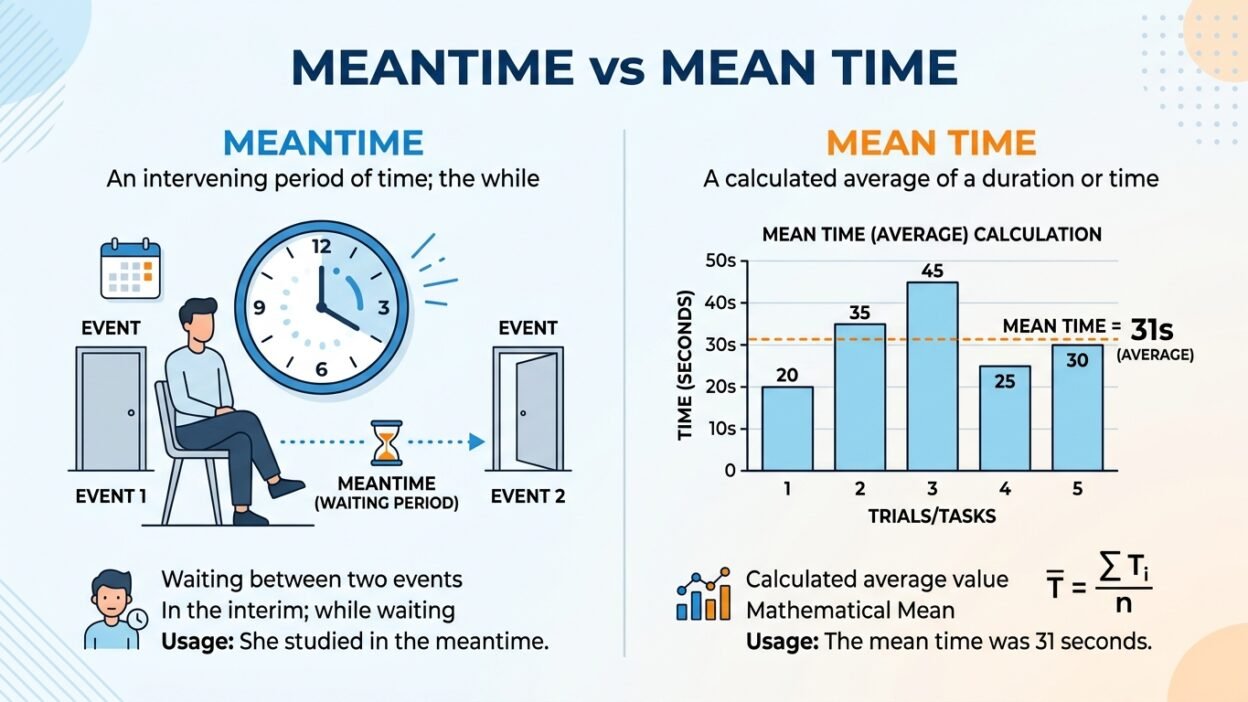
Meantime is the correct and common word.
It means:
- During the time between two events
- While waiting for something
Examples:
- “The food is cooking. In the meantime, let’s talk.”
- “She will arrive soon. Meantime, we can start.”
What is “Mean Time”?
Mean time (two words) is:
- Rare in everyday English
- Used in technical or scientific contexts
For example, in science:
- “mean time” can mean average time
Example:
- “The mean time to finish the task is two hours.”
So, this form has a different meaning and is not used like “meantime.”
Comparison Table
| Form | Type | Meaning | Example Sentence |
|---|---|---|---|
| Meantime | Adverb/Noun | While something else happens | “Meantime, we waited.” |
| Mean time | Phrase | Average time (technical use) | “Mean time was calculated.” |
Which One to Use and When
Use meantime when:
- You mean “during the waiting period”
- You are speaking or writing normally
Use mean time when:
- You are talking about averages (math or science)
Simple Tip to Remember
- Meantime = middle waiting time
- Mean time = average time (math)
Common Mistakes People Make
1. Writing “mean time” instead of “meantime”
❌ “Mean time, we will wait.”
✔ “Meantime, we will wait.”
2. Thinking both forms are the same
They are not. They have different meanings.
3. Splitting the word by mistake
Many learners separate it because it sounds like two words.
Everyday Real Life Examples
In Emails
- “We are fixing the issue. Meantime, please wait.”
In Messages
- “I’ll call you later. Meantime, take care.”
On Social Media
- “Waiting for the results. Meantime, relaxing 😄”
In Daily Life
- “Dinner will be ready soon. Meantime, set the table.”
In Technical Use
- “The mean time to complete the test is 30 minutes.”
Short Learning Section for Students
Here is an easy way to learn:
Step 1: Learn the common word
- Meantime = common
- Mean time = special use
Step 2: Practice
- “Meantime, we waited.”
- “The mean time is 5 minutes.”
Step 3: Use memory trick
Think:
Meantime = time in the middle
Step 4: Check your writing
If you mean “while waiting,” always use meantime.
FAQ
Is “mean time” wrong?
Not always, but it is not correct when you mean “while waiting.”
Which one is more common?
Meantime is much more common.
Can I use “meantime” in formal writing?
Yes, it is correct in both formal and informal English.
What does “mean time” mean?
It usually means average time in technical contexts.
Why do people confuse them?
Because they sound the same.
Is “in the meantime” correct?
Yes, it is a very common phrase.
Can I split “meantime” into two words?
No, not for the same meaning.
Conclusion
The difference between meantime and mean time is simple when you understand it.
- Meantime is the correct word for everyday use and means “while something else is happening.”
- Mean time is a technical phrase meaning “average time.”
If you remember one rule, remember this:
Use “meantime” for daily situations and “mean time” only for technical meaning.
With this, you can avoid a very common mistake in English.