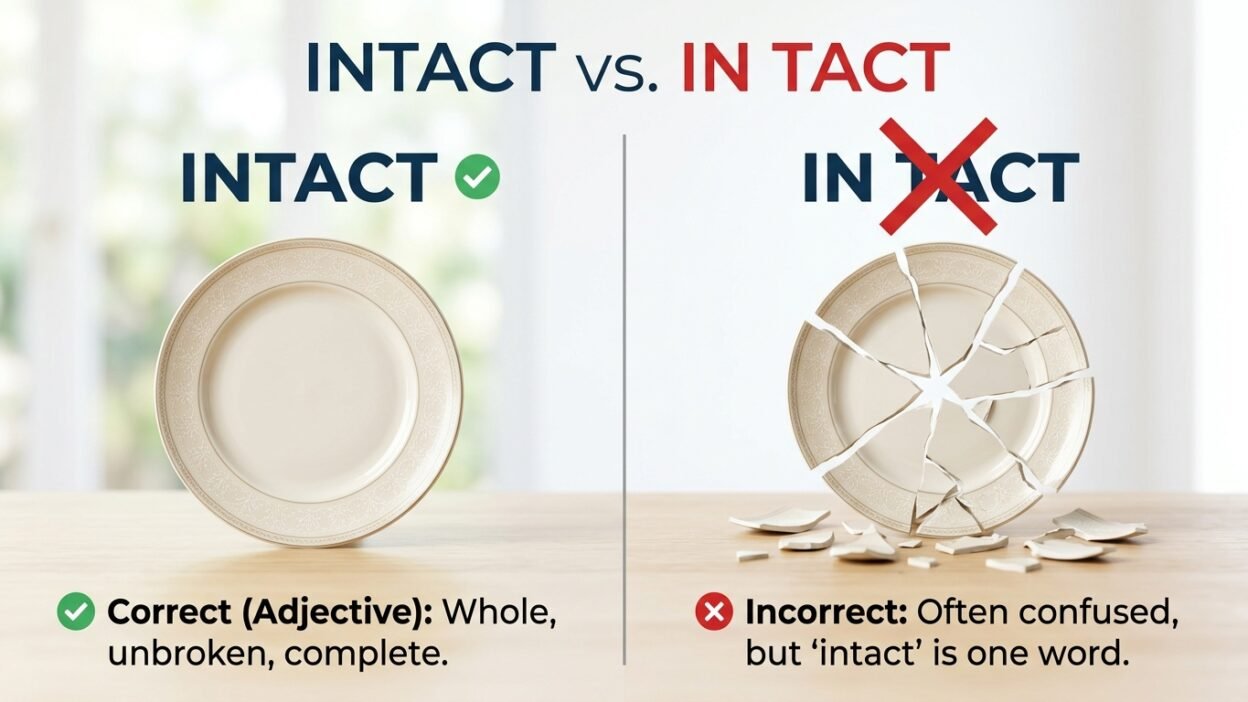
Many learners get confused between “in tact” and “intact.” They sound exactly the same when spoken, so it is easy to think both are correct.
But here’s the simple truth: only one of them is correct in standard English.
Quick Answer
- Intact = correct word
→ means not broken, complete, or whole - In tact = incorrect spelling
→ not used in standard English
Simple Background
The word intact comes from Latin. It means untouched or not damaged. Over time, it became a common English word used in everyday situations.
The spelling “in tact” is just a mistake. People often write it this way because they hear two sounds: “in” and “tact.”
Clear Explanation of the Difference
What is “Intact”?
Intact is the correct and only proper form.
It means:
- Not broken
- Not damaged
- Complete
Examples:
- “The glass was still intact after the fall.”
- “Most of the building remained intact.”
What is “In tact”?
In tact is not a correct word in English.
Even though:
- “In” is a word
- “Tact” is also a word (meaning skill in dealing with people)
Together, “in tact” does not form a correct expression.
❌ “The phone is in tact.”
✔ “The phone is intact.”
Comparison Table
| Form | Type | Meaning | Correct Usage |
|---|---|---|---|
| Intact | Adjective | Not broken or damaged | ✅ Yes |
| In tact | Incorrect | No real meaning together | ❌ No |
Which One to Use and When
Always use intact when:
- Something is still whole
- Nothing is broken or missing
Never use in tact in normal writing.
Simple Tip to Remember
Think:
Intact = in one piece
If something is still in one piece, it is intact.
Common Mistakes People Make
1. Splitting the word
❌ “The package arrived in tact.”
✔ “The package arrived intact.”
2. Thinking “tact” changes the meaning
“Tact” means being polite or careful with words, but it does not connect with “in” this way.
3. Writing by sound
People often write what they hear, and “intact” sounds like two words.
Everyday Real Life Examples
In Emails
- “The items arrived intact.”
In News
- “The historic building remained intact after the storm.”
On Social Media
- “My phone is still intact after I dropped it 😅”
In Daily Life
- “Luckily, the eggs stayed intact.”
- “The old book is still intact.”
Short Learning Section for Students
Here is a simple way to remember:
Step 1: Learn the correct word
- Intact = correct
- In tact = wrong
Step 2: Practice
- “The box is intact.”
- “Everything is intact.”
Step 3: Use memory trick
Think:
Intact = not attacked (not damaged)
Step 4: Double check writing
Always check spelling in exams and assignments.
FAQ
Is “in tact” ever correct?
No, it is not correct in standard English.
What does “intact” mean?
It means something is not broken or damaged.
Why do people write “in tact”?
Because it sounds like two words when spoken.
Can “tact” be used alone?
Yes. “Tact” means being polite and careful with words.
Is “intact” formal or informal?
It is used in both formal and informal English.
How can I remember the spelling?
Think: intact = in one piece.
Is this mistake common?
Yes, many learners make this mistake.
Conclusion
The difference between in tact and intact is very simple.
- Intact is the correct word and means not broken or damaged.
- In tact is just a spelling mistake and should not be used.
If you remember one thing, remember this:
Always write “intact” as one word.
With a little practice, you will use it correctly every time.