Many learners feel confused about “on site” and “onsite.” They look almost the same, but they are used in different ways. You may see both in emails, job posts, or websites, and wonder which one is correct.
The good news is: both are correct but they are used in different situations. This guide will help you understand the difference in very simple English so you can use them confidently every time.
Quick Answer
Here is the simple rule:
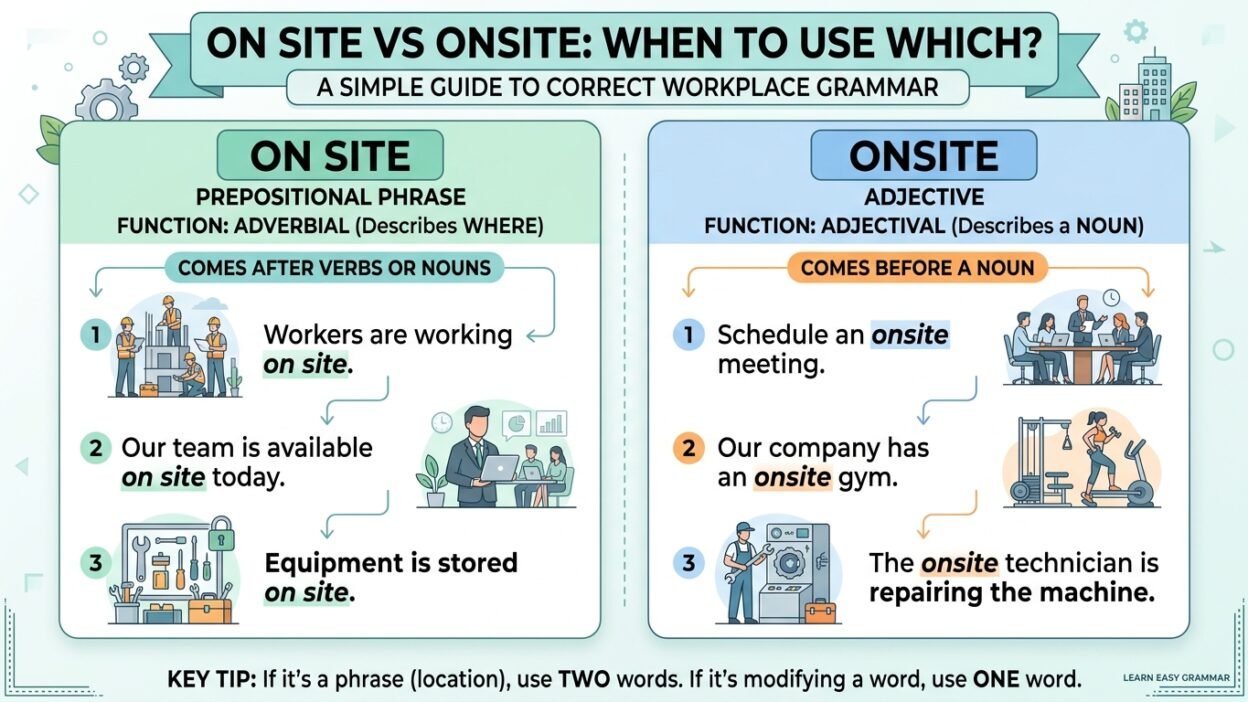
- “On site” (two words) → used as a phrase (adverb or noun phrase)
- “Onsite” (one word) → used as an adjective (describes a noun)
Easy tip:
- If it comes after a verb → use on site
- If it comes before a noun → use onsite
Simple Background
The phrase “on site” came first. It means “at a place” or “at a location.” For example, a construction site or work location.
Over time, people started joining the two words to make “onsite.” This is common in English. When two words are used together again and again, they sometimes become one word.
So now:
- “On site” is the original form
- “Onsite” is the newer form used as an adjective
Clear Explanation of the Difference
Let’s understand this in a very easy way.
“On site” (two words)
This is used when you talk about being at a location.
It answers the question: Where?
Examples:
- The engineer is on site.
- We will meet on site tomorrow.
- The manager is already on site.
“Onsite” (one word)
This is used to describe something related to a location.
It comes before a noun.
Examples:
- We offer onsite training.
- The company has onsite support.
- There is an onsite doctor.
Comparison Table
| Feature | On site (two words) | Onsite (one word) |
|---|---|---|
| Type | Phrase | Adjective |
| Meaning | At a location | Related to a location |
| Position | After a verb | Before a noun |
| Example | She is on site | Onsite staff is available |
| Question it answers | Where? | What kind? |
Which One to Use and When
Use this simple guide:
Use “on site” when:
- You are talking about a place or location
- It comes after the verb
Examples:
- The team is working on site.
- He will be on site all day.
- The workers arrived on site early.
Use “onsite” when:
- You are describing a noun
- It comes before a noun
Examples:
- We provide onsite services.
- The company offers onsite parking.
- There is an onsite cafeteria.
Common Mistakes People Make
Mistake 1
❌ The manager is onsite.
✔ The manager is on site.
Mistake 2
❌ We offer on site training.
✔ We offer onsite training.
Mistake 3
❌ The onsite is ready.
✔ The team is on site.
✔ The onsite team is ready.
Mistake 4
Many learners forget to check the position in the sentence.
Remember:
- Before a noun → onsite
- After a verb → on site
Everyday Real Life Examples
In Emails
- “Our technician will be on site tomorrow.”
- “We provide onsite installation services.”
In Job Posts
- “This is an onsite position.”
- “You must be available on site during working hours.”
In News
- “Emergency teams are on site.”
- “The company offers onsite healthcare.”
In Social Media
- “Finally on site for the event!”
- “Great onsite experience today!”
In Daily Conversations
- “Are you on site right now?”
- “They have onsite security.”
Short Learning Section for Students and Beginners
Here is a simple way to remember:
Step 1
Ask: Is it describing something or telling where?
Step 2
Check position:
- Before a noun → onsite
- After a verb → on site
Step 3
Quick test:
- “at the location” → on site
- “location-based” → onsite
Practice
- The workers are _______.
- We provide _______ support.
- The manager is _______.
- The company offers _______ services.
Answers:
- on site
- onsite
- on site
- onsite
FAQ
1. Is “onsite” one word or two?
Both are correct. “On site” is two words, and “onsite” is one word.
2. Which is more correct?
Both are correct. You just need to use them in the right way.
3. Can I say “I am onsite”?
It is better to say: “I am on site.”
4. Can I write “on site services”?
No. You should write: “onsite services.”
5. Is “onsite” formal or informal?
It is used in both formal and informal English.
6. How can I remember the difference?
Think:
- “On site” = place
- “Onsite” = description
7. Are both used in British and American English?
Yes, both are used in both types of English.
8. Is it wrong to mix them?
Yes, using the wrong one can make your sentence incorrect.
Conclusion
The difference between “on site” and “onsite” is simple once you understand it.
- Use “on site” when talking about a place
- Use “onsite” when describing something
Simple rule to remember:
👉 Place = on site
👉 Description = onsite
With practice, you will use both forms correctly without thinking.