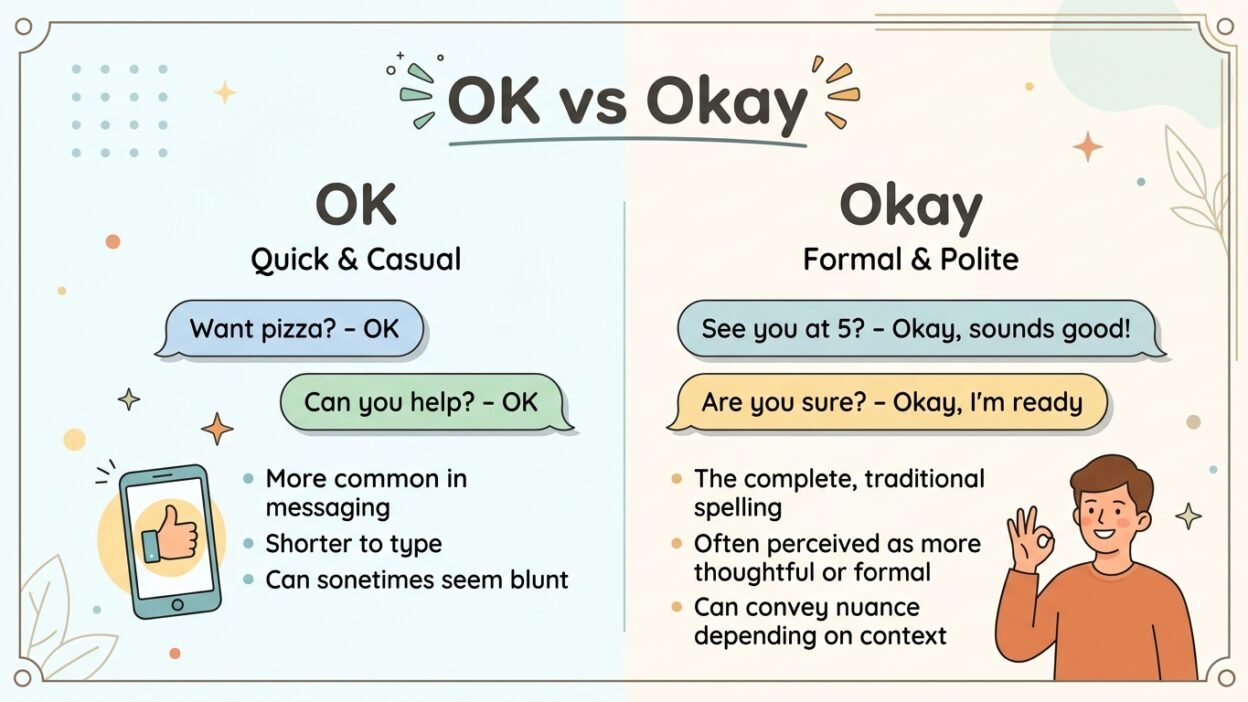
Many learners wonder whether they should write “OK” or “okay.” Both forms are very common in English, and people use them in messages, emails, schools, and daily conversations.
This often creates confusion because both seem correct.
The good news is simple: both are accepted in modern English.
Quick Answer
- OK = short, common spelling
- Okay = full-word spelling
Both mean:
- acceptable
- fine
- all right
Simple Background
The word “OK” became popular in the 1800s in the United States. It started as a funny abbreviation and later spread around the world.
Over time, people also began writing the full form:
- okay
Today, both forms are widely used in English.
Clear Explanation of the Difference
What is “OK”?
OK is:
- The shorter form
- Very common in casual writing and speech
Examples:
- “Are you OK?”
- “Everything is OK.”
What is “Okay”?
Okay is:
- A more fully written form
- Common in everyday writing
Examples:
- “I’m feeling okay now.”
- “Okay, let’s begin.”
Comparison Table
| Word | Type | Meaning | Usage Style |
|---|---|---|---|
| OK | Short form | Fine / acceptable | Short, casual |
| Okay | Full spelling | Fine / acceptable | Natural, conversational |
Which One to Use and When
Use OK when:
- Writing short messages
- Using quick replies
- Writing casually
Use okay when:
- Writing naturally in sentences
- Wanting a softer or more conversational tone
Simple Tip to Remember
- OK = shorter
- Okay = fuller spelling
Both are correct, so choose one style and stay consistent.
Common Mistakes People Make
1. Thinking one is wrong
Both are accepted English forms.
2. Mixing styles in formal writing
It is better to stay consistent.
3. Using unusual spellings
❌ “okeh”
❌ “okey”
✔ “OK” or “okay”
Everyday Real Life Examples
In Messages
- “OK, see you later.”
- “Okay, no problem.”
In Emails
- “Everything looks OK.”
- “Okay, I understand.”
On Social Media
- “I’m okay now 😊”
In Daily Life
- “Are you OK?”
- “Okay, let’s go.”
Short Learning Section for Students
Here is a simple way to remember:
Step 1: Learn the meanings
Both words mean:
- fine
- acceptable
- all right
Step 2: Practice
- “I’m OK.”
- “Okay, thank you.”
Step 3: Use memory trick
Think:
OK = short version
Okay = full version
Step 4: Stay consistent
Choose one style in your writing.
FAQ
Is “OK” correct English?
Yes, it is completely correct.
Is “okay” more formal?
Not exactly, but it can feel more natural in full sentences.
Which one is more common?
Both are very common.
Can I use “OK” in exams?
Yes, but “okay” may look more polished in formal writing.
Why are there two spellings?
“Okay” developed from the abbreviation “OK.”
Is this confusion common?
Yes, many learners wonder which one is correct.
Should I use both together?
It is better to stay consistent in one piece of writing.
Conclusion
The difference between OK and okay is very small.
- Both are correct and widely used.
- OK is shorter and quick.
- Okay is fuller and more conversational.
Remember this easy rule:
Use whichever style fits your writing, but stay consistent.
With this, you can confidently use both forms in everyday English.