Many learners get confused between “drier” and “dryer.” These words look almost the same and sound very similar, so it can be difficult to know which spelling to use.
The confusion becomes bigger because both words are actually correct—but they are used differently.
Quick Answer
- Drier = comparative form of “dry”
→ means more dry - Dryer = a machine or device that dries things
→ sometimes also used as an adjective in informal English
Simple Background
The word “dry” can change in two ways:
- As an adjective comparison:
dry → drier - As a noun for a machine:
dryer
Because the spellings differ by only one letter, learners often mix them up.
Clear Explanation of the Difference
What is “Drier”?
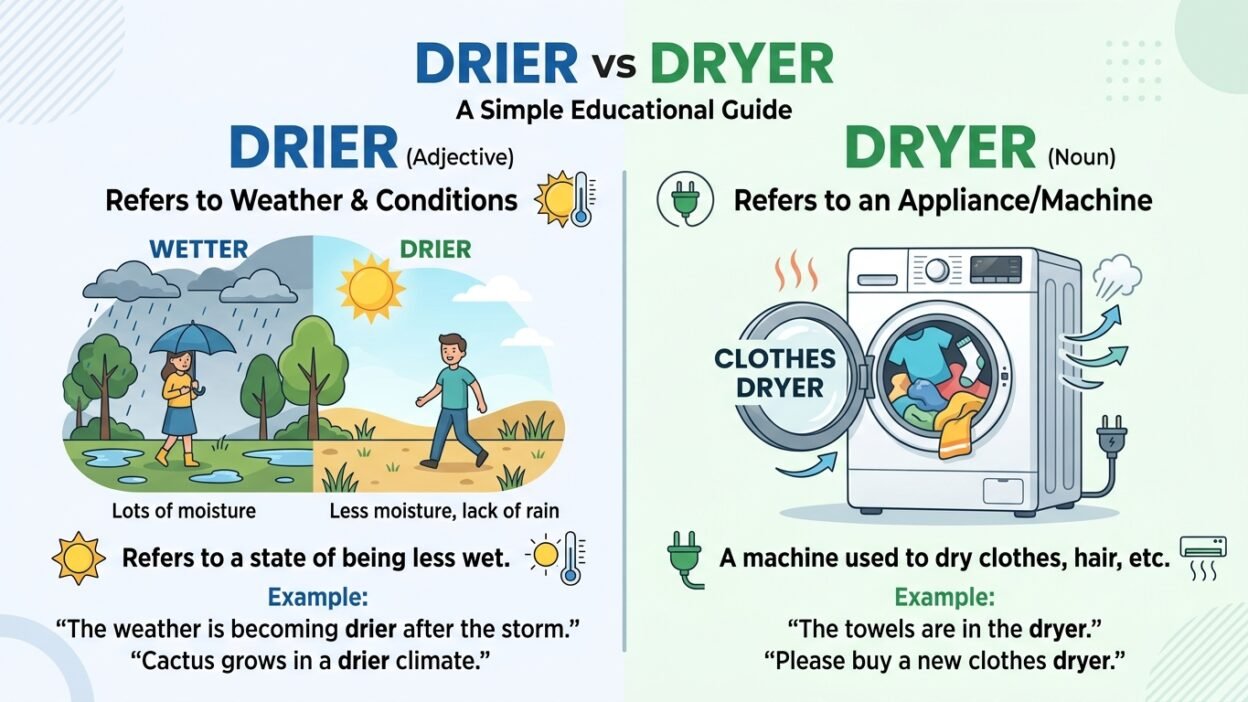
Drier is the comparative form of dry.
It means:
- More dry
- Less wet
Examples:
- “This climate is drier than before.”
- “The towel became drier in the sun.”
What is “Dryer”?
Dryer is usually a noun.
It means:
- A machine that dries clothes or hair
Examples:
- “The clothes are in the dryer.”
- “She bought a new hair dryer.”
In some informal cases, people also use “dryer” as a comparative adjective, but “drier” is preferred in standard writing.
Comparison Table
| Word | Type | Meaning | Example Sentence |
|---|---|---|---|
| Drier | Comparative adj. | More dry | “Today is drier.” |
| Dryer | Noun | Drying machine or device | “Use the dryer.” |
Which One to Use and When
Use drier when:
- Comparing dryness
- Talking about weather, skin, towels, or air
Use dryer when:
- Talking about a machine or tool
- Referring to hair dryers or clothes dryers
Simple Tip to Remember
- Drier = more dry
- Dryer = machine
Think:
- hair dryer
- clothes dryer
Common Mistakes People Make
1. Using “dryer” for comparisons
❌ “The weather is dryer today.”
✔ “The weather is drier today.”
2. Using “drier” for machines
❌ “Put the clothes in the drier.”
✔ “Put the clothes in the dryer.”
3. Forgetting context
One is about comparison, the other is usually an object.
Everyday Real Life Examples
In Weather
- “This season is much drier.”
In the Home
- “The dryer stopped working.”
In Daily Life
- “My skin gets drier in winter.”
- “She used a hair dryer.”
In Messages
- “The air feels drier today.”
Short Learning Section for Students
Here is a simple way to remember:
Step 1: Learn the meanings
- Drier = more dry
- Dryer = machine
Step 2: Practice
- “The desert is drier.”
- “The dryer is noisy.”
Step 3: Use memory trick
Think:
Dryer dries clothes
Step 4: Check the sentence
Ask:
- Is it comparing dryness? → drier
- Is it a machine? → dryer
FAQ
Is “dryer” always a machine?
Usually yes, especially in modern English.
Is “drier” correct English?
Yes, it is the preferred comparative form.
Why do people confuse these words?
Because they look and sound similar.
Can “dryer” mean more dry?
Sometimes informally, but “drier” is preferred.
Which spelling should I use in formal writing?
Use “drier” for comparisons.
Is this mistake common?
Yes, very common among learners.
How can I remember easily?
Think: dryer = machine.
Conclusion
The difference between drier and dryer is simple once you know their roles.
- Drier means more dry.
- Dryer is usually a machine that dries things.
Remember this easy rule:
Drier compares dryness, dryer dries clothes.
With this, you can use both spellings correctly and confidently.