Many learners get confused between “everyday” and “every day.” These forms look almost the same, but they are used differently in English. Because the difference is only a space, mistakes are very common.
The good news is that the rule is simple once you understand it.
Quick Answer
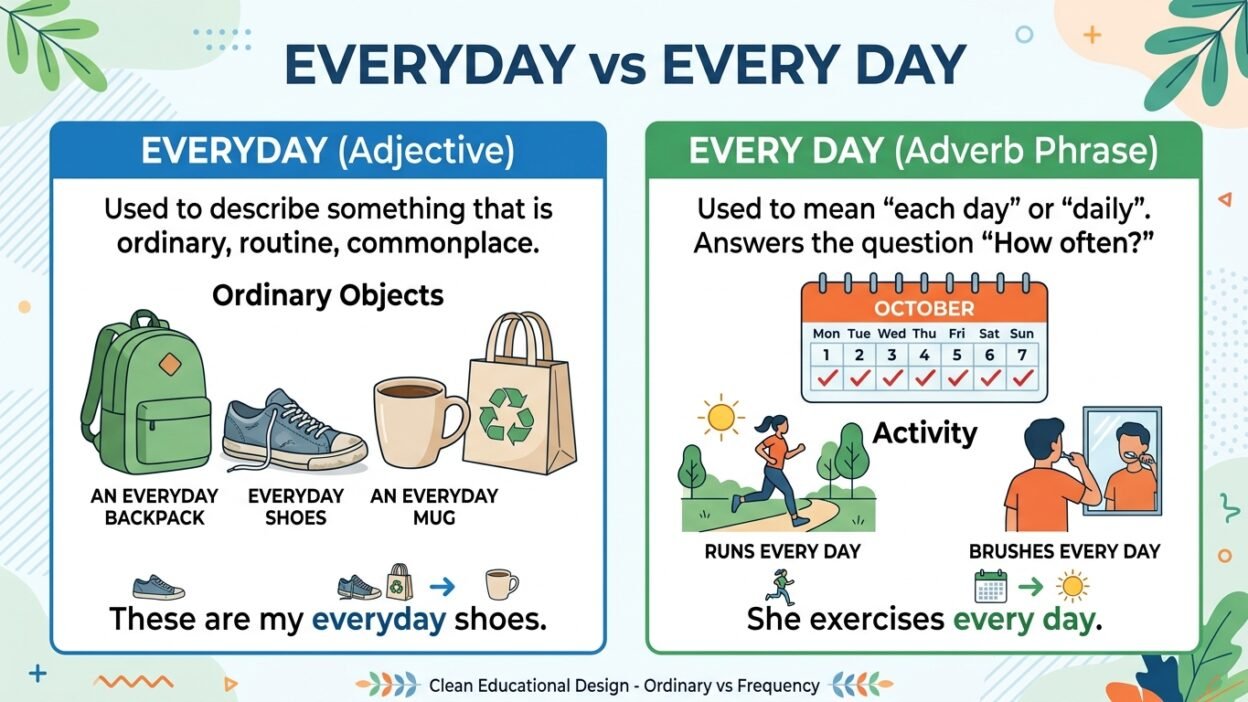
- Everyday = an adjective meaning ordinary or common
- Every day = means each day or daily
Simple Background
These expressions developed from the same words but now have different grammar roles.
- Everyday became a single adjective
- Every day stayed as a phrase showing time
Understanding the role in the sentence helps you choose the correct form.
Clear Explanation of the Difference
What is “Everyday”?
Everyday is an adjective.
It means:
- Normal
- Ordinary
- Common
Examples:
- “These are my everyday shoes.”
- “Stress is part of everyday life.”
What is “Every Day”?
Every day is a time phrase.
It means:
- Each day
- Daily
Examples:
- “I exercise every day.”
- “She studies English every day.”
Comparison Table
| Form | Type | Meaning | Example Sentence |
|---|---|---|---|
| Everyday | Adjective | Ordinary or common | “This is everyday clothing.” |
| Every day | Phrase | Each day / daily | “I walk every day.” |
Which One to Use and When
Use everyday when:
- Describing something common or normal
- The word comes before a noun
Use every day when:
- Talking about frequency or time
- You mean “each day”
Simple Tip to Remember
- Every day = every single day
- Everyday = ordinary thing
Quick test:
If you can replace it with “each day,” use every day.
Common Mistakes People Make
1. Using “everyday” for daily actions
❌ “I read everyday.”
✔ “I read every day.”
2. Using “every day” before nouns
❌ “These are my every day clothes.”
✔ “These are my everyday clothes.”
3. Forgetting grammar roles
One is an adjective, the other is a phrase.
Everyday Real Life Examples
In Emails
- “We meet every day.”
- “This is everyday office work.”
In Messages
- “I call her every day.”
On Social Media
- “Coffee is part of my everyday routine ☕”
In Daily Life
- “He wears everyday shoes.”
- “They practice every day.”
Short Learning Section for Students
Here is an easy way to remember:
Step 1: Learn the meanings
- Everyday = ordinary
- Every day = each day
Step 2: Practice
- “Everyday problems happen.”
- “I study every day.”
Step 3: Use memory trick
Think:
Every day = every single day
Step 4: Check the sentence
Ask: Is it describing something or showing time?
FAQ
Is “everyday” one word?
Yes, when it means ordinary or common.
Is “every day” always two words?
Yes, when talking about time or frequency.
Which one is more common?
Both are common but used differently.
Why do people confuse them?
Because the difference is only a space.
Can “everyday” describe objects?
Yes. Example: “everyday clothes.”
How can I remember easily?
Think: every day = each day.
Should I check this in exams?
Yes, this is a common grammar mistake.
Conclusion
The difference between everyday and every day is simple once you know their roles.
- Everyday means ordinary or common.
- Every day means each day.
Remember this rule:
If you mean “each day,” use two words.
With this, you can use both forms correctly and confidently.

Austin Brandon serves as both an author and administrator at GrammerPeak. He manages site operations while creating clear, accurate grammar content that helps readers correct mistakes, understand language rules, and write with confidence, precision, and clarity across academic, professional, and everyday English communication.