
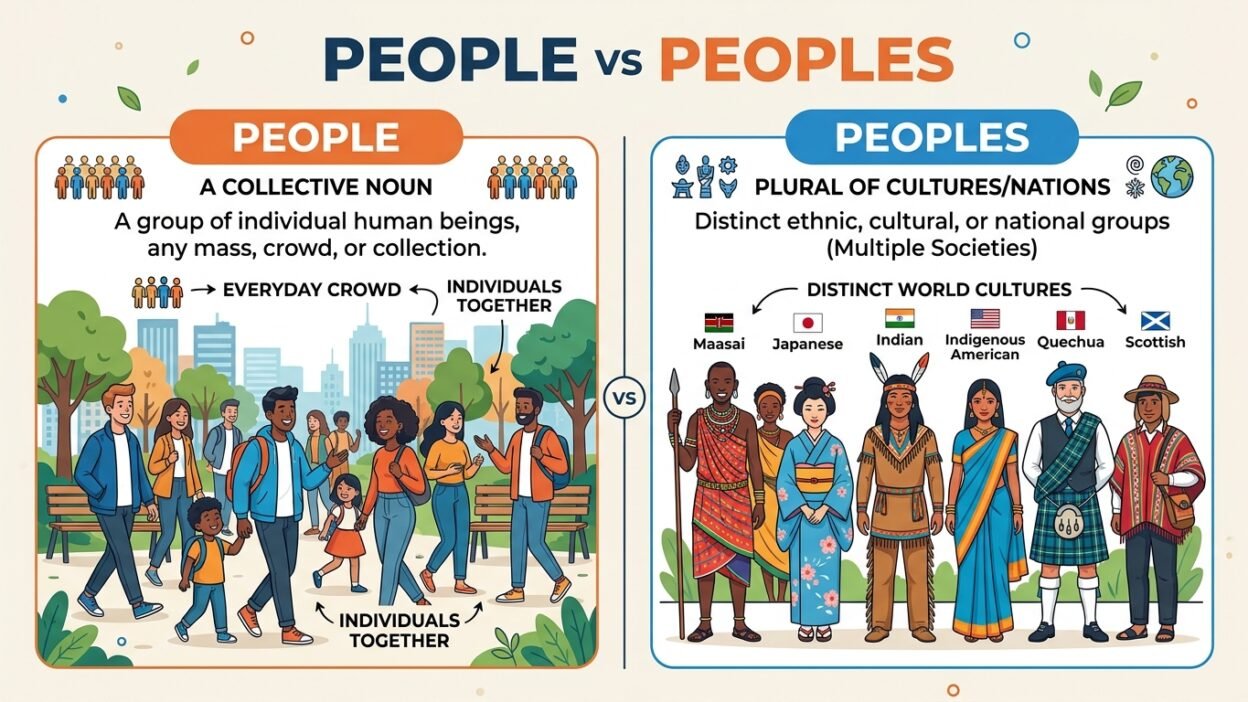
Many learners get confused between “people” and “peoples.” Since both forms exist in English, it can be hard to know when to use each one correctly.
The confusion happens because “people” is already plural, so adding “s” feels strange. But in some situations, “peoples” is actually correct.
Quick Answer
- People = the normal plural of “person”
- Peoples = different groups, nations, or ethnic communities
Simple Background
The word “people” started as a collective noun, meaning a group of persons together.
Later, the form “peoples” developed for talking about:
- Different nations
- Ethnic groups
- Communities around the world
That is why both words exist today.
Clear Explanation of the Difference
What is “People”?
People is the normal and most common form.
It means:
- More than one person
- Humans in general
Examples:
- “Many people attended the event.”
- “People are waiting outside.”
What is “Peoples”?
Peoples is used when talking about:
- Different ethnic groups
- Different nations or cultures
Examples:
- “The indigenous peoples of the region have rich traditions.”
- “Different peoples lived there long ago.”
This form is more formal and less common in everyday conversation.
Comparison Table
| Word | Meaning | Usage Level | Example Sentence |
|---|---|---|---|
| People | More than one person | Very common | “People are kind.” |
| Peoples | Different cultural or ethnic groups | Formal/special use | “The peoples of Africa are diverse.” |
Which One to Use and When
Use people when:
- Talking about ordinary groups of humans
- Speaking in daily conversation
- Writing normally
Use peoples when:
- Talking about multiple ethnic or cultural groups
- Writing about history, culture, or anthropology
Simple Tip to Remember
- People = ordinary plural
- Peoples = many different groups of people
Common Mistakes People Make
1. Using “peoples” for normal situations
❌ “Many peoples came to the party.”
✔ “Many people came to the party.”
2. Thinking “peoples” is always wrong
It is correct in cultural or historical contexts.
3. Forgetting that “people” is already plural
“People” already means more than one person.
Everyday Real Life Examples
In Daily Life
- “People are shopping today.”
- “Young people use social media often.”
In News
- “The peoples of the region celebrated together.”
In School
- “People need clean water.”
- “Ancient peoples built these structures.”
In Social Media
- “People love this trend!”
Short Learning Section for Students
Here is an easy way to remember:
Step 1: Learn the basic rule
- People = normal plural
- Peoples = many groups or nations
Step 2: Practice
- “People are friendly.”
- “Different peoples have different traditions.”
Step 3: Use memory trick
Think:
Peoples = multiple populations or cultures
Step 4: Keep it simple
In most situations, use people.
FAQ
Is “peoples” a real word?
Yes, it is correct in special contexts.
Which one is more common?
“People” is much more common.
Can I use “peoples” in daily conversation?
Usually, no. “People” is better for normal situations.
What does “peoples” mean exactly?
It refers to different cultural, ethnic, or national groups.
Is “people” already plural?
Yes, it is the plural form of “person.”
Why does “peoples” exist?
It developed to describe multiple groups or nations.
Which should I use in exams?
Use “people” unless the topic is cultural or historical.
Conclusion
The difference between people and peoples is simple once you understand the context.
- People is the normal plural form used in everyday English.
- Peoples is used for different cultural, ethnic, or national groups.
Remember this simple rule:
Use “people” most of the time, and use “peoples” only for separate groups or cultures.
With this, you can use both words correctly and confidently.

Austin Brandon serves as both an author and administrator at GrammerPeak. He manages site operations while creating clear, accurate grammar content that helps readers correct mistakes, understand language rules, and write with confidence, precision, and clarity across academic, professional, and everyday English communication.