
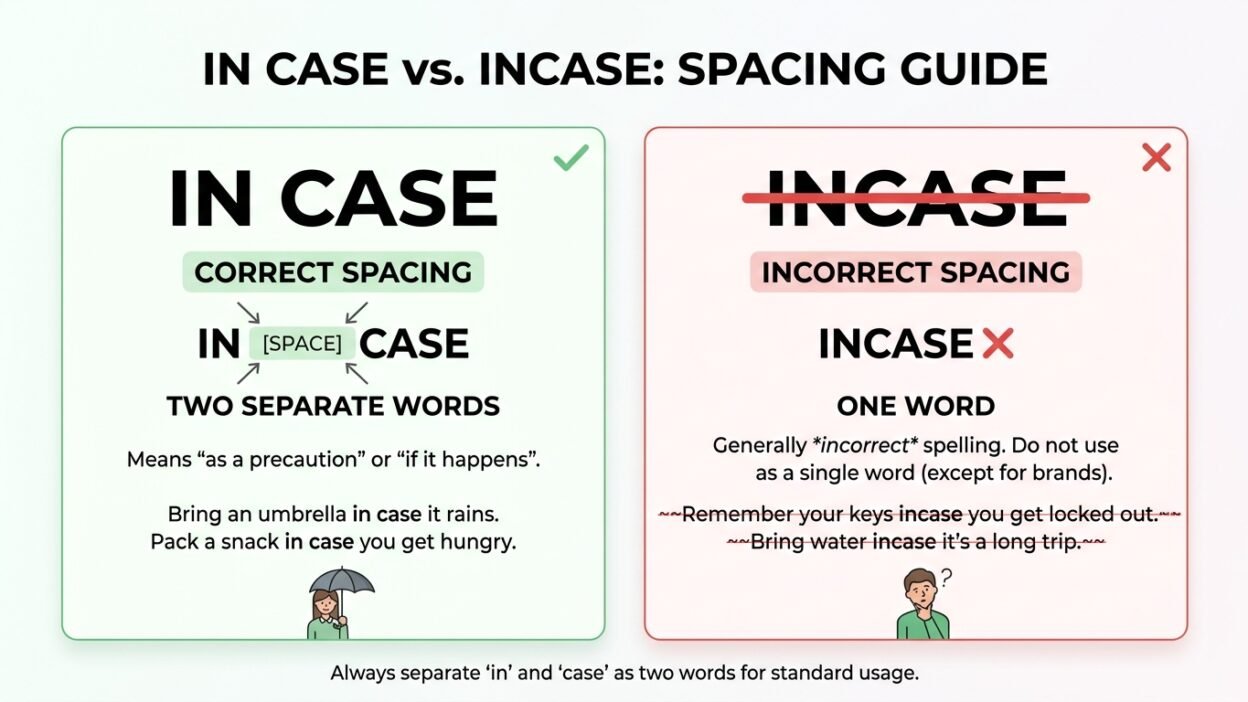
Many learners get confused between “incase” and “in case.” They look very similar, and when spoken, they sound the same. Because of this, people often write them as one word by mistake.
The truth is simple: only one form is correct in standard English.
Quick Answer
- In case = correct form
→ used to talk about possibility or precaution - Incase = incorrect spelling
→ should not be used
Simple Background
The phrase “in case” is made of two separate words:
- in (a preposition)
- case (a noun meaning situation)
Together, they mean “if something happens” or “as a precaution.”
The single word “incase” is not accepted in standard English.
Clear Explanation of the Difference
What is “In Case”?
In case is the correct phrase.
It means:
- As a precaution
- If something happens
Examples:
- “Take an umbrella in case it rains.”
- “Bring extra money in case you need it.”
What is “Incase”?
Incase is:
- Not a correct word in standard English
- A spelling mistake
❌ “Take a jacket incase it gets cold.”
✔ “Take a jacket in case it gets cold.”
Comparison Table
| Word | Type | Meaning | Correct Usage |
|---|---|---|---|
| In case | Phrase | If something happens | ✅ Yes |
| Incase | Incorrect | No meaning | ❌ No |
Which One to Use and When
Always use in case when:
- Talking about possible situations
- Giving advice or precaution
Never use incase in proper writing.
Simple Tip to Remember
- In case = two words → think “in a situation”
Example:
“In case of rain” → “In a situation of rain”
Common Mistakes People Make
1. Writing it as one word
❌ “incase”
✔ “in case”
2. Confusing it with “in case”
This is not standard either in normal writing.
3. Forgetting the meaning
It always relates to possibility or safety.
Everyday Real Life Examples
In Emails
- “Please save the file in case you need it later.”
In Messages
- “Take a charger in case your phone dies.”
On Social Media
- “Carry water in case it gets hot.”
In Daily Life
- “Lock the door in case someone tries to enter.”
- “Write it down in case you forget.”
Short Learning Section for Students
Here is a simple way to remember:
Step 1: Learn the correct form
- In case = correct
- Incase = wrong
Step 2: Practice
- “Take notes in case you forget.”
- “Call me in case of emergency.”
Step 3: Use memory trick
Think:
In case = in a situation
Step 4: Check spacing
Always write it as two words.
FAQ Section
Is “incase” ever correct?
No, it is always incorrect.
Why is it written as two words?
Because it is a phrase, not a single word.
What does “in case” mean?
It means “if something happens” or “as a precaution.”
Is this mistake common?
Yes, many learners write it as one word.
Can I use “in case” in formal writing?
Yes, it is correct in all types of writing.
How can I remember easily?
Think: in case = in a situation.
Should I worry about this in exams?
Yes, spacing mistakes can affect your writing.
Conclusion
The difference between incase and in case is very simple.
- In case is the correct form and used for possible situations.
- Incase is a spelling mistake and should be avoided.
Remember this rule:
Always write “in case” as two words.
With this, you can write clearly and correctly every time.