
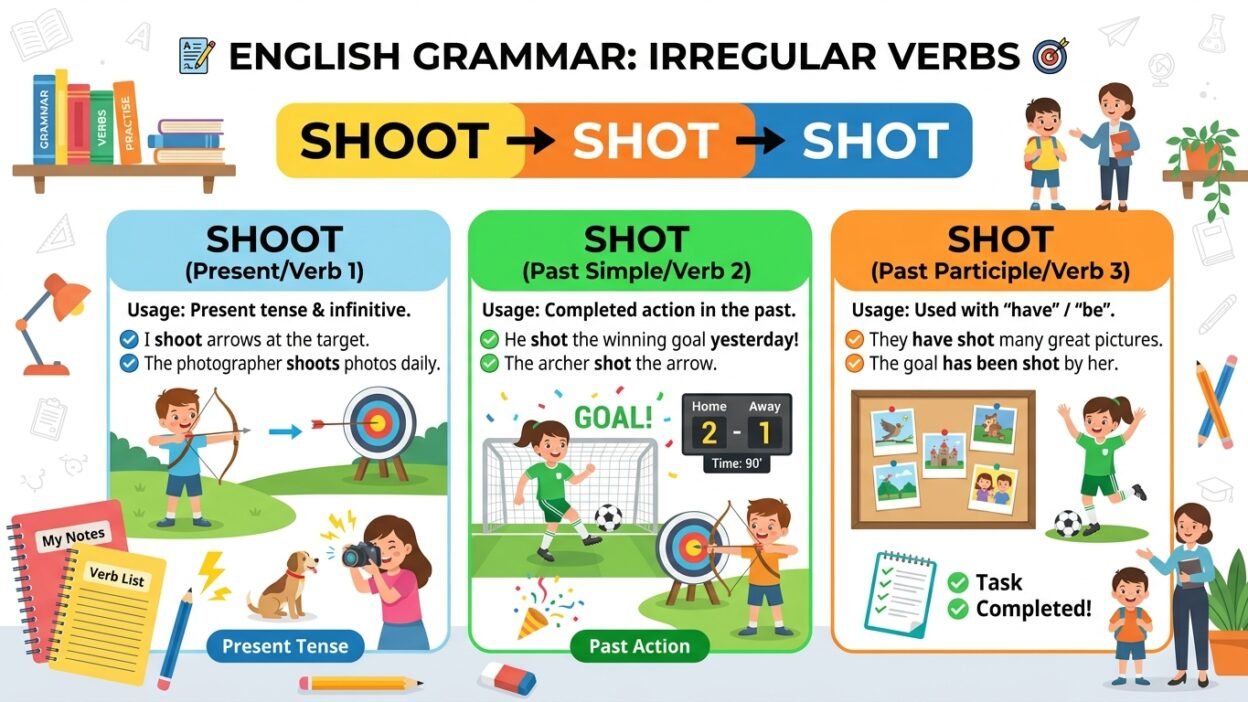
Many English learners get confused about shoot and shot because both words come from the same verb. They are often used when talking about firing a weapon, taking a photograph, kicking a ball, or moving quickly in a particular direction.
The confusion usually happens because shoot is the base form of the verb, while shot can be both the past tense and the past participle. Since one word does two grammar jobs, learners sometimes use the wrong form.
The good news is that the rule is simple. Once you understand when to use shoot and when to use shot, you can avoid common mistakes and speak more naturally.
Quick Answer
- Shoot = base form (present tense)
- Shot = past tense and past participle
- Use shoot for present and future actions.
- Use shot for past actions and with helping verbs.
Examples
✅ I shoot photos every weekend.
✅ I shot photos at the wedding yesterday.
✅ I have shot photos at many weddings.
❌ I have shoot photos before.
❌ Yesterday I shoot photos at the wedding.
Simple Origin or Background Explanation
The verb shoot is an irregular verb in English. Unlike regular verbs, it does not add -ed to form the past tense.
For example:
- Walk → Walked
- Play → Played
But shoot follows a different pattern:
| Verb Form | Word |
|---|---|
| Base Verb | Shoot |
| Past Tense | Shot |
| Past Participle | Shot |
Notice that the past tense and past participle are the same word: shot.
This is one reason why learners find the verb confusing.
The Difference Between Shoot and Shot
The difference depends on the grammar of the sentence.
Shoot
Shoot is the base form of the verb.
Use it for:
- Present tense
- Future tense
- After modal verbs such as can, could, will, would, should, may, and might
Examples:
- I shoot photographs professionally.
- They shoot videos for social media.
- She can shoot excellent pictures.
- We will shoot a new video tomorrow.
Shot
Shot is both the simple past tense and the past participle.
Examples:
- He shot a goal yesterday.
- The photographer shot hundreds of pictures.
- She has shot several documentaries.
- The movie was shot in Canada.
Comparison Table
| Feature | Shoot | Shot |
|---|---|---|
| Verb Type | Base Form | Past Tense & Past Participle |
| Time Reference | Present/Future | Past/Perfect Tenses |
| Used Alone? | Yes | Yes |
| Needs Helping Verb? | No | Sometimes |
| Example | I shoot videos. | I shot videos yesterday. |
| Example with Helper | I can shoot videos. | I have shot videos before. |
Which One to Use and When
Use “Shoot” When:
- Talking about present actions
- Talking about future actions
- Using modal verbs
Examples:
- I shoot wildlife photos.
- They shoot short films.
- She can shoot professional videos.
- We will shoot a commercial next week.
Use “Shot” When:
- Talking about a completed action in the past
- Using perfect tenses
- Using passive voice
Examples:
- I shot photos yesterday.
- She shot the winning goal.
- They have shot several films.
- The movie was shot overseas.
Easy Memory Trick
Remember this pattern:
Shoot → Shot → Shot
If the action happened in the past, you will usually need shot.
If you see has, have, or had, you will also use shot.
Common Mistakes People Make
Mistake 1: Using Shoot for the Past
❌ Yesterday I shoot a video.
✅ Yesterday I shot a video.
Mistake 2: Using Shoot After “Have”
❌ I have shoot many photos.
✅ I have shot many photos.
Mistake 3: Adding “-ed”
❌ Shooted
✅ Shot
The standard past tense is shot, not shooted.
Mistake 4: Using the Wrong Form in Passive Voice
❌ The movie was shoot in London.
✅ The movie was shot in London.
Mistake 5: Forgetting the Verb Pattern
Remember:
Shoot → Shot → Shot
Everyday Real Life Examples
In Emails
✅ I shot the product photos yesterday.
✅ I have shot all the images you requested.
In News Reports
✅ The team shot three goals in the second half.
✅ The documentary was shot over two years.
On Social Media
✅ I shot this photo with my phone.
✅ I’ve shot hundreds of pictures this year.
At School
✅ The students shot a short film for class.
✅ The film was shot on campus.
In Sports
✅ He shot the ball into the net.
✅ She has shot many winning goals.
In Photography
✅ The photographer shot the event yesterday.
✅ The photographer has shot events around the world.
Short Learning Section for Students and Beginners
The easiest way to remember this verb is to learn all forms together.
| Base Form | Past Tense | Past Participle |
|---|---|---|
| Shoot | Shot | Shot |
Practice saying them aloud:
- Shoot
- Shot
- Shot
Now make simple sentences:
- I shoot photos.
- I shot photos yesterday.
- I have shot photos before.
This simple practice helps you remember the correct pattern.
FAQ
Is “shoot” correct English?
Yes. Shoot is the base form of the verb.
Example:
- I shoot photos professionally.
Is “shot” correct English?
Yes. Shot is both the past tense and past participle form.
Example:
- I shot photos yesterday.
- I have shot photos before.
Can I say “I have shoot”?
No.
The correct sentence is:
- I have shot.
What is the past tense of shoot?
The past tense is shot.
Example:
- She shot a great video.
What is the past participle of shoot?
The past participle is also shot.
Example:
- She has shot a great video.
Is “shooted” a word?
No. In standard English, the correct form is shot, not shooted.
Can “shot” be a noun?
Yes.
Examples:
- A basketball shot
- A flu shot
- A camera shot
How can I remember the difference?
Remember this simple pattern:
Shoot → Shot → Shot
Use shoot for the present and shot for the past and perfect tenses.
Conclusion
The difference between shoot and shot is straightforward.
- Shoot is the base form.
- Shot is both the past tense and the past participle.
- Use shoot for present and future actions.
- Use shot for past actions, perfect tenses, and passive constructions.
Remember the pattern shoot → shot → shot, and you’ll be able to use these forms correctly in everyday English.

Austin Brandon serves as both an author and administrator at GrammerPeak. He manages site operations while creating clear, accurate grammar content that helps readers correct mistakes, understand language rules, and write with confidence, precision, and clarity across academic, professional, and everyday English communication.