Many English learners ask whether they should use set or setted when talking about something in the past.
The confusion is understandable because many English verbs form their past tense by adding -ed:
- Start → Started
- Open → Opened
- Finish → Finished
So it seems logical that set would become setted.
However, English has many irregular verbs, and set is one of them.
Quick Answer
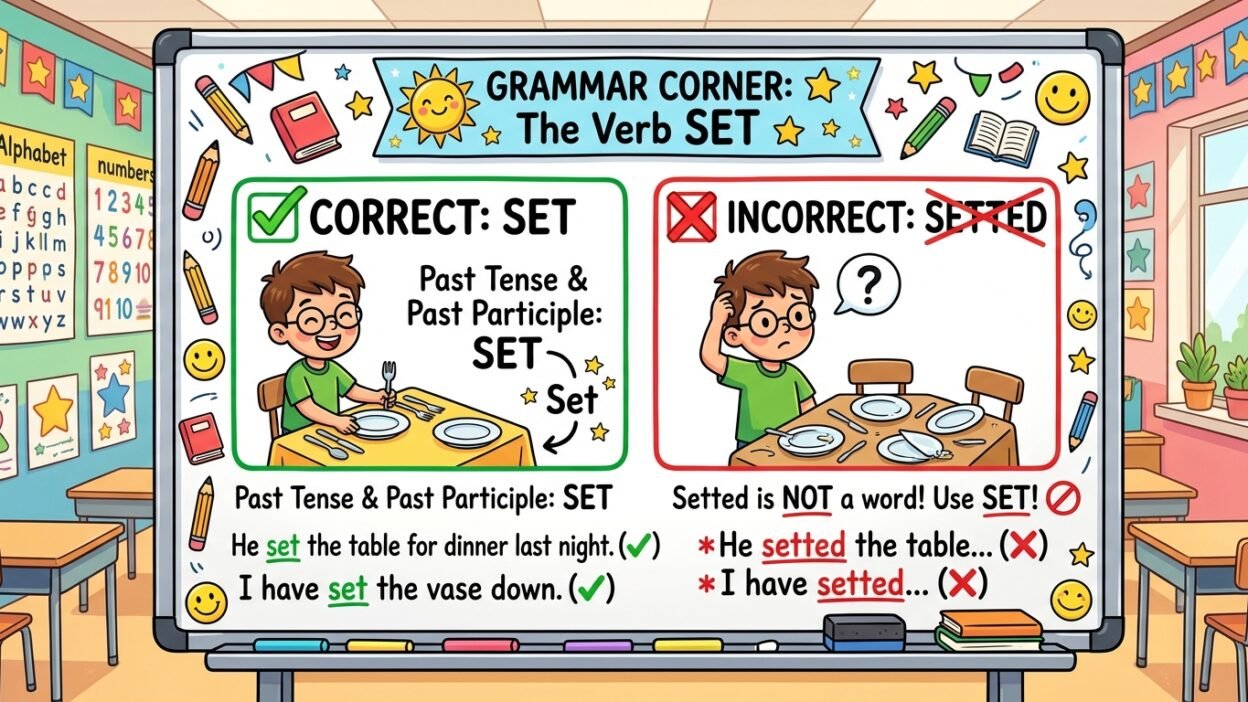
- ✅ Set = correct
- ❌ Setted = incorrect in standard English
Verb forms:
| Form | Word |
|---|---|
| Base Form | Set |
| Past Tense | Set |
| Past Participle | Set |
Examples:
- I set the alarm every night.
- Yesterday, I set the alarm before bed.
- I have set the alarm already.
The word remains set in all three forms.
Background
The verb set is an irregular verb that does not change its spelling in the past tense or past participle.
Other verbs that behave similarly include:
- Cut → Cut → Cut
- Hit → Hit → Hit
- Put → Put → Put
Likewise:
- Set → Set → Set
Because learners are used to adding -ed to verbs, they sometimes create the incorrect form setted.
Difference Between Set and Setted
Set
Set is the correct form in:
- Present tense
- Past tense
- Past participle
Examples:
- I set the table every evening.
- I set the table yesterday.
- I have set the table already.
Setted
Setted is generally not accepted in standard English.
❌ I setted the alarm last night.
✅ I set the alarm last night.
❌ She has setted a new goal.
✅ She has set a new goal.
Comparison Table
| Feature | Set | Setted |
|---|---|---|
| Standard English | ✅ Yes | ❌ No |
| Present Tense | ✅ Yes | ❌ No |
| Past Tense | ✅ Yes | ❌ No |
| Past Participle | ✅ Yes | ❌ No |
| Formal Writing | ✅ Yes | ❌ No |
| Everyday Conversation | ✅ Yes | ❌ No |
Which One to Use and When
Use “Set” for Present Actions
Examples:
- I set the timer.
- They set the rules.
- She sets goals every month.
Use “Set” for Past Actions
Examples:
- I set the timer yesterday.
- They set the rules last year.
- She set a new record.
Use “Set” with Helping Verbs
Examples:
- I have set the timer.
- They had set the rules.
- She has set new goals.
No matter the tense, set remains the same.
Common Mistakes People Make
Mistake 1
❌ I setted the alarm.
✅ I set the alarm.
Mistake 2
❌ She has setted the table.
✅ She has set the table.
Mistake 3
❌ They setted a meeting for Monday.
✅ They set a meeting for Monday.
Mistake 4
❌ We had setted everything up.
✅ We had set everything up.
Everyday Examples
At Home
- I set the table before dinner.
- She set the thermostat to 22 degrees.
At School
- The teacher set homework for Friday.
- The students set up the science project.
At Work
- We set a deadline for the project.
- The manager set clear expectations.
On Social Media
- He set his profile picture yesterday.
- She has set her account to private.
Using Technology
- I set an alarm on my phone.
- They set up a new computer system.
Learning Tip for Students
Remember this simple pattern:
| Verb | Past | Past Participle |
|---|---|---|
| Set | Set | Set |
A helpful sentence:
Today I set the alarm. Yesterday I set the alarm. I have set the alarm.
The word never changes.
FAQ
Is setted a real word?
In standard English, setted is considered incorrect for the verb set.
What is the past tense of set?
The past tense of set is set.
What is the past participle of set?
The past participle is set.
Is “I setted the alarm” correct?
No. The correct sentence is “I set the alarm.”
Why doesn’t set become setted?
Because set is an irregular verb that keeps the same form in all major verb forms.
Is “have set” correct?
Yes. Example: “I have set the table.”
How can I remember the rule?
Just remember:
Set → Set → Set
The word never changes.
Conclusion
When choosing between set and setted, the correct choice is almost always set.
- I set the alarm.
- Yesterday I set the alarm.
- I have set the alarm.
The form setted is not used in standard English and should be avoided.
The easiest rule to remember is:
Set → Set → Set
Once you learn this pattern, you’ll use the verb set correctly in speaking, writing, schoolwork, and everyday conversations.