
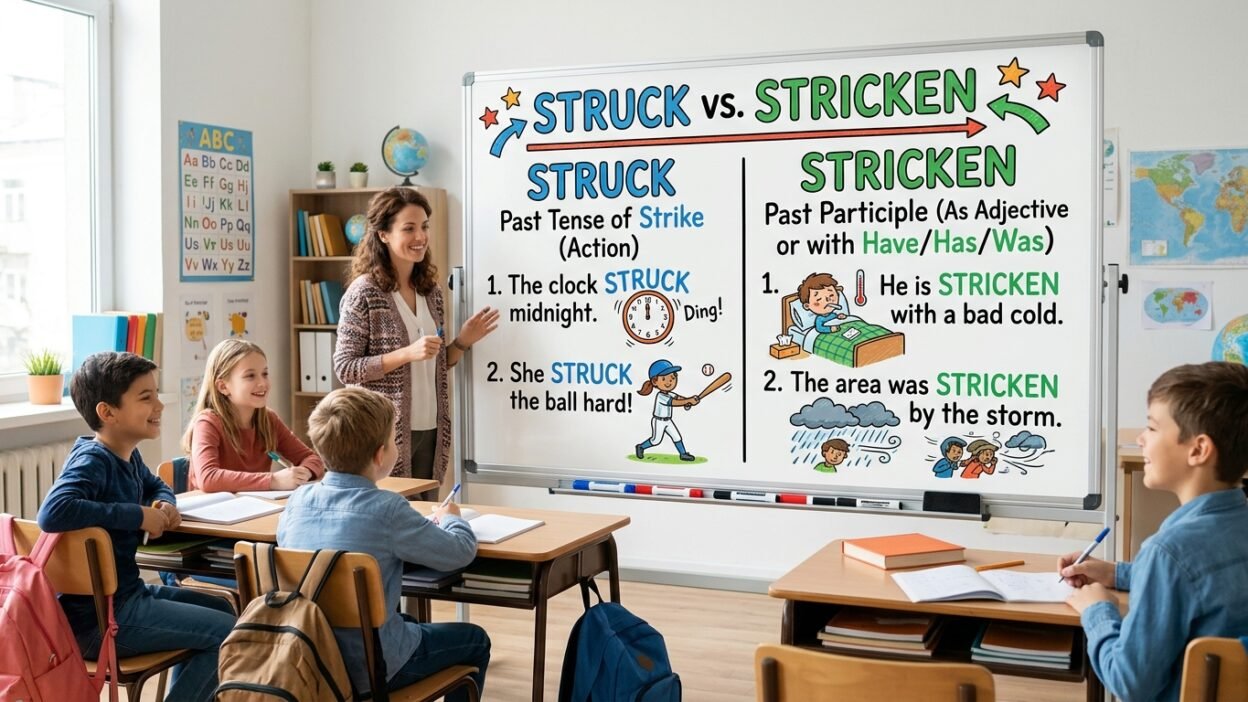
Many English learners get confused between struck and stricken because both words come from the verb strike. They look similar and are both correct, but they are not always used in the same way.
For example:
- Lightning struck the tree. ✅
- The town was stricken by disease. ✅
Both sentences are correct, but each word has a different job in English.
In this guide, you’ll learn the difference between struck and stricken, when to use each one, common mistakes to avoid, and plenty of everyday examples.
Quick Answer
- Strike = present tense
- Struck = past tense and the most common past participle
- Stricken = an alternative past participle, mainly used before nouns or after be for serious situations such as illness, disaster, grief, or hardship
Examples:
- The clock struck twelve.
- The snake struck quickly.
- The town was stricken by drought.
- She looked stricken with fear.
Origin and Background
Strike is an irregular verb.
Its main forms are:
| Verb Form | Word |
|---|---|
| Base Form | Strike |
| Past Simple | Struck |
| Past Participle | Struck (most common) / Stricken (special uses) |
Over time, struck became the usual past tense and the most common past participle. Stricken remained in English but developed a more specific meaning. Today, it is mostly used to describe someone or something suffering from a serious problem.
Difference Between Struck and Stricken
The biggest difference is how they are used.
Struck
Struck is the normal past tense of strike.
It is also the most common past participle.
Examples:
- Lightning struck the tree.
- The boxer struck his opponent.
- The bell struck midnight.
- The company was struck by a cyberattack.
You will see struck in everyday speaking and writing much more often than stricken.
Stricken
Stricken is usually used as an adjective or as a past participle in formal English to describe someone or something affected by a serious condition.
Examples:
- The village was stricken by famine.
- She was stricken with grief.
- He looked panic-stricken.
- The flood-stricken families received help.
Here, stricken emphasizes suffering or being badly affected.
Comparison Table
| Feature | Struck | Stricken |
|---|---|---|
| Past tense of strike | ✅ Yes | ❌ No |
| Common past participle | ✅ Yes | Sometimes |
| Describes a physical hit | ✅ Yes | Rare |
| Used for illness, disaster, grief | Sometimes | ✅ Very common |
| Common in everyday English | ✅ Yes | Less common |
Which One to Use and When
Use “Struck” When
You are talking about an action in the past.
Examples:
- The ball struck the window.
- The earthquake struck the region.
- Inspiration struck suddenly.
- A bullet struck the wall.
Use “Stricken” When
You are describing someone or something suffering from a serious problem.
Examples:
- The country was stricken by war.
- She was stricken with shock.
- The drought-stricken farms needed rain.
- He looked grief-stricken after the news.
If you can replace it with badly affected, stricken is often the better choice.
Common Mistakes People Make
Mistake 1
❌ Lightning stricken the tree.
✅ Lightning struck the tree.
Mistake 2
❌ He was struck with grief.
✅ He was stricken with grief.
(While “struck with grief” is sometimes used, stricken with grief is much more natural and common.)
Mistake 3
❌ The boxer stricken his opponent.
✅ The boxer struck his opponent.
Mistake 4
❌ The drought struck villages needed help.
✅ The drought-stricken villages needed help.
Everyday Real Life Examples
In News
- The hurricane struck the coast overnight.
- The region is drought-stricken.
At School
- The idea struck me during class.
- The students were stricken with worry before the exam results.
In Daily Conversation
- The ball struck my foot.
- She looked stricken after hearing the bad news.
On Social Media
- Inspiration struck at midnight.
- Our thoughts are with the flood-stricken families.
Short Learning Section for Students and Beginners
Remember this pattern:
| Verb | Past | Past Participle |
|---|---|---|
| Strike | Struck | Struck / Stricken |
An easy trick:
- Struck = action
- Stricken = suffering or badly affected
Practice:
- Lightning _____ the tree.
- Answer: struck
- The town was _____ by famine.
- Answer: stricken
- An idea suddenly _____ me.
- Answer: struck
- The earthquake left many _____ families.
- Answer: stricken
FAQ
Is it struck or stricken?
Both are correct, but they are used differently. Struck is the normal past tense, while stricken is mainly used for serious conditions like illness, grief, or disasters.
What is the past tense of strike?
The past tense of strike is struck.
What is the past participle of strike?
The most common past participle is struck. Stricken is also used in certain expressions, especially to describe someone or something badly affected.
Can I say “He was struck with grief”?
Yes, but “He was stricken with grief” is more common and sounds more natural.
Is stricken an adjective?
Yes. In many sentences, stricken functions as an adjective.
Example:
- The disaster-stricken town needed help.
Why do newspapers use stricken?
Because stricken clearly shows that people or places have been seriously affected by illness, disasters, poverty, war, or sadness.
How can I remember the difference?
Use this simple rule:
- Struck = hit or happened
- Stricken = suffering or badly affected
Conclusion
The difference between struck and stricken is easier than it first appears.
Use struck for past actions:
- Lightning struck the tree.
- The bell struck noon.
- An idea struck me.
Use stricken when talking about serious suffering or hardship:
- The town was stricken by disease.
- She was stricken with grief.
- The flood-stricken community received aid.
A simple way to remember is:
- Struck = action
- Stricken = seriously affected
Learning this distinction will help you sound more natural and confident in both spoken and written English.