
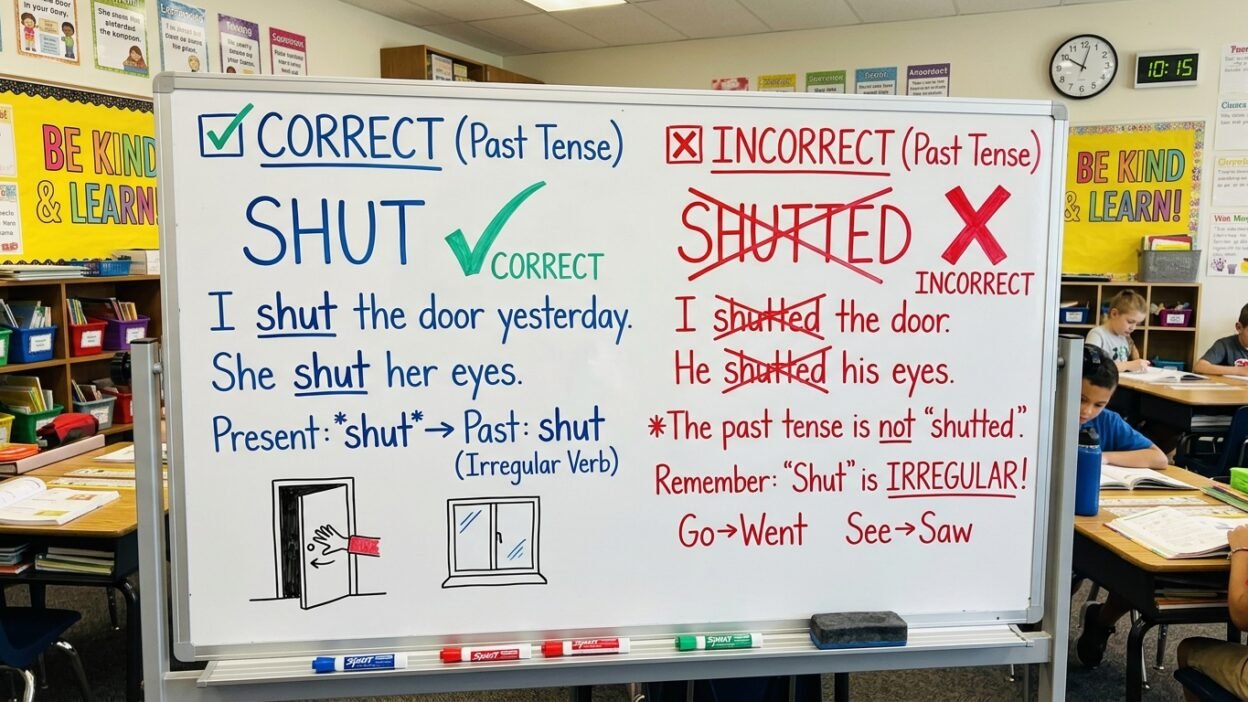
Many English learners wonder what the past tense of shut is. Since many verbs add -ed in the past tense, some people think shutted is correct.
However, shut is an irregular verb, so it does not follow the usual -ed rule.
In this guide, you’ll learn the correct past tense of shut, why shutted is incorrect, and how to use shut with confidence.
Quick Answer
- ✅ Shut = correct
- ❌ Shutted = incorrect
Verb forms:
| Form | Word |
|---|---|
| Base Form | Shut |
| Past Tense | Shut |
| Past Participle | Shut |
Examples:
- I shut the door every night.
- Yesterday, I shut the door quietly.
- I have shut all the windows.
Origin and Background
The verb shut has been used in English for centuries. It belongs to a small group of irregular verbs that keep the same spelling in all three main forms.
Other verbs like this include:
- Cut → Cut → Cut
- Put → Put → Put
- Set → Set → Set
- Hit → Hit → Hit
Similarly:
- Shut → Shut → Shut
Because many English verbs add -ed, learners sometimes mistakenly create the word shutted, but this is not standard English.
The Difference Between Shut and Shutted
Shut
Shut is used as:
- Present tense
- Past tense
- Past participle
Examples:
- Please shut the window.
- She shut the window yesterday.
- They have shut the store for the day.
Shutted
Shutted is not a correct past tense of shut.
❌ I shutted the gate.
✅ I shut the gate.
Comparison Table
| Feature | Shut | Shutted |
|---|---|---|
| Standard English | ✅ Yes | ❌ No |
| Present Tense | ✅ Yes | ❌ No |
| Past Tense | ✅ Yes | ❌ No |
| Past Participle | ✅ Yes | ❌ No |
| Used in Writing | ✅ Yes | ❌ No |
Which One to Use and When
Use “Shut” in the Present
Examples:
- Please shut the door.
- They shut the shop every evening.
Use “Shut” in the Past
Examples:
- He shut the gate before leaving.
- I shut my laptop after work.
- She shut the windows because it was raining.
Use “Shut” with Helping Verbs
Examples:
- I have shut the garage.
- The store has shut for the holiday.
- They had shut all the doors before the storm.
Common Mistakes People Make
Mistake 1
❌ I shutted the door.
✅ I shut the door.
Mistake 2
❌ She has shutted the window.
✅ She has shut the window.
Mistake 3
❌ They shutted the business last year.
✅ They shut the business last year.
Mistake 4
❌ We had shutted everything before leaving.
✅ We had shut everything before leaving.
Everyday Real Life Examples
At Home
- I shut the front door before bed.
- She shut the kitchen window.
At School
- The teacher shut the classroom door.
- The students shut their notebooks after class.
At Work
- He shut down his computer.
- We shut the office at 6 p.m.
In News
- The company shut several stores.
- The road was shut after the accident.
On Social Media
- I shut off my phone for the weekend.
- She shut down the rumors with one post.
Short Learning Section for Students and Beginners
Remember this easy pattern:
| Verb | Past | Past Participle |
|---|---|---|
| Shut | Shut | Shut |
Practice these sentences:
- Yesterday I _____ the window.
- Answer: shut
- We have _____ the shop for today.
- Answer: shut
- She _____ the gate before leaving.
- Answer: shut
The word never changes.
FAQ
What is the past tense of shut?
The past tense of shut is shut.
Is shutted a real word?
No. Shutted is not the correct past tense of shut in standard English.
What is the past participle of shut?
The past participle is shut.
Can I say “I shutted the door”?
No. The correct sentence is “I shut the door.”
Is “have shut” correct?
Yes. For example: “I have shut all the windows.”
Why doesn’t shut become shutted?
Because shut is an irregular verb that keeps the same form in the present, past, and past participle.
How can I remember the rule?
Just remember:
Shut → Shut → Shut
The word stays the same in all three forms.
Conclusion
The correct past tense of shut is shut, not shutted.
Use shut for the present tense, past tense, and past participle:
- I shut the door.
- Yesterday I shut the door.
- I have shut the door.
The simple rule is:
Shut → Shut → Shut
Once you remember this pattern, you’ll avoid a common grammar mistake and use the verb shut correctly in everyday English.

Austin Brandon serves as both an author and administrator at GrammerPeak. He manages site operations while creating clear, accurate grammar content that helps readers correct mistakes, understand language rules, and write with confidence, precision, and clarity across academic, professional, and everyday English communication.