
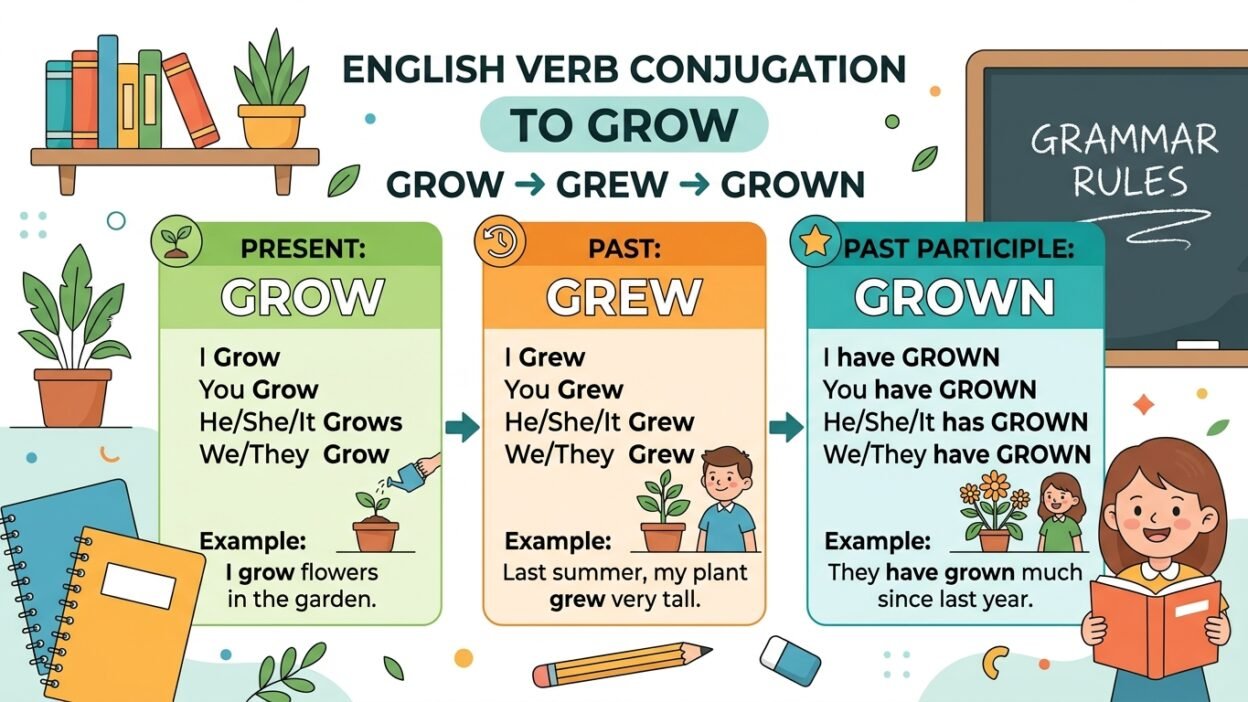
Many English learners struggle with grew and grown because both words come from the verb grow. They are related to the same action, but they are used in different grammar situations.
You might hear sentences like:
- “The plant grew quickly.”
- “The plant has grown quickly.”
Both are correct, but they follow different grammar rules.
The confusion usually happens because grew is the past tense, while grown is the past participle. Once you understand this simple difference, choosing the right word becomes easy.
Quick Answer
- Grow = base form
- Grew = simple past tense
- Grown = past participle
- Use grew for actions completed in the past.
- Use grown with helping verbs such as has, have, had, was, were, be, been.
Examples
✅ The tree grew very fast last year.
✅ The tree has grown very fast this year.
❌ The tree has grew very fast.
❌ The tree grown very fast last year.
Simple Origin or Background Explanation
The verb grow is an irregular verb. Unlike regular verbs, it does not form its past tense by simply adding -ed.
For example:
- Walk → Walked
- Play → Played
But grow follows a different pattern:
| Verb Form | Word |
|---|---|
| Base Verb | Grow |
| Past Tense | Grew |
| Past Participle | Grown |
Because these forms look different, learners often mix them up.
The Difference Between Grew and Grown
The difference is based on grammar, not meaning.
Grew
Grew is the simple past tense of grow.
Use it when talking about something that happened and finished in the past.
Examples:
- The flowers grew quickly.
- My hair grew longer during the summer.
- The company grew rapidly last year.
- The child grew taller over the holidays.
No helping verb is needed.
Grown
Grown is the past participle form.
It is usually used with helping verbs.
Examples:
- The flowers have grown quickly.
- My hair has grown longer.
- The company has grown significantly.
- The child had grown taller before school started.
Notice that grown is normally not used alone.
Comparison Table
| Feature | Grew | Grown |
|---|---|---|
| Verb Type | Past Tense | Past Participle |
| Used Alone? | Yes | Usually No |
| Needs Helping Verb? | No | Yes |
| Common Helpers | None | Has, Have, Had, Was, Were, Been |
| Example | The plant grew fast. | The plant has grown fast. |
| Used in Simple Past? | Yes | No |
| Used in Perfect Tenses? | No | Yes |
Which One to Use and When
Use “Grew” When:
- Talking about a completed action in the past
- No helping verb comes before it
Examples:
- The business grew quickly.
- He grew stronger every year.
- The city grew after new industries arrived.
Use “Grown” When:
- A helping verb comes before it
- You are using perfect tenses
- You are describing a completed process connected to the present
Examples:
- The business has grown quickly.
- He had grown stronger by then.
- The city has grown over the last decade.
Easy Memory Trick
If you see:
- has
- have
- had
- been
you will usually need grown, not grew.
Common Mistakes People Make
Mistake 1: Using Grew After “Have”
❌ The company has grew.
✅ The company has grown.
Mistake 2: Using Grown Without a Helping Verb
❌ Last year the company grown quickly.
✅ Last year the company grew quickly.
Mistake 3: Mixing Past Tense and Past Participle
❌ She had grew taller.
✅ She had grown taller.
Mistake 4: Forgetting the Verb Pattern
Remember:
Grow → Grew → Grown
Mistake 5: Using the Wrong Form in Formal Writing
❌ The market has grew significantly.
✅ The market has grown significantly.
Everyday Real-Life Examples
In Emails
✅ Our customer base grew last month.
✅ Our customer base has grown steadily this year.
In News Reports
✅ The economy grew by three percent last year.
✅ The economy has grown faster than expected.
On Social Media
✅ My channel grew a lot this month.
✅ My audience has grown so much recently.
At School
✅ The student grew more confident during the year.
✅ The student has grown into a strong leader.
At Home
✅ The tomatoes grew quickly in the garden.
✅ The tomatoes have grown larger this week.
At Work
✅ The company grew after opening new offices.
✅ The company has grown into a global business.
Short Learning Section for Students and Beginners
The easiest way to remember these forms is to learn them together.
| Base Form | Past Tense | Past Participle |
|---|---|---|
| Grow | Grew | Grown |
Practice saying them aloud:
- Grow
- Grew
- Grown
Now practice with sentences:
- Plants grow quickly.
- The plants grew quickly.
- The plants have grown quickly.
This simple exercise helps the pattern stay in your memory.
FAQ
Is “grew” correct English?
Yes. Grew is the correct simple past tense of grow.
Example:
- The tree grew quickly.
Is “grown” correct English?
Yes. Grown is the correct past participle form.
Example:
- The tree has grown quickly.
Can I say “has grew”?
No.
The correct phrase is:
- Has grown
What is the past tense of grow?
The past tense is grew.
Example:
- The business grew rapidly.
What is the past participle of grow?
The past participle is grown.
Example:
- The business has grown rapidly.
Is “had grown” correct?
Yes.
Example:
- The child had grown taller before the school year started.
Why do people confuse grew and grown?
Because both words come from the same verb and have similar meanings. The difference is their grammatical role.
How can I remember the difference?
Remember this pattern:
Grow → Grew → Grown
- Past tense = Grew
- Past participle = Grown
Conclusion
The difference between grew and grown is simple once you know the verb forms.
- Grew is the past tense.
- Grown is the past participle.
- Use grew for completed actions in the past.
- Use grown with helping verbs such as has, have, and had.
Remember the pattern grow → grew → grown, and you’ll be able to use both words correctly in speaking and writing.