Many English learners get confused about woke and woken because both words come from the verb wake. Since they are closely related and both refer to stopping sleep, it is easy to mix them up.
The difference is actually simple. Woke is the past tense form, while woken is the past participle form. Once you understand when each form is used, choosing the correct word becomes much easier.
In this guide, you’ll learn the difference between woke and woken in simple English, with clear examples and easy-to-follow rules.
Quick Answer
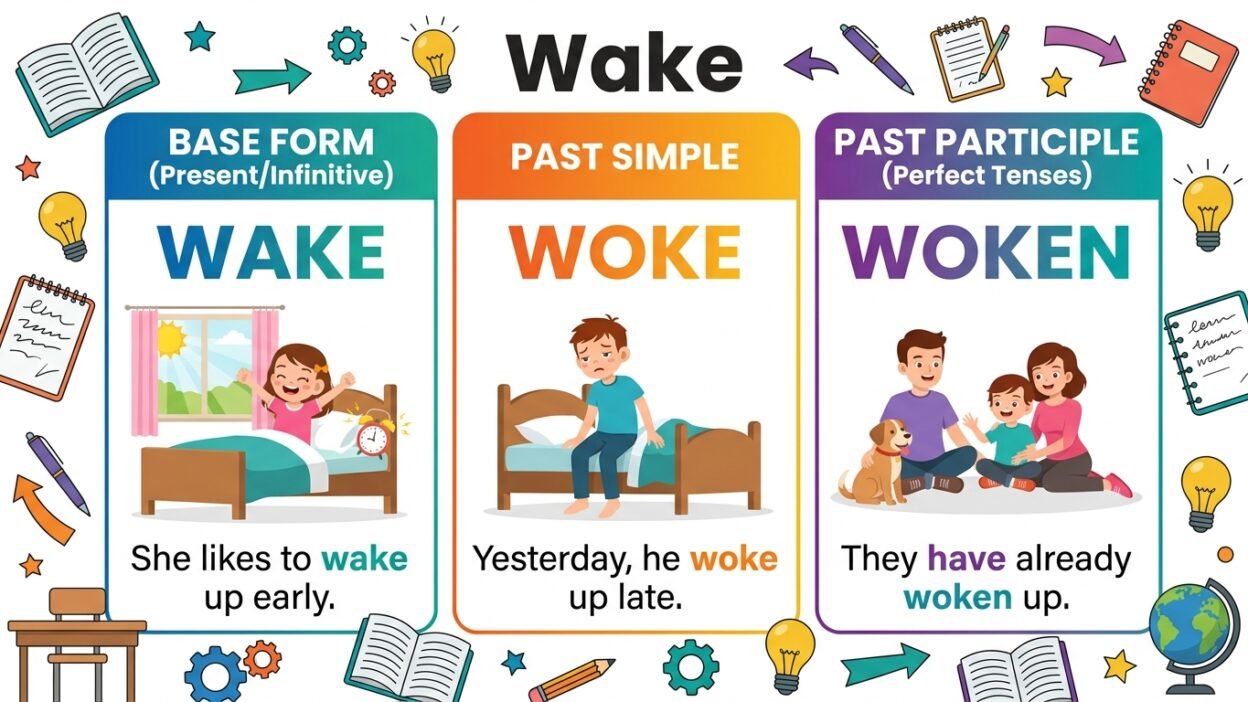
- Wake = base form
- Woke = simple past tense
- Woken = past participle
- Use woke for actions that happened in the past.
- Use woken with helping verbs such as has, have, had, was, were, be, been.
Examples
✅ I woke up at 6 a.m.
✅ I have woken up at 6 a.m. every day this week.
❌ I have woke up at 6 a.m.
❌ I woken up at 6 a.m. yesterday.
Simple Origin or Background Explanation
The verb wake is an irregular verb. This means it does not follow the normal -ed pattern used by regular verbs.
For example:
- Walk → Walked
- Jump → Jumped
But wake changes form:
| Verb Form | Word |
|---|---|
| Base Verb | Wake |
| Past Tense | Woke |
| Past Participle | Woken |
Because these forms are different, many learners accidentally use one where the other should be used.
The Difference Between Woke and Woken
The main difference is grammatical.
Woke
Woke is the simple past tense of wake.
Use it when talking about something that happened and finished in the past.
Examples:
- I woke up early today.
- She woke at sunrise.
- We woke to the sound of rain.
- He woke suddenly during the night.
In these examples, no helping verb is needed.
Woken
Woken is the past participle form.
It is usually used with helping verbs.
Examples:
- I have woken up early every day.
- She had woken before the alarm rang.
- We were woken by loud music.
- He has woken several times tonight.
Notice that woken normally appears with another verb.
Comparison Table
| Feature | Woke | Woken |
|---|---|---|
| Verb Type | Past Tense | Past Participle |
| Used Alone? | Yes | Usually No |
| Needs Helping Verb? | No | Yes |
| Common Helpers | None | Has, Have, Had, Was, Were, Been |
| Example | I woke early. | I have woken early. |
| Used in Simple Past? | Yes | No |
| Used in Perfect Tenses? | No | Yes |
Which One to Use and When
A simple rule makes it easy.
Use “Woke” When:
- Talking about a completed action in the past
- No helping verb comes before it
Examples:
- I woke at 7 a.m.
- She woke suddenly.
- They woke to a loud noise.
Use “Woken” When:
- A helping verb comes before it
- You are using perfect tenses
- You are using passive voice
Examples:
- I have woken up early all week.
- She had woken before everyone else.
- We were woken by the storm.
Easy Memory Trick
If you see:
- has
- have
- had
- was
- were
- been
you will usually need woken, not woke.
Common Mistakes People Make
Mistake 1: Using Woke After “Have”
❌ I have woke up already.
✅ I have woken up already.
Mistake 2: Using Woken Without a Helping Verb
❌ Yesterday I woken up late.
✅ Yesterday I woke up late.
Mistake 3: Mixing Past Tense and Past Participle
❌ She had woke before sunrise.
✅ She had woken before sunrise.
Mistake 4: Incorrect Passive Voice
❌ We were woke by the alarm.
✅ We were woken by the alarm.
Mistake 5: Forgetting the Verb Pattern
Remember:
Wake → Woke → Woken
Learning the full pattern helps prevent mistakes.
Everyday Real Life Examples
In Emails
✅ I woke up late and missed the meeting.
✅ I have woken up early to prepare for today’s meeting.
In News Reports
✅ Residents woke to heavy rain this morning.
✅ Residents were woken by emergency sirens.
On Social Media
✅ I woke up and saw hundreds of messages.
✅ I’ve woken up feeling much better today.
At School
✅ The student woke just before class started.
✅ The student had woken early to study.
At Home
✅ Dad woke up before everyone else.
✅ The children were woken by the dog.
At Work
✅ I woke up thinking about the project.
✅ I’ve woken up earlier since starting this job.
Short Learning Section for Students and Beginners
The easiest way to learn these forms is to memorize them together.
| Base Form | Past Tense | Past Participle |
|---|---|---|
| Wake | Woke | Woken |
Practice saying them aloud:
- Wake
- Woke
- Woken
Then make simple sentences:
- I wake up at 6 a.m.
- I woke up at 6 a.m. yesterday.
- I have woken up at 6 a.m. every day this week.
This method helps you remember the correct forms naturally.
FAQ
Is “woke” correct English?
Yes. Woke is the correct simple past tense of wake.
Example:
- I woke up early.
Is “woken” correct English?
Yes. Woken is the correct past participle form.
Example:
- I have woken up early.
Can I say “I have woke”?
No.
The correct sentence is:
- I have woken.
What is the past tense of wake?
The past tense is woke.
Example:
- She woke up at dawn.
What is the past participle of wake?
The past participle is woken.
Example:
- She has woken up already.
Is “was woken” correct?
Yes.
Example:
- He was woken by the alarm clock.
Why do people confuse woke and woken?
Because both come from the verb wake and have similar meanings. The difference is grammatical.
How can I remember the difference?
Remember this pattern:
Wake → Woke → Woken
If a helping verb like has, have, or had appears, use woken.
Conclusion
The difference between woke and woken is simple once you understand their grammar roles.
- Woke is the past tense.
- Woken is the past participle.
- Use woke for completed actions in the past.
- Use woken with helping verbs and passive constructions.
Remember the pattern wake → woke → woken, and you’ll be able to use both words correctly and confidently in everyday English.