Many English learners get confused about sewed and sewn because both words come from the verb sew. Since they are connected to the same action of joining fabric with a needle and thread, it can be difficult to know which one to use.
The good news is that the difference is easy to understand. Sewed is usually the past tense form, while sewn is the past participle form. Once you learn this simple rule, you can use both words correctly in everyday English.
This guide explains the difference in clear, beginner-friendly language with plenty of examples.
Quick Answer
- Sew = base form
- Sewed = simple past tense
- Sewn = past participle
- Use sewed for actions completed in the past.
- Use sewn with helping verbs such as has, have, had, was, were, be, been.
Examples
✅ My grandmother sewed a dress yesterday.
✅ My grandmother has sewn many dresses.
❌ My grandmother has sewed many dresses.
❌ My grandmother sewn a dress yesterday.
Simple Origin or Background Explanation
The verb sew has been part of English for hundreds of years. It refers to joining pieces of fabric or other materials with thread.
Unlike many regular verbs, sew has a special past participle form.
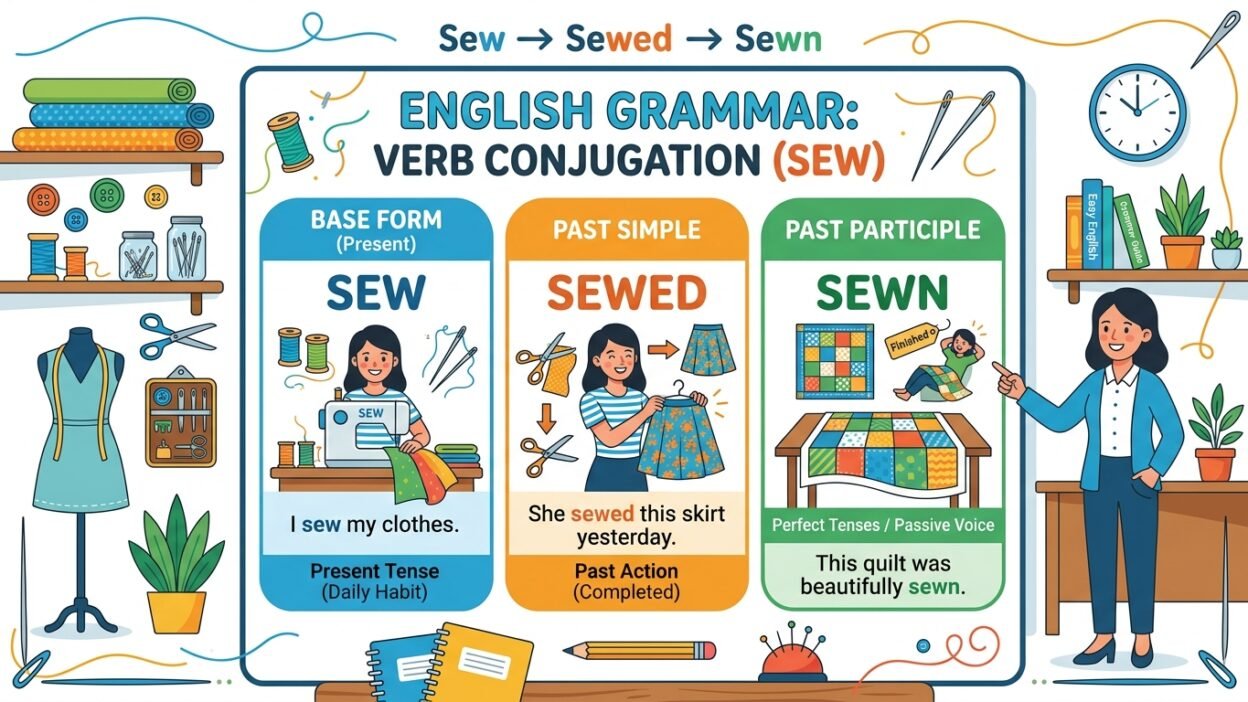
The standard pattern is:
| Verb Form | Word |
|---|---|
| Base Verb | Sew |
| Past Tense | Sewed |
| Past Participle | Sewn |
Because sewed and sewn look similar, many learners accidentally use one in place of the other.
The Difference Between Sewed and Sewn
The difference is grammatical.
Sewed
Sewed is the simple past tense of sew.
Use it when talking about something that happened and finished in the past.
Examples:
- She sewed a button onto my shirt.
- My mother sewed a new curtain.
- He sewed the torn pocket.
- They sewed costumes for the play.
No helping verb is needed.
Sewn
Sewn is the past participle form.
It is usually used with helping verbs.
Examples:
- She has sewn a button onto my shirt.
- The curtain was sewn by hand.
- He had sewn the pocket before leaving.
- The costumes have been sewn already.
Notice that sewn usually appears with another verb.
Comparison Table
| Feature | Sewed | Sewn |
|---|---|---|
| Verb Type | Past Tense | Past Participle |
| Used Alone? | Yes | Usually No |
| Needs Helping Verb? | No | Yes |
| Common Helpers | None | Has, Have, Had, Was, Were, Been |
| Example | She sewed a dress. | She has sewn a dress. |
| Used in Simple Past? | Yes | No |
| Used in Perfect Tenses? | No | Yes |
Which One to Use and When
Use “Sewed” When:
- Talking about a completed action in the past
- No helping verb comes before it
Examples:
- Grandma sewed a blanket.
- I sewed my school badge onto my shirt.
- She sewed the torn fabric yesterday.
Use “Sewn” When:
- A helping verb comes before it
- You are using perfect tenses
- You are using passive voice
Examples:
- Grandma has sewn many blankets.
- I had sewn the badge before school started.
- The dress was sewn by hand.
Easy Memory Trick
If you see:
- has
- have
- had
- was
- were
- been
you will usually need sewn, not sewed.
Common Mistakes People Make
Mistake 1: Using Sewed After “Have”
❌ I have sewed the dress.
✅ I have sewn the dress.
Mistake 2: Using Sewn Without a Helping Verb
❌ Yesterday I sewn a pillow.
✅ Yesterday I sewed a pillow.
Mistake 3: Mixing Past Tense and Past Participle
❌ She had sewed the curtain.
✅ She had sewn the curtain.
Mistake 4: Incorrect Passive Voice
❌ The shirt was sewed by hand.
✅ The shirt was sewn by hand.
Mistake 5: Forgetting the Verb Pattern
Remember:
Sew → Sewed → Sewn
Learning the full pattern helps prevent mistakes.
Everyday Real Life Examples
In Emails
✅ I sewed the company logo onto the uniform.
✅ I have sewn the logo onto all uniforms.
In News Reports
✅ Volunteers sewed blankets for families in need.
✅ Thousands of blankets have been sewn by volunteers.
On Social Media
✅ I sewed my first dress today.
✅ I’ve sewn three dresses this month.
At School
✅ The students sewed small fabric projects.
✅ The projects have been sewn successfully.
At Home
✅ Mom sewed a button onto my jacket.
✅ The button has been sewn securely.
As a Hobby
✅ She sewed a handmade bag.
✅ She has sewn many handmade bags over the years.
Short Learning Section for Students and Beginners
The easiest way to remember these forms is to learn them together.
| Base Form | Past Tense | Past Participle |
|---|---|---|
| Sew | Sewed | Sewn |
Practice saying them aloud:
- Sew
- Sewed
- Sewn
Then make your own sentences:
- I sew clothes.
- I sewed clothes yesterday.
- I have sewn clothes before.
This simple exercise helps the forms stay in your memory.
FAQ
Is “sewed” correct English?
Yes. Sewed is the correct simple past tense of sew.
Example:
- She sewed a new dress.
Is “sewn” correct English?
Yes. Sewn is the standard past participle form.
Example:
- She has sewn a new dress.
Can I say “I have sewed”?
In modern standard English, I have sewn is preferred.
What is the past tense of sew?
The past tense is sewed.
Example:
- He sewed the torn shirt.
What is the past participle of sew?
The past participle is sewn.
Example:
- He has sewn the torn shirt.
Is “was sewn” correct?
Yes.
Example:
- The costume was sewn by hand.
Why do people confuse sewed and sewn?
Because both words come from the same verb and are very similar in appearance. The difference is grammatical.
How can I remember the difference?
Remember:
Sew → Sewed → Sewn
If a helping verb comes before the verb, use sewn.
Conclusion
The difference between sewed and sewn is simple.
- Sewed is the past tense.
- Sewn is the past participle.
- Use sewed for completed actions in the past.
- Use sewn with helping verbs and passive constructions.
Remember the pattern sew → sewed → sewn, and you’ll be able to use both forms correctly and confidently in everyday English.