Many English learners wonder whether they should use burst or bursted. It seems natural to think that adding -ed makes the past tense, just like walk → walked or play → played.
However, burst is an irregular verb. That means its past tense and past participle do not change. The word bursted is considered incorrect in standard English.
If you’ve ever asked, “Is it burst or bursted?” this guide will clear up the confusion with simple explanations and everyday examples.
Quick Answer
- Burst = base form, past tense, and past participle
- Bursted = incorrect in standard English
- Use burst for the present, past, and past participle.
- Never use bursted in normal English writing or speaking.
Examples
✅ The balloon burst suddenly.
✅ The balloon has burst.
❌ The balloon bursted suddenly.
❌ The balloon has bursted.
Simple Origin or Background Explanation
The verb burst is one of several English verbs that stay exactly the same in all three forms.
Unlike regular verbs that add -ed, burst never changes.
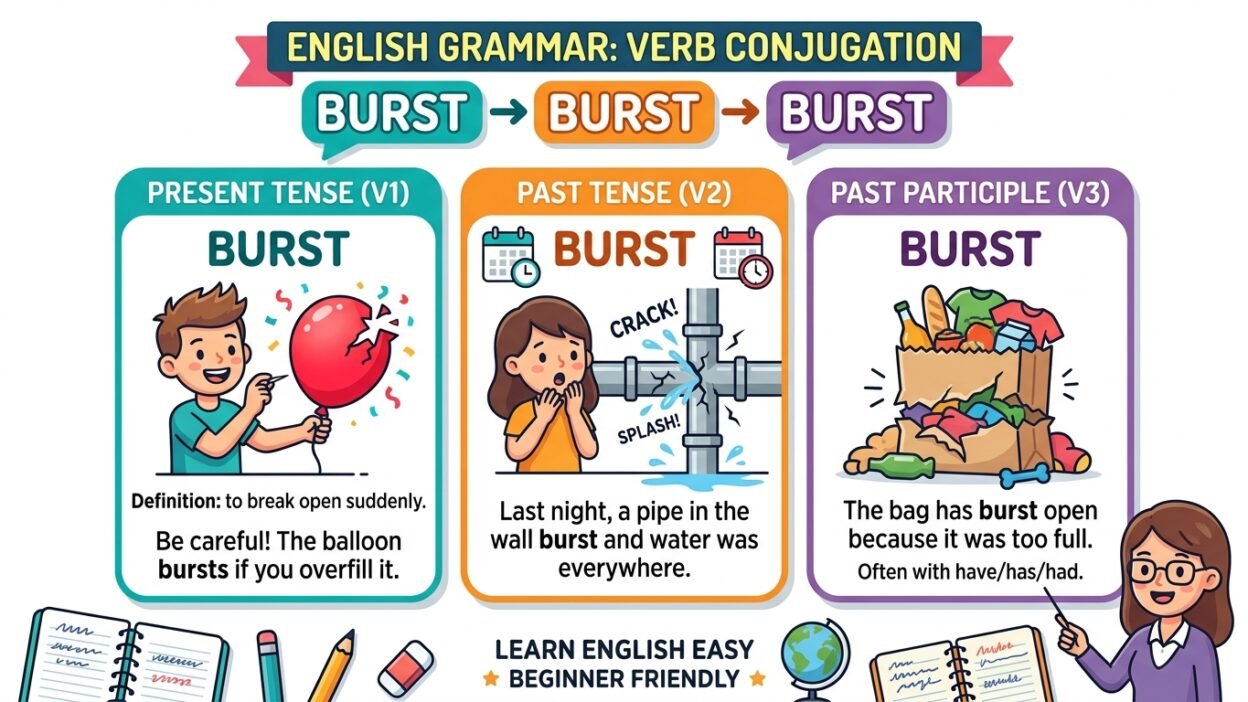
Here is the correct verb pattern:
| Verb Form | Word |
|---|---|
| Base Verb | Burst |
| Past Tense | Burst |
| Past Participle | Burst |
Since all three forms are identical, many learners mistakenly create the word bursted, but it is not accepted in standard English.
The Difference Between Burst and Bursted
The answer is simple.
Burst
Burst is the correct form in every verb tense.
Examples:
- The balloon burst.
- The pipe burst during the winter.
- The children burst into laughter.
- The dam burst after heavy rain.
It is also used with helping verbs.
Examples:
- The balloon has burst.
- The pipe had burst before workers arrived.
- Several water pipes have burst this year.
Bursted
Bursted is not the standard past tense or past participle of burst.
Although you may occasionally see it in very old texts or regional speech, it is considered incorrect in modern standard English.
Examples:
❌ The balloon bursted.
❌ The pipe has bursted.
Always replace bursted with burst.
Comparison Table
| Feature | Burst | Bursted |
|---|---|---|
| Correct Standard English? | ✅ Yes | ❌ No |
| Base Form | Yes | No |
| Past Tense | Yes | No |
| Past Participle | Yes | No |
| Used with Helping Verbs? | Yes | No |
| Example | The balloon burst. | The balloon bursted. ❌ |
Which One to Use and When
Use “Burst” When:
- Talking about the present
- Talking about the past
- Using perfect tenses
- Using passive voice
Examples:
- Balloons sometimes burst in hot weather.
- The balloon burst yesterday.
- The balloon has burst already.
- The pipe had burst before the repair team arrived.
Never Use “Bursted”
Avoid sentences like:
❌ My tire bursted.
✅ My tire burst.
❌ The bubble has bursted.
✅ The bubble has burst.
Easy Memory Trick
Remember:
Burst → Burst → Burst
If the verb is burst, it never changes.
Common Mistakes People Make
Mistake 1: Adding “-ed”
❌ Bursted
✅ Burst
Mistake 2: Using Bursted After “Has”
❌ The pipe has bursted.
✅ The pipe has burst.
Mistake 3: Using Bursted in the Past
❌ The balloon bursted.
✅ The balloon burst.
Mistake 4: Forgetting It’s an Irregular Verb
Many learners think every past tense ends with -ed, but burst is an exception.
Mistake 5: Confusing It with Regular Verbs
Regular verbs:
- Start → Started
- Jump → Jumped
Irregular verb:
- Burst → Burst
Everyday Real Life Examples
In Emails
✅ A water pipe burst this morning.
✅ The pipe has burst, and repairs are underway.
In News Reports
✅ A gas pipe burst late last night.
✅ Several water mains have burst because of freezing weather.
On Social Media
✅ My balloon burst before the party started.
✅ My phone battery almost burst!
At School
✅ The science experiment burst unexpectedly.
✅ The balloon had burst before the teacher arrived.
At Home
✅ The balloon burst with a loud noise.
✅ A pipe has burst in the kitchen.
In Daily Conversations
✅ Everyone burst into laughter.
✅ She has burst into tears several times today.
Short Learning Section for Students and Beginners
The easiest way to remember this verb is to memorize all three forms together.
| Base Form | Past Tense | Past Participle |
|---|---|---|
| Burst | Burst | Burst |
Practice saying them aloud:
- Burst
- Burst
- Burst
Now practice with sentences:
- Balloons burst easily.
- The balloon burst yesterday.
- The balloon has burst.
Since every form is the same, it’s one of the easiest irregular verbs to remember.
FAQ
Is “bursted” a real word?
In modern standard English, bursted is considered incorrect. Use burst instead.
Is “burst” the past tense?
Yes.
Example:
- The balloon burst.
Is “burst” the past participle?
Yes.
Example:
- The balloon has burst.
What is the correct verb pattern?
The correct pattern is:
Burst → Burst → Burst
Can I say “has bursted”?
No.
The correct sentence is:
- Has burst
Why do people say “bursted”?
Many learners think every past tense needs -ed, but burst is an irregular verb that never changes.
What does “burst into laughter” mean?
It means to suddenly start laughing.
Example:
- Everyone burst into laughter.
How can I remember the correct form?
Remember this simple pattern:
Burst → Burst → Burst
If you’re ever tempted to say bursted, replace it with burst.
Conclusion
The difference between burst and bursted is very simple.
- Burst is the correct base form, past tense, and past participle.
- Bursted is not correct in standard English.
- Always use burst, whether you’re talking about the present, the past, or a perfect tense.
Remember the pattern burst → burst → burst, and you’ll never make this mistake again.