Many English learners wonder whether the past tense of cut is cutted or simply cut. The confusion happens because most English verbs add -ed in the past tense. However, cut is different.
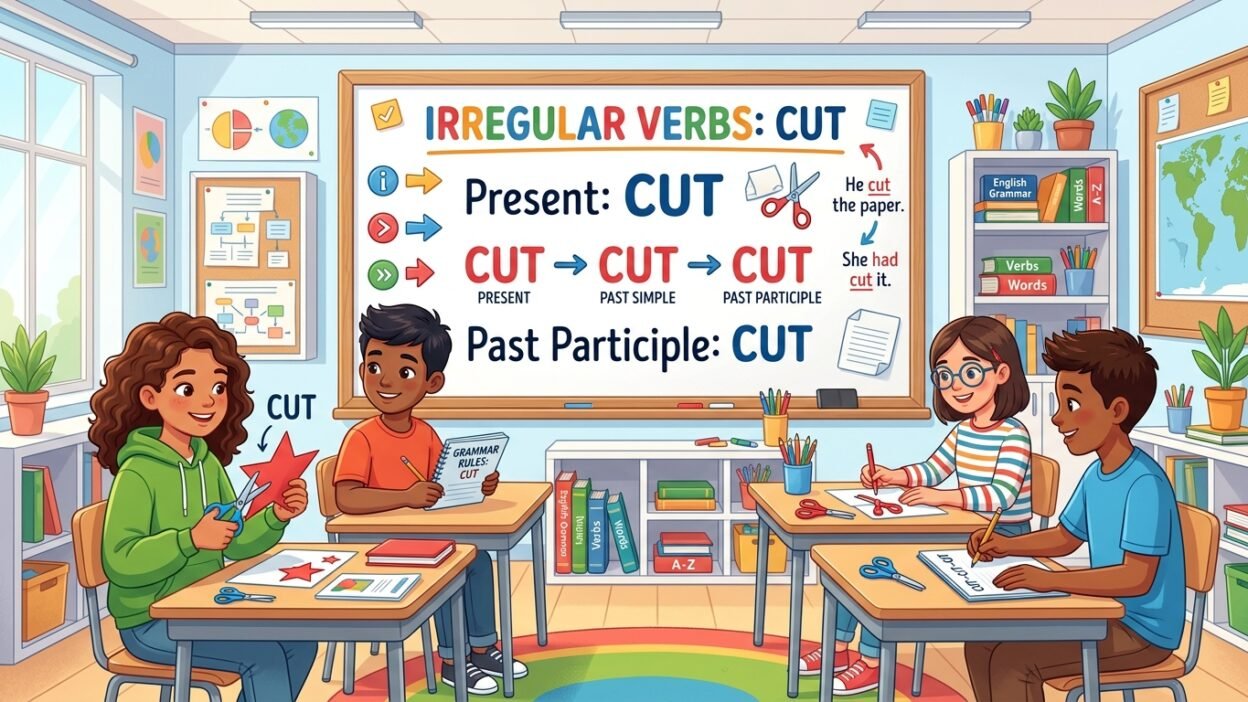
The verb cut is an irregular verb, which means its forms do not change. Whether you are talking about the present, the past, or the past participle, the spelling stays the same.
This guide explains the irregular forms of cut, when to use them, common mistakes, and plenty of simple examples.
Quick Answer
- Base Form: Cut
- Past Tense: Cut
- Past Participle: Cut
- Present Participle: Cutting
Examples:
- I cut the paper every day.
- I cut the paper yesterday.
- I have cut the paper already.
Remember: Never write cutted. It is incorrect in standard English.
Origin and Background
The verb cut is one of the oldest verbs in English. Unlike regular verbs, it has kept the same form for centuries.
Many common English verbs are irregular, but cut is especially easy because all three main forms are identical.
| Verb Form | Word |
|---|---|
| Base Form | Cut |
| Past Simple | Cut |
| Past Participle | Cut |
This makes it easier to remember than many other irregular verbs.
What Makes Cut an Irregular Verb?
Most English verbs form the past tense by adding -ed.
Examples:
- Walk → Walked
- Clean → Cleaned
- Open → Opened
The verb cut does not follow this rule.
Instead, it keeps the same spelling in every main form.
Examples:
- I cut vegetables every evening.
- Yesterday I cut vegetables.
- I have cut vegetables many times.
Only the time words and helping verbs tell you whether the action is in the present or past.
Comparison Table
| Verb Form | Example |
|---|---|
| Base Form | I cut paper every day. |
| Past Tense | I cut paper yesterday. |
| Past Participle | I have cut paper before. |
| Present Participle | I am cutting paper now. |
Which Form Should You Use?
Use Cut (Base Form)
Use it in the present tense.
Examples:
- I cut fruit every morning.
- They cut the grass every weekend.
Use Cut (Past Tense)
Use it for actions completed in the past.
Examples:
- She cut her hair yesterday.
- He cut the rope carefully.
- We cut the cake after dinner.
Use Cut (Past Participle)
Use it with helping verbs like have, has, had, was, or been.
Examples:
- I have cut my finger.
- She has cut the paper.
- The tree has been cut down.
Common Mistakes People Make
Mistake 1: Writing “Cutted”
❌ I cutted the paper.
✅ I cut the paper.
Mistake 2: Using the Wrong Past Participle
❌ I have cutted my hair.
✅ I have cut my hair.
Mistake 3: Confusing Present and Past
Because the spelling stays the same, learners sometimes become confused.
Present:
- I cut vegetables every day.
Past:
- I cut vegetables yesterday.
Time expressions help you understand the meaning.
Everyday Real Life Examples
In Emails
- I cut the document into smaller sections.
- I have cut the unnecessary information.
In School
- The student cut the paper carefully.
- We cut shapes for the project.
At Home
- Dad cut the wood.
- Mom has cut the vegetables.
On Social Media
- I finally cut my hair today!
- He cut the video into short clips.
In the News
- Workers cut down several damaged trees.
- The company has cut costs this year.
Short Learning Section for Students and Beginners
Memorize this simple pattern:
Cut → Cut → Cut
Practice these sentences:
- Yesterday I _____ the cake.
- Answer: cut
- I have _____ the rope.
- Answer: cut
- Every morning I _____ fruit.
- Answer: cut
- She is _____ vegetables now.
- Answer: cutting
The spelling stays the same, so you only need to pay attention to the sentence and any helping verbs.
Frequently Asked Questions
Is cut an irregular verb?
Yes. Cut is an irregular verb because its past tense and past participle do not change.
What is the past tense of cut?
The past tense of cut is cut.
What is the past participle of cut?
The past participle is also cut.
Is “cutted” a word?
No. Cutted is not correct in standard English.
How do I use cut in the present perfect tense?
Use have or has with cut.
Example: I have cut the paper.
Why doesn’t cut change in the past tense?
It is an irregular verb that has kept the same form in all three main verb forms.
What is the -ing form of cut?
The present participle is cutting.
What are the three forms of cut?
- Base Form: Cut
- Past Tense: Cut
- Past Participle: Cut
Conclusion
The verb cut is one of the easiest irregular verbs to remember because its three main forms are exactly the same.
- Cut = base form
- Cut = past tense
- Cut = past participle
The only form that changes is cutting, which is used for continuous tenses.
Whenever you are tempted to write cutted, remember this simple rule:
Cut → Cut → Cut
Learning this pattern will help you use cut correctly in conversations, writing, schoolwork, and everyday English.

Austin Brandon serves as both an author and administrator at GrammerPeak. He manages site operations while creating clear, accurate grammar content that helps readers correct mistakes, understand language rules, and write with confidence, precision, and clarity across academic, professional, and everyday English communication.