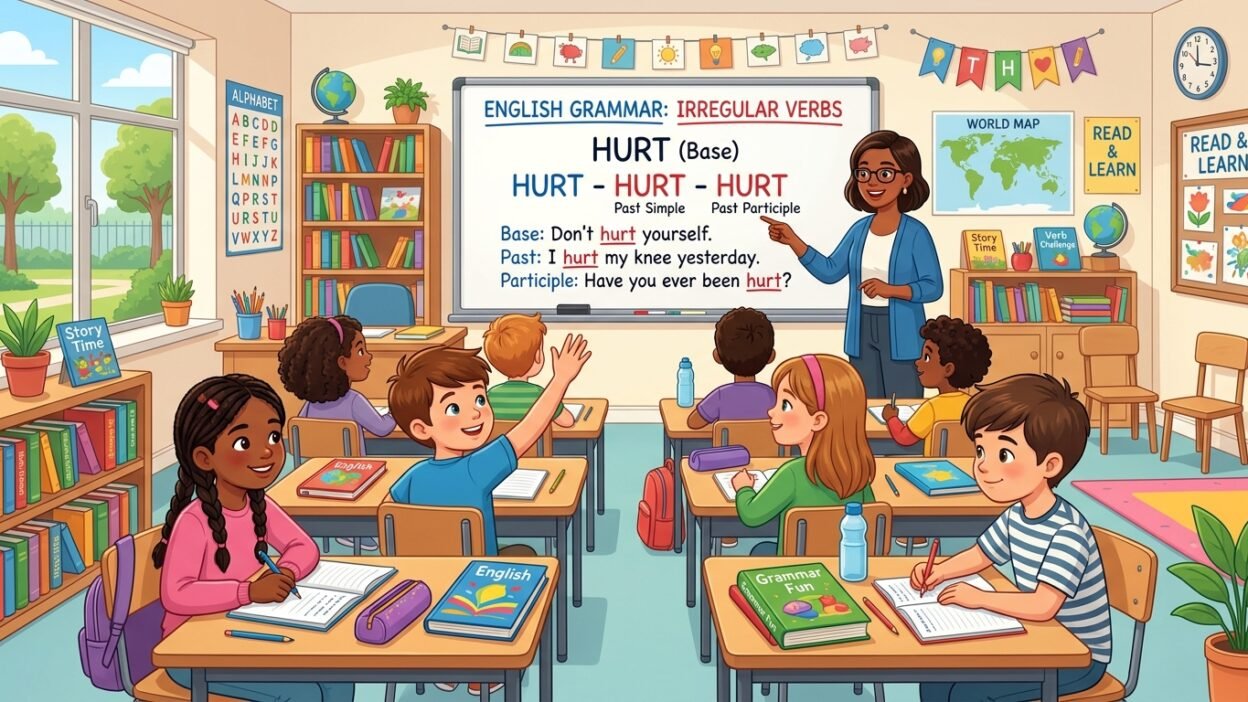
The verb hurt is one of the easiest irregular verbs in English because all three forms are the same. However, many learners still wonder whether they should say hurt, hurted, or another form.
The simple answer is that hurt never changes. If you are talking about the present, the past, or the past participle, the word stays hurt.
In this guide, you’ll learn the forms of hurt, when to use each one, common mistakes, and plenty of easy examples.
Quick Answer
- Base Form: hurt
- Past Simple: hurt
- Past Participle: hurt
- Present Participle: hurting
Examples:
- I hurt my hand yesterday.
- She has hurt her knee.
- They are hurting after the game.
Verb Forms of Hurt
| Verb Form | Word |
|---|---|
| Base Form | hurt |
| Third Person Singular | hurts |
| Present Participle | hurting |
| Past Simple | hurt |
| Past Participle | hurt |
Is Hurt an Irregular Verb?
Yes.
Hurt is an irregular verb because it does not add -ed in the past tense.
Instead of changing, it stays the same.
- Present: hurt
- Past: hurt
- Past Participle: hurt
This makes it similar to verbs like:
- cut → cut → cut
- put → put → put
- let → let → let
- shut → shut → shut
What Does Hurt Mean?
The verb hurt usually means:
- to cause physical pain
- to cause emotional pain
- to damage something
Examples:
Physical Pain
- I hurt my ankle.
- She hurt her back.
- He hurt his finger.
Emotional Pain
- His words hurt me.
- She was hurt by the comment.
- The news hurt everyone.
Damage
- Heavy rain hurt the crops.
- The accident hurt the business.
- The fire hurt nearby buildings.
How to Use Hurt in Different Tenses
Present Tense
Use hurt for actions happening now or regularly.
Examples:
- My foot hurts.
- Loud sounds hurt my ears.
- They hurt each other’s feelings.
Past Tense
Use hurt for actions that happened in the past.
Examples:
- I hurt my shoulder yesterday.
- She hurt her arm while running.
- They hurt themselves during the game.
Present Perfect
Use have/has + hurt.
Examples:
- I have hurt my knee.
- She has hurt her wrist.
- They have hurt their chances of winning.
Past Perfect
Use had + hurt.
Examples:
- He had hurt his back before the race.
- We had hurt our chances by arriving late.
Future Tense
Examples:
- I will hurt myself if I’m not careful.
- They will hurt their reputation if they lie.
Comparison Table
| Tense | Example |
|---|---|
| Present | I hurt my finger easily. |
| Past | I hurt my finger yesterday. |
| Present Perfect | I have hurt my finger. |
| Past Perfect | I had hurt my finger before the match. |
| Future | I will hurt my finger if I’m careless. |
Common Mistakes
Mistake 1: Saying “Hurted”
❌ I hurted my hand.
✅ I hurt my hand.
There is no word “hurted” as the past tense of hurt.
Mistake 2: Using “Have Hurted”
❌ She has hurted her leg.
✅ She has hurt her leg.
The past participle is also hurt.
Mistake 3: Forgetting the Third Person Form
❌ My arm hurt every day.
✅ My arm hurts every day.
In the present simple, use hurts with he, she, it, or singular subjects.
Everyday Examples
At Home
- I hurt my thumb while cooking.
- Dad hurt his back lifting a box.
At School
- She hurt her knee in gym class.
- He hurt his hand playing basketball.
At Work
- I hurt my wrist typing all day.
- She has hurt her shoulder carrying heavy files.
On Social Media
- That movie really hurt my feelings.
- I hurt my foot hiking today!
In the News
- Several players hurt themselves during the match.
- The storm hurt local businesses.
Short Learning Section for Students
Remember this simple pattern:
hurt → hurt → hurt
Only the -ing form changes:
- hurting
Practice:
- Yesterday I _____ my knee.
- Answer: hurt
- She has _____ her ankle.
- Answer: hurt
- We are _____ after the long hike.
- Answer: hurting
- My brother _____ his hand yesterday.
- Answer: hurt
Frequently Asked Questions
Is hurt a regular or irregular verb?
Hurt is an irregular verb because its past tense and past participle do not end in -ed.
What are the three forms of hurt?
- Base form: hurt
- Past simple: hurt
- Past participle: hurt
Is “hurted” a correct word?
No. The correct past tense is hurt, not hurted.
What is the past tense of hurt?
The past tense is hurt.
Example: I hurt my foot yesterday.
What is the past participle of hurt?
The past participle is hurt.
Example: She has hurt her shoulder.
How do I use hurt in the present perfect?
Use have/has + hurt.
Example:
- I have hurt my hand.
- He has hurt his knee.
Why doesn’t hurt change in the past tense?
Because hurt is an irregular verb with the same form in the base, past, and past participle.
Conclusion
The verb hurt is one of the simplest irregular verbs to learn because its main forms never change.
- Base form: hurt
- Past simple: hurt
- Past participle: hurt
The biggest mistake learners make is writing hurted, but this is incorrect. Simply use hurt for both the past tense and the past participle.
Once you remember the pattern hurt → hurt → hurt, you’ll be able to use this common English verb correctly in everyday speaking and writing.