Many English learners get confused about swore and sworn because both words come from the verb swear. Since they are connected to the same action, they often seem interchangeable. However, they have different grammar roles and cannot always be used in the same way.
The good news is that the difference is simple. Once you understand when to use the past tense and when to use the past participle, choosing between swore and sworn becomes easy.
This guide explains everything in clear, simple English with practical examples that students, learners, and beginners can understand right away.
Quick Answer
- Swear = base form
- Swore = simple past tense
- Sworn = past participle
- Use swore for an action that happened in the past.
- Use sworn with helping verbs such as has, have, had, was, were, be, been.
Examples
✅ He swore that he was telling the truth.
✅ He has sworn that he was telling the truth.
❌ He has swore that he was telling the truth.
❌ He sworn that he was telling the truth.
Simple Origin or Background Explanation
Swear is an irregular verb. This means it does not follow the normal pattern of adding -ed to form the past tense.
Many regular verbs work like this:
- Talk → Talked
- Play → Played
- Watch → Watched
But swear follows a different pattern:
| Verb Form | Word |
|---|---|
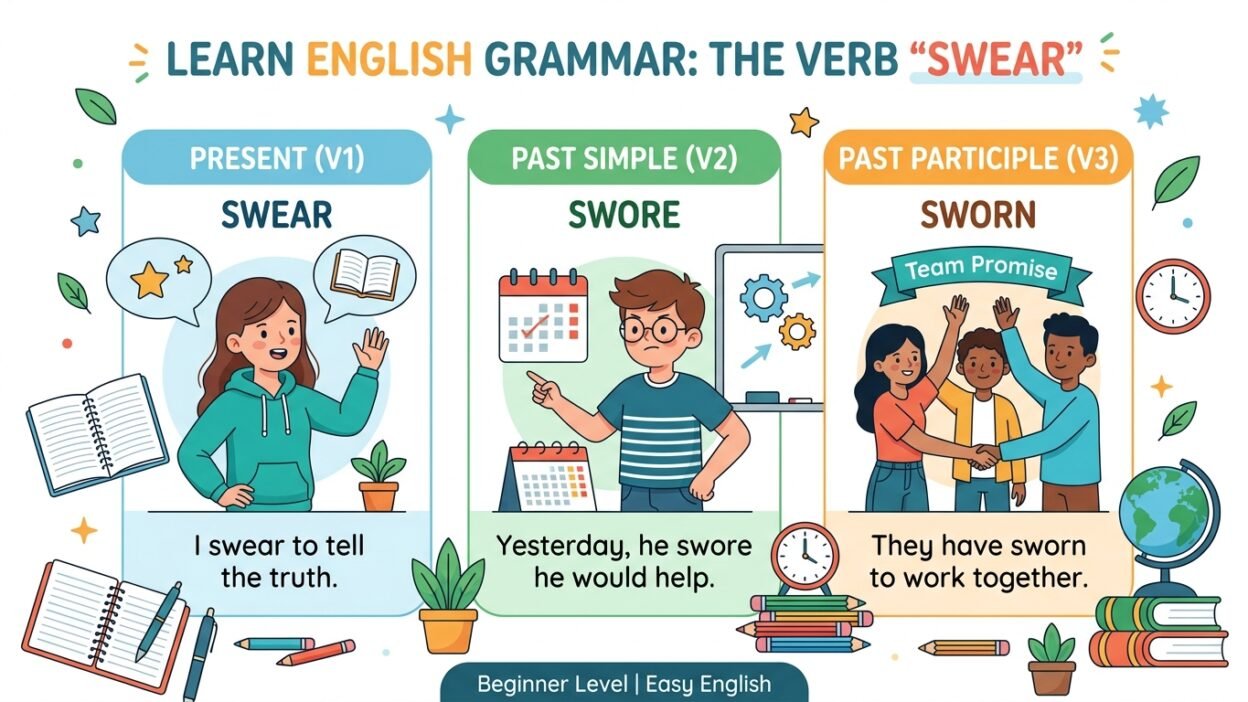
| Base Verb | Swear |
| Past Tense | Swore |
| Past Participle | Sworn |
Because the forms are different, learners often mix them up.
The Difference Between Swore and Sworn
The difference is grammatical rather than meaning.
Swore
Swore is the simple past tense of swear.
Use it when talking about something that happened and finished in the past.
Examples:
- She swore to tell the truth.
- He swore he would return.
- They swore loyalty to their team.
- I swore I saw him yesterday.
In these sentences, no helping verb is needed.
Sworn
Sworn is the past participle form.
It is usually used with helping verbs.
Examples:
- She has sworn to tell the truth.
- He had sworn never to return.
- They have sworn loyalty to the organization.
- The statement was sworn before a judge.
Notice that sworn normally appears with another verb.
Comparison Table
| Feature | Swore | Sworn |
|---|---|---|
| Verb Type | Past tense | Past participle |
| Used Alone? | Yes | |
| Usually No? | No | Yes |
| Needs Helping Verb? | No | Yes |
| Common Helpers | None | Has, Have, Had, Was, Were, Been |
| Example | He swore an oath. | He has sworn an oath. |
| Used in Simple Past? | Yes | No |
| Used in Perfect Tenses? | No | Yes |
Which One to Use and When
A simple rule can help.
Use “Swore” When:
- Talking about a completed action in the past
- No helping verb comes before it
Examples:
- He swore he was innocent.
- She swore never to lie again.
- They swore an oath before the ceremony.
Use “Sworn” When:
- A helping verb comes before it
- You are using perfect tenses
- You are using passive voice
Examples:
- He has sworn to keep the secret.
- She had sworn loyalty to the group.
- A sworn statement was submitted.
Easy Memory Trick
If you see:
- has
- have
- had
- was
- were
- been
you will usually need sworn, not swore.
Common Mistakes People Make
Mistake 1: Using Swore After “Have”
❌ I have swore to tell the truth.
✅ I have sworn to tell the truth.
Mistake 2: Using Sworn Without a Helping Verb
❌ Yesterday he sworn an oath.
✅ Yesterday he swore an oath.
Mistake 3: Mixing Up Past Tense and Past Participle
❌ She had swore never to return.
✅ She had sworn never to return.
Mistake 4: Forgetting the Verb Pattern
Remember:
Swear → Swore → Sworn
Learning the complete pattern makes it much easier to use the correct form.
Everyday Real Life Examples
In Emails
✅ He swore that the information was correct.
✅ He has sworn that the information is correct.
In News Reports
✅ The witness swore that the statement was true.
✅ The witness had sworn an official oath before testifying.
On Social Media
✅ I swore I left my keys here.
✅ I’ve sworn to spend less time online.
At School
✅ The student swore that he completed the assignment himself.
✅ The student had sworn honesty during the competition.
In Daily Conversations
✅ She swore she would call later.
✅ She has sworn never to forget that day.
In Legal Situations
✅ The witness swore to tell the truth.
✅ The witness has sworn an oath.
Short Learning Section for Students and Beginners
The easiest way to remember these forms is to learn them together.
| Base Form | Past Tense | Past Participle |
|---|---|---|
| Swear | Swore | Sworn |
Practice saying them aloud:
- Swear
- Swore
- Sworn
Now try these sentences:
- I swear to tell the truth.
- I swore to tell the truth.
- I have sworn to tell the truth.
This simple exercise helps you remember the correct pattern.
FAQ
Is “swore” correct English?
Yes. Swore is the correct simple past tense of swear.
Example:
- He swore he was innocent.
Is “sworn” correct English?
Yes. Sworn is the correct past participle form.
Example:
- He has sworn he was innocent.
Can I say “I have swore”?
No.
The correct form is:
- I have sworn.
Which is correct: “swore an oath” or “sworn an oath”?
Both can be correct depending on the sentence structure.
- He swore an oath. ✅
- He has sworn an oath. ✅
What does “sworn statement” mean?
A sworn statement is a statement officially declared to be true, often under oath.
Can “sworn” be used as an adjective?
Yes.
Examples:
- A sworn witness
- A sworn officer
- A sworn statement
Why do people confuse swore and sworn?
Because both come from the verb swear and have similar meanings. The difference is mainly grammatical.
How can I remember the difference?
Remember this pattern:
Swear → Swore → Sworn
If a helping verb like has, have, or had appears, use sworn.
Conclusion
The difference between swore and sworn is simple once you understand their grammar roles.
- Swore is the past tense.
- Sworn is the past participle.
- Use swore for completed actions in the past.
- Use sworn with helping verbs and in passive constructions.
Remember the pattern swear → swore → sworn, and you’ll be able to use both words correctly and confidently in everyday English.