Many English learners get confused about showed and shown because both words come from the verb show. They look similar, and both refer to displaying, presenting, or letting someone see something.
The confusion usually happens because one word is used as the past tense, while the other is used as the past participle. Knowing when to use each form will help you speak and write more naturally.
In this guide, you’ll learn the difference between showed and shown in very simple English, with clear examples and easy rules to remember.
Quick Answer
- Show = base form
- Showed = simple past tense
- Shown = past participle
- Use showed for actions completed in the past.
- Use shown with helping verbs such as has, have, had, was, were, be, been.
Examples
✅ I showed my friend the photo yesterday.
✅ I have shown my friend the photo already.
❌ I have showed my friend the photo.
❌ I shown my friend the photo yesterday.
Simple Origin or Background Explanation
The verb show is interesting because it has two accepted past participle forms in some situations:
- Showed
- Shown
However, in modern English, shown is much more common as the past participle.
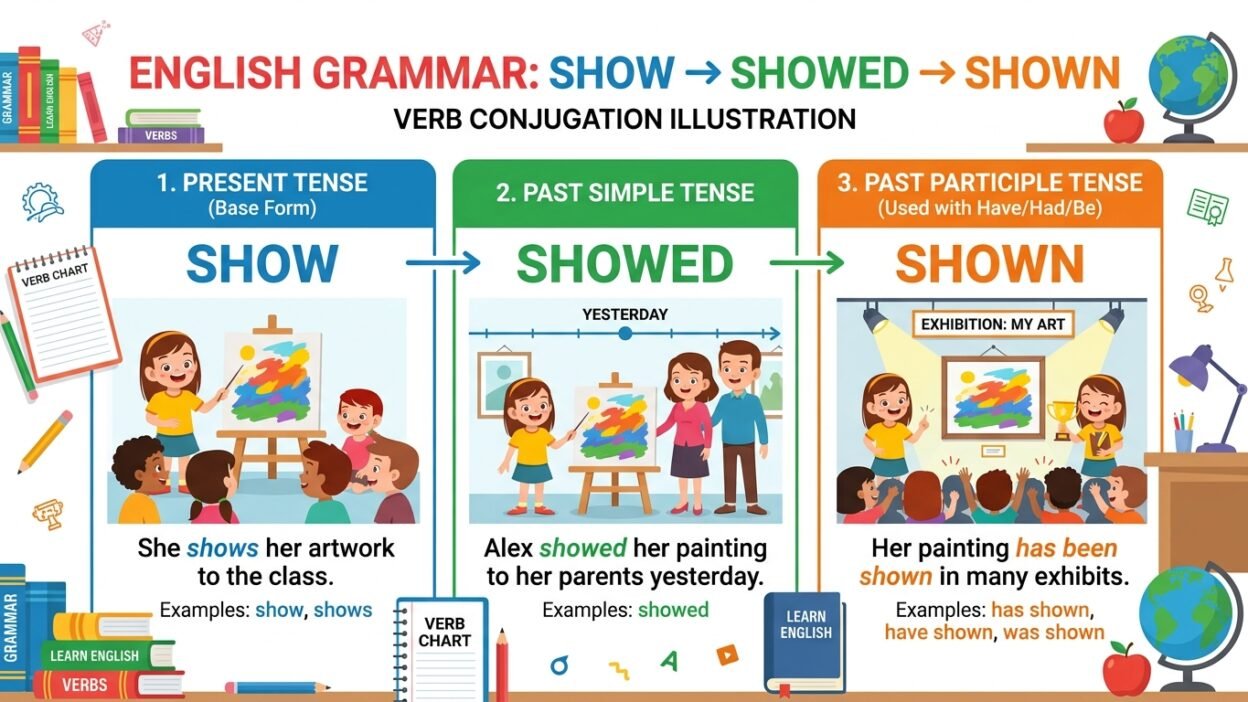
The standard verb pattern is:
| Verb Form | Word |
|---|---|
| Base Verb | Show |
| Past Tense | Showed |
| Past Participle | Shown |
This is why many learners mistakenly use showed where shown should be used.
The Difference Between Showed and Shown
The difference is mainly grammatical.
Showed
Showed is the simple past tense of show.
Use it when talking about an action that happened and ended in the past.
Examples:
- She showed me her new phone.
- The teacher showed us a video.
- I showed him the way home.
- They showed great kindness.
In these examples, no helping verb is needed.
Shown
Shown is the past participle form.
It is usually used with helping verbs.
Examples:
- She has shown me her new phone.
- The results have been shown online.
- They had shown interest before.
- The video was shown to students.
Notice that shown normally appears with another verb.
Comparison Table
| Feature | Showed | Shown |
|---|---|---|
| Verb Type | Past tense | Past participle |
| Used Alone? | Yes | Usually no |
| Needs Helping Verb? | No | Yes |
| Common Helpers | None | Has, Have, Had, Was, Were, Been |
| Example | I showed her the photo. | I have shown her the photo. |
| Used in Simple Past? | Yes | No |
| Used in Perfect Tenses? | No | Yes |
Which One to Use and When
A simple rule can help you choose correctly.
Use “Showed” When:
- Talking about a finished action in the past
- No helping verb comes before it
Examples:
- He showed me his homework.
- We showed our tickets at the entrance.
- The guide showed us around the museum.
Use “Shown” When:
- A helping verb comes before it
- You are using perfect tenses
- You are using passive voice
Examples:
- I have shown the report to my manager.
- She had shown great improvement.
- The movie was shown on television.
Easy Memory Trick
If you see:
- has
- have
- had
- was
- were
- been
you will usually need shown, not showed.
Common Mistakes People Make
Mistake 1: Using Showed After “Have”
❌ I have showed the report.
✅ I have shown the report.
Mistake 2: Using Shown Without a Helping Verb
❌ Yesterday I shown my passport.
✅ Yesterday I showed my passport.
Mistake 3: Mixing Up the Forms
❌ She had showed us the document.
✅ She had shown us the document.
Mistake 4: Incorrect Passive Voice
❌ The movie was showed last night.
✅ The movie was shown last night.
Mistake 5: Forgetting the Verb Pattern
Remember:
Show → Showed → Shown
Learning the complete pattern helps prevent mistakes.
Everyday Real Life Examples
In Emails
✅ I showed the presentation to the team yesterday.
✅ I have shown the presentation to the team.
In News Reports
✅ The company showed strong growth this year.
✅ The results have been shown to investors.
On Social Media
✅ I showed everyone my vacation photos.
✅ I’ve already shown those photos before.
At School
✅ The teacher showed us how to solve the problem.
✅ The answer has been shown on the board.
At Home
✅ Mom showed me an old family album.
✅ The pictures have been shown to everyone.
At Work
✅ The manager showed us the new system.
✅ The new system has been shown to employees.
Short Learning Section for Students and Beginners
The easiest way to remember these forms is to learn them together.
| Base Form | Past Tense | Past Participle |
|---|---|---|
| Show | Showed | Shown |
Practice these sentences:
- I show my work.
- I showed my work yesterday.
- I have shown my work already.
This simple pattern helps build confidence and improves grammar.
FAQ
Is “showed” correct English?
Yes. Showed is the correct simple past tense of show.
Example:
- She showed me her new car.
Is “shown” correct English?
Yes. Shown is the standard past participle form.
Example:
- She has shown me her new car.
Can I say “I have showed”?
In modern standard English, I have shown is preferred and considered the correct form.
Which is more common, showed or shown?
Both are common, but they are used in different situations.
- Simple past = showed
- Past participle = shown
Is “was shown” correct?
Yes.
Example:
- The documentary was shown on television.
Can “shown” be used as an adjective?
Yes.
Examples:
- The shown results were accurate.
- The shown image was clear.
However, this use is less common than the verb form.
Why do people confuse showed and shown?
Because both words come from the same verb and refer to the same action. The difference is grammatical, not meaning.
How can I remember the difference?
Remember:
Show → Showed → Shown
If there is a helping verb like has, have, had, was, or were, use shown.
Conclusion
The difference between showed and shown is straightforward.
- Showed is the simple past tense.
- Shown is the past participle.
- Use showed when talking about a completed action in the past.
- Use shown with helping verbs and in passive sentences.
Remember the pattern show → showed → shown, and you’ll know exactly which word to use in every situation.