Many English learners get confused about the past tense of “grind.” Since it is an irregular verb, people sometimes use incorrect forms such as “grinded” when they mean the standard past tense.
The good news is that the most common past tense form is easy to learn.
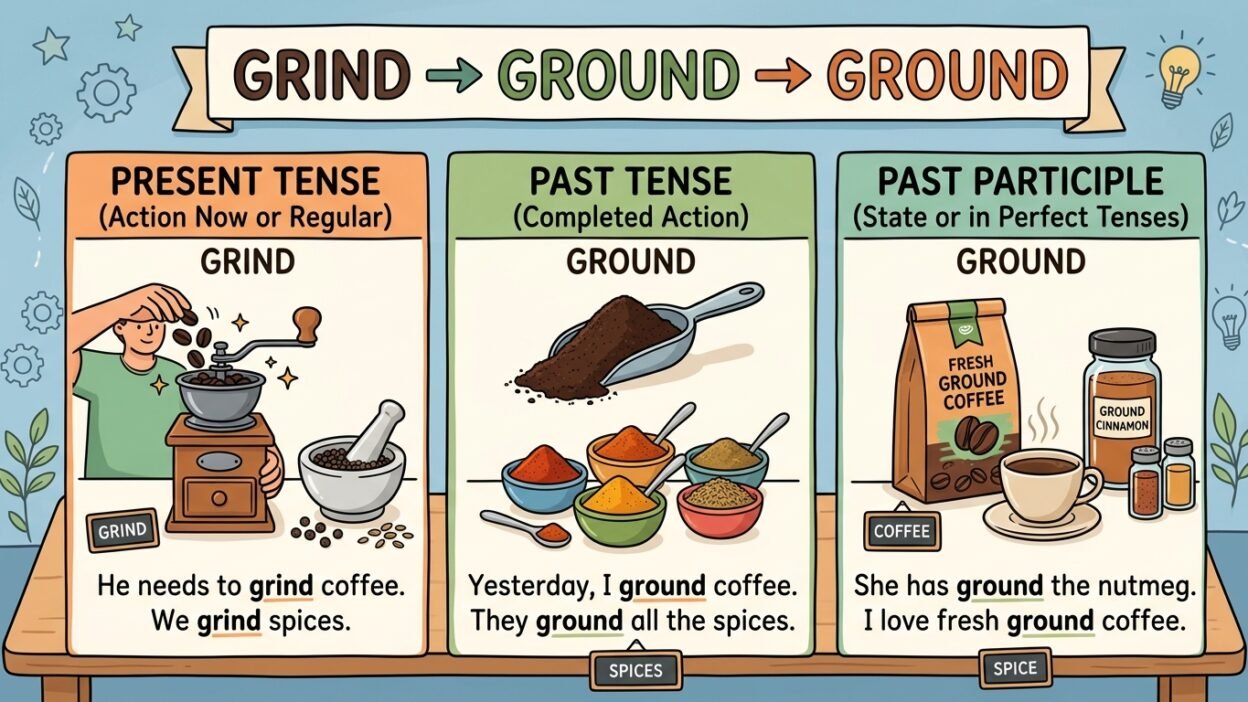
Quick Answer
- Grind = present tense
- Ground = past tense
- Ground = past participle
Verb Forms
| Form | Word |
|---|---|
| Base Verb | Grind |
| Past Tense | Ground |
| Past Participle | Ground |
Simple Background
The verb “grind” means:
- To crush something into small pieces
- To make something into powder
- To rub two surfaces together
Examples:
- “They grind coffee beans every morning.”
- “The machine can grind spices.”
Because grind is an irregular verb, its past tense becomes ground, not “grinded” in most situations.
Clear Explanation of the Difference
What is “Grind”?
Grind is the present tense form.
Examples:
- “I grind fresh coffee every day.”
- “Workers grind the metal surface.”
- “The machine can grind grain.”
What is “Ground”?
Ground is the standard past tense and past participle form.
Examples:
- “She ground the coffee beans yesterday.”
- “The mill ground the wheat into flour.”
- “They have ground the spices already.”
Comparison Table
| Verb Form | Word | Example |
|---|---|---|
| Present | Grind | “I grind coffee.” |
| Past | Ground | “I ground coffee yesterday.” |
| Past Participle | Ground | “I have ground coffee before.” |
Which One to Use and When
Use grind when:
- Talking about the present
- Talking about habits
- Talking about future actions
Examples:
- “I grind pepper regularly.”
- “We will grind the grain tomorrow.”
Use ground when:
- Talking about completed past actions
- Using has, have, or had
Examples:
- “He ground the spices.”
- “She has ground the beans.”
Simple Tip to Remember
Think:
- Today → grind
- Yesterday → ground
- Has/have/had → ground
Common Mistakes People Make
1. Saying “grinded”
❌ “I grinded the coffee.”
✔ “I ground the coffee.”
2. Using the present tense for past actions
❌ “She grind the wheat yesterday.”
✔ “She ground the wheat yesterday.”
3. Confusing “ground” with the noun
Remember that ground can also mean:
- the surface of the earth
Example:
- “The ball fell to the ground.”
Everyday Real Life Examples
In the Kitchen
- “She ground fresh pepper.”
- “They have ground the coffee beans.”
At Work
- “The machine ground the metal.”
- “Workers grind materials every day.”
On a Farm
- “The mill ground the grain.”
- “Farmers grind animal feed.”
In Daily Life
- “The gears ground loudly.”
- “He ground the spices for dinner.”
Short Learning Section for Students
Step 1: Learn the forms
- Grind
- Ground
- Ground
Step 2: Practice
- “I grind coffee.”
- “I ground coffee yesterday.”
- “I have ground coffee before.”
Step 3: Use a memory trick
Think:
Grind → Ground → Ground
Step 4: Avoid “grinded”
In standard English, use ground as the past tense.
FAQ
What is the past tense of grind?
The past tense of grind is ground.
What is the past participle of grind?
The past participle is ground.
Is “grinded” correct?
In standard English, ground is the usual and preferred form. “Grinded” appears only in a few special technical contexts.
Is grind a regular verb?
No. It is an irregular verb.
Can I say “I have ground the coffee”?
Yes. That is correct.
Why does grind become ground?
It follows an older irregular English verb pattern.
How can I remember the forms?
Think:
Grind → Ground → Ground
Conclusion
The past tense of grind is ground, and the past participle is also ground.
- Grind = present tense
- Ground = past tense
- Ground = past participle
Remember this easy rule:
Use “ground,” not “grinded,” in normal English.
With this simple pattern, you can use the verb correctly and confidently in speaking and writing.