Many English learners get confused about the past tense of “find.” Since English has many irregular verbs, people sometimes guess the wrong form or mistakenly write “finded.”
The good news is that the correct past tense is easy to learn and very common in everyday English.
Quick Answer
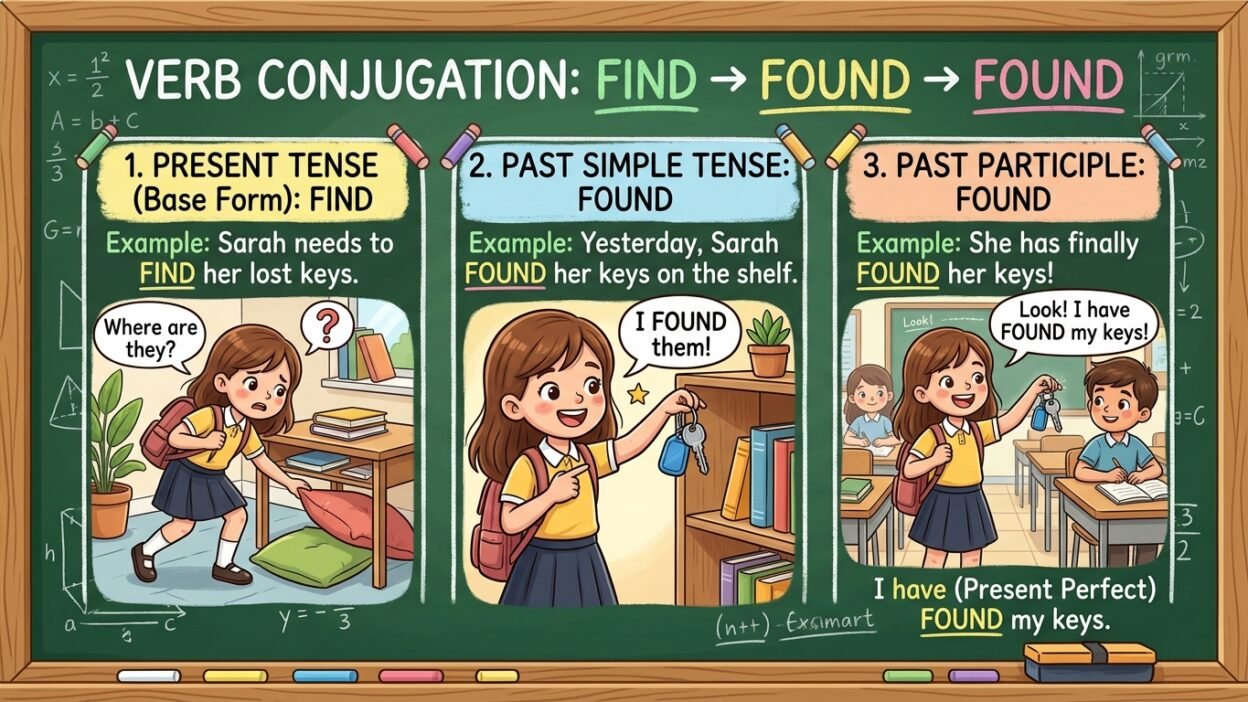
- Find = present tense
- Found = past tense
- Found = past participle
Verb Forms
| Form | Word |
|---|---|
| Base Verb | Find |
| Past Tense | Found |
| Past Participle | Found |
Simple Background
The verb “find” means:
- To discover something
- To locate something
- To get or obtain something
Examples:
- “I hope I find my keys.”
- “She finds useful information online.”
Because find is an irregular verb, it does not become “finded.”
Clear Explanation of the Difference
What is “Find”?
Find is the present tense form.
Examples:
- “I find math interesting.”
- “They find new places to visit.”
- “Can you find my book?”
What is “Found”?
Found is the past tense and past participle form.
Examples:
- “I found my keys yesterday.”
- “She found a great restaurant.”
- “They have found the answer.”
Comparison Table
| Verb Form | Word | Example |
|---|---|---|
| Present | Find | “I find mistakes easily.” |
| Past | Found | “I found the mistake.” |
| Past Participle | Found | “I have found the mistake.” |
Which One to Use and When
Use find when:
- Talking about the present
- Talking about habits
- Talking about future situations
Examples:
- “I find this lesson helpful.”
- “You will find the information soon.”
Use found when:
- Talking about something discovered in the past
- Using has, have, or had
Examples:
- “I found my phone.”
- “She has found her wallet.”
Simple Tip to Remember
Think:
- Today → find
- Yesterday → found
- Has/have/had → found
Common Mistakes People Make
1. Saying “finded”
❌ “I finded my keys.”
✔ “I found my keys.”
2. Using present tense for past actions
❌ “She find her bag yesterday.”
✔ “She found her bag yesterday.”
3. Forgetting the irregular form
Remember:
- find → found
Everyday Real Life Examples
At Home
- “I found my glasses.”
- “Can you find the remote?”
In School
- “The student found the correct answer.”
- “I find science interesting.”
At Work
- “We found a solution.”
- “They have found a new customer.”
Online
- “I found a helpful article.”
- “She found the video quickly.”
Short Learning Section for Students
Step 1: Learn the forms
- Find
- Found
- Found
Step 2: Practice
- “I find.”
- “I found.”
- “I have found.”
Step 3: Use a memory trick
Think:
Find → Found → Found
Step 4: Avoid “finded”
The word finded is not correct in standard English.
FAQ
What is the past tense of find?
The past tense of find is found.
What is the past participle of find?
The past participle is found.
Is “finded” correct?
No. The correct form is found.
Is find a regular verb?
No. It is an irregular verb.
Can I say “I have found”?
Yes. That is correct.
Why does find become found?
It follows an older irregular English verb pattern.
How can I remember the forms?
Think:
Find → Found → Found
Conclusion
The past tense of find is found, and the past participle is also found.
- Find = present tense
- Found = past tense
- Found = past participle
Remember this easy rule:
Never use “finded.” Always use “found” for past actions.
With this simple pattern, you can use the verb correctly and confidently in everyday English.