Many English learners get confused about the past tense of “bite.” Since English has many irregular verbs, people sometimes use incorrect forms such as “bited.”
The good news is that once you learn the correct forms, the verb is easy to use.
Quick Answer
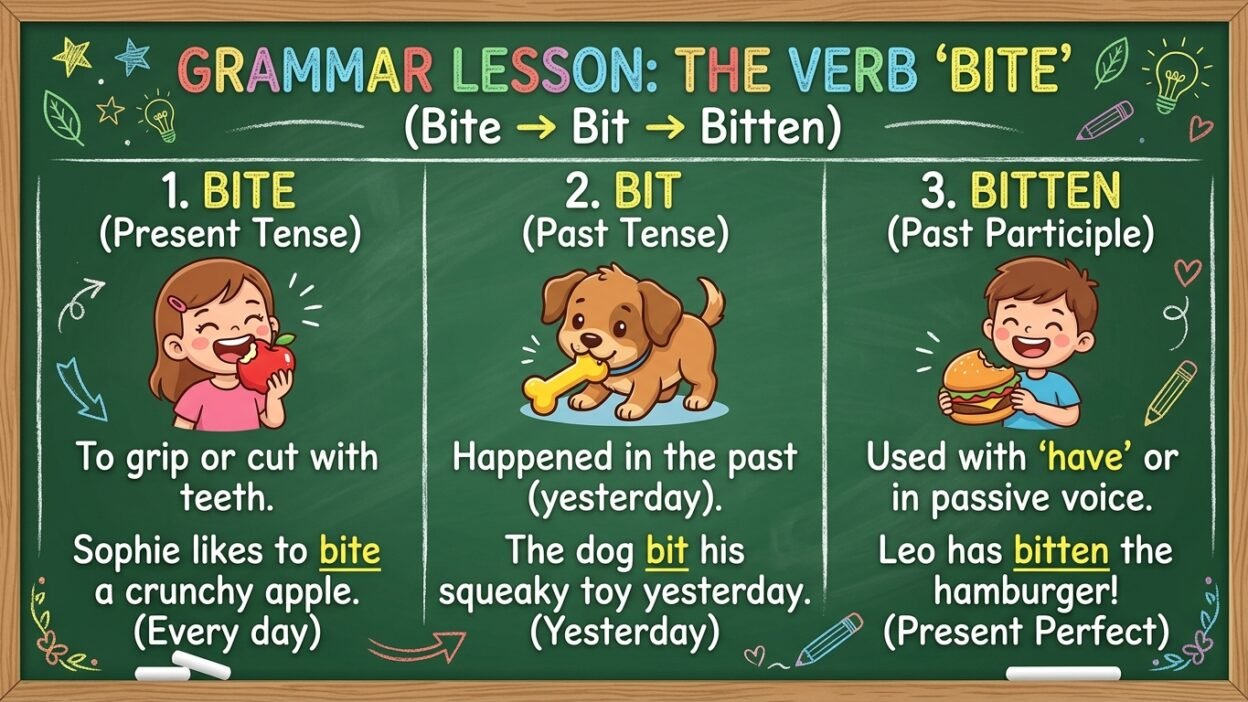
- Bite = present tense
- Bit = past tense
- Bitten = past participle
Verb Forms
| Form | Word |
|---|---|
| Base Verb | Bite |
| Past Tense | Bit |
| Past Participle | Bitten |
Simple Background
The verb “bite” means:
- To cut with the teeth
- To grip with the teeth
- To sting or pierce
Examples:
- “The dog might bite.”
- “A mosquito can bite people.”
Because bite is an irregular verb, it does not become “bited.”
Clear Explanation of the Difference
What is “Bite”?
Bite is the present tense form.
Examples:
- “Dogs sometimes bite.”
- “Be careful not to bite your tongue.”
- “The puppy may bite the toy.”
What is “Bit”?
Bit is the past tense form.
Examples:
- “The dog bit the mail carrier.”
- “I bit my lip.”
- “The mosquito bit me yesterday.”
What is “Bitten”?
Bitten is the past participle form.
Examples:
- “The dog has bitten several shoes.”
- “She was bitten by a mosquito.”
- “I have never been bitten by a snake.”
Comparison Table
| Verb Form | Word | Example |
|---|---|---|
| Present | Bite | “Dogs bite.” |
| Past | Bit | “The dog bit me.” |
| Past Participle | Bitten | “The dog has bitten me.” |
Which One to Use and When
Use bite when:
- Talking about the present
- Talking about habits
- Talking about future possibilities
Examples:
- “Some insects bite.”
- “Be careful, the dog may bite.”
Use bit when:
- Talking about a completed past action
Examples:
- “The dog bit the toy.”
- “I bit into the apple.”
Use bitten when:
- Using has, have, or had
- Using passive voice
Examples:
- “He has bitten his nails.”
- “She was bitten by a spider.”
Simple Tip to Remember
Think:
- Today → bite
- Yesterday → bit
- Has/have/had → bitten
Common Mistakes People Make
1. Saying “bited”
❌ “The dog bited me.”
✔ “The dog bit me.”
2. Using “bit” instead of “bitten”
❌ “The dog has bit me.”
✔ “The dog has bitten me.”
3. Mixing up past tense and past participle
Remember:
- Past tense = bit
- Past participle = bitten
Everyday Real Life Examples
In Daily Life
- “I bit into a sandwich.”
- “The puppy bit my shoe.”
At Home
- “The cat bit the string.”
- “He has bitten his fingernails.”
Outdoors
- “A mosquito bit my arm.”
- “She was bitten by an insect.”
In Stories
- “The wolf bit the hunter.”
- “The vampire had bitten its victim.”
Short Learning Section for Students
Step 1: Learn the forms
- Bite
- Bit
- Bitten
Step 2: Practice
- “I bite.”
- “I bit.”
- “I have bitten.”
Step 3: Use a memory trick
Think:
Bite → Bit → Bitten
Step 4: Watch for “has” and “have”
After:
- has
- have
- had
Use bitten, not bit.
FAQ
What is the past tense of bite?
The past tense of bite is bit.
What is the past participle of bite?
The past participle is bitten.
Is “bited” correct?
No. “Bited” is not correct English.
Is bite a regular verb?
No. It is an irregular verb.
Which is correct: bit or bitten?
Both are correct, but they are used differently.
- Past tense = bit
- Past participle = bitten
Can I say “has bit”?
In standard English, use has bitten.
How can I remember the forms?
Think:
Bite → Bit → Bitten
Conclusion
The past tense of bite is bit, and the past participle is bitten.
- Bite = present
- Bit = past
- Bitten = past participle
Remember this easy rule:
Never use “bited.” Use “bit” for the past tense and “bitten” after has, have, or had.
With this simple pattern, you can use the verb correctly in speaking and writing.