Many English learners get confused between “didn’t” and “doesn’t.” Both words are negative forms of helping verbs, and both are very common in everyday English.
The confusion usually happens because both can be used with similar verbs, but they refer to different times.
The good news is that the difference is simple: one is used for the past, and the other is used for the present.
Quick Answer
- Didn’t = did not = past tense
- Doesn’t = does not = present tense (he, she, it)
Simple Rule
- Past action → didn’t
- Present action → doesn’t
Simple Background
Both words are contractions:
- Didn’t = did not
- Doesn’t = does not
They are used to make negative sentences.
Examples:
- “I didn’t go.” (past)
- “She doesn’t go.” (present)
Clear Explanation of the Difference
What is “Didn’t”?
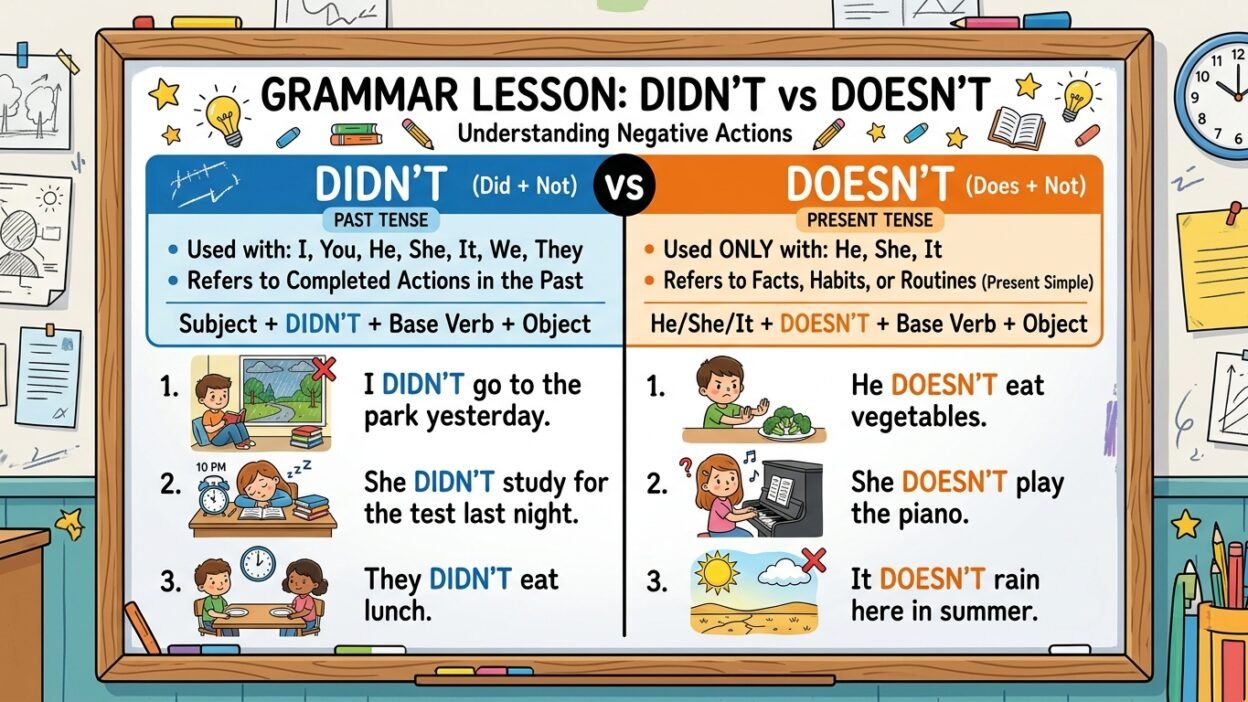
Didn’t is the short form of did not.
Use it when talking about something that did not happen in the past.
Examples:
- “I didn’t see him yesterday.”
- “They didn’t finish the project.”
- “We didn’t go to school last Friday.”
What is “Doesn’t”?
Doesn’t is the short form of does not.
Use it with:
- he
- she
- it
- singular nouns
It describes something that is not true now or does not happen regularly.
Examples:
- “She doesn’t like coffee.”
- “He doesn’t drive.”
- “The car doesn’t start.”
Comparison Table
| Word | Full Form | Tense | Example |
|---|---|---|---|
| Didn’t | Did not | Past | “I didn’t call.” |
| Doesn’t | Does not | Present | “She doesn’t call.” |
Which One to Use and When
Use didn’t when:
- Talking about yesterday
- Talking about last week
- Talking about any completed past event
Examples:
- “I didn’t sleep well.”
- “They didn’t arrive on time.”
Use doesn’t when:
- Talking about the present
- Talking about habits
- Talking about facts
Examples:
- “He doesn’t eat meat.”
- “She doesn’t work here.”
Simple Tip to Remember
Think:
- Did = past
- Does = present
So:
- didn’t = past negative
- doesn’t = present negative
Common Mistakes People Make
1. Using “doesn’t” for past events
❌ “She doesn’t come yesterday.”
✔ “She didn’t come yesterday.”
2. Using “didn’t” for present situations
❌ “He didn’t like coffee.” (when talking about now)
✔ “He doesn’t like coffee.”
3. Adding a past tense verb after “didn’t”
❌ “I didn’t went.”
✔ “I didn’t go.”
After didn’t, always use the base verb.
Everyday Real Life Examples
In School
- “I didn’t do my homework.”
- “She doesn’t understand the lesson.”
In Daily Life
- “We didn’t watch the movie.”
- “He doesn’t cook often.”
In Emails
- “I didn’t receive your message.”
- “The attachment doesn’t open.”
On Social Media
- “I didn’t know that!”
- “This phone doesn’t work properly.”
Short Learning Section for Students
Step 1: Remember the time
- Past = didn’t
- Present = doesn’t
Step 2: Practice
- “I didn’t eat breakfast.”
- “She doesn’t eat breakfast.”
Step 3: Learn the pattern
After didn’t:
- use the base verb
Examples:
- didn’t go
- didn’t see
- didn’t eat
Step 4: Read and speak
The more examples you see, the easier the difference becomes.
FAQ
What is the difference between didn’t and doesn’t?
“Didn’t” is used for the past, while “doesn’t” is used for the present.
Is didn’t past tense?
Yes. It means “did not.”
Is doesn’t present tense?
Yes. It means “does not.”
Can I use doesn’t with I?
No. Use “don’t” with I.
✔ “I don’t know.”
Can I use didn’t with he or she?
Yes.
✔ “He didn’t come.”
✔ “She didn’t call.”
Why do we say “didn’t go” and not “didn’t went”?
Because after “didn’t,” the verb stays in its base form.
How can I remember easily?
Think:
- did = past
- does = present
Conclusion
The difference between didn’t and doesn’t is mainly about time.
- Didn’t is used for the past.
- Doesn’t is used for the present.
Remember this easy rule:
If it happened before, use “didn’t.” If it is happening now or regularly, use “doesn’t.”
With this rule, you can use both words correctly and confidently in everyday English.