Many English learners get confused between “creeped” and “crept.” The confusion happens because both forms are used in English, and both can be correct.
The difference is mostly about style, region, and how formal the language sounds.
The good news is that understanding when to use each form is quite simple.
Quick Answer
- Crept = traditional and more common past tense of creep
- Creeped = also accepted, but less common
Both can be correct depending on the context.
Simple Background
The verb “creep” means:
- To move slowly and quietly
- To move carefully without being noticed
- To gradually spread or increase
Over time, English developed two past tense forms:
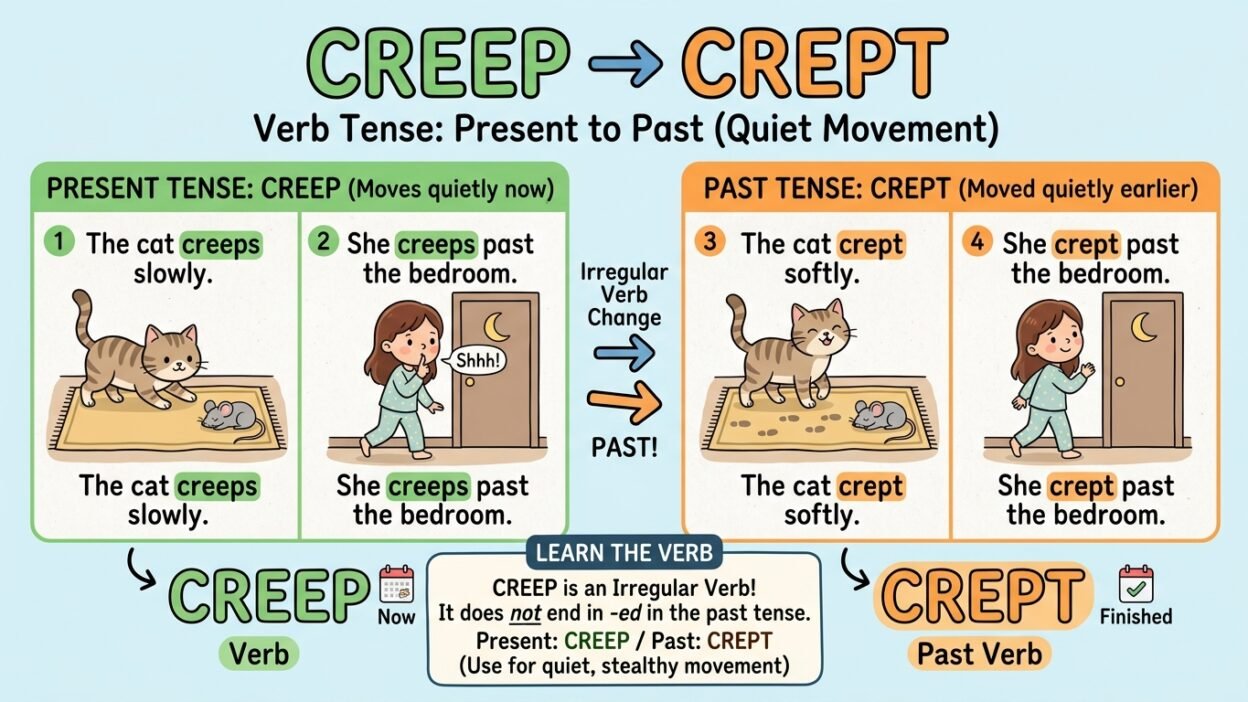
- creep → crept
- creep → creeped
Today, crept is far more common in most writing and speech.
Clear Explanation of the Difference
What is “Crept”?
Crept is the traditional past tense and past participle form of creep.
Examples:
- “The cat crept across the floor.”
- “Fear crept into his mind.”
- “She had crept out quietly.”
This is the form you will see most often in books, news articles, and everyday English.
What is “Creeped”?
Creeped is also accepted by some dictionaries and style guides, but it is much less common.
Examples:
- “The child creeped toward the door.”
- “The vines creeped across the wall.”
Many native speakers still prefer crept in these sentences.
Comparison Table
| Word | Meaning | Common Usage |
|---|---|---|
| Crept | Past tense of creep | Very common |
| Creeped | Past tense of creep | Less common |
| Crept | Past participle | Very common |
| Creeped | Past participle | Less common |
Which One to Use and When
Use crept when:
- Writing school assignments
- Writing professionally
- Speaking formal English
- Following traditional grammar
Use creeped when:
- Following a style guide that accepts it
- Writing casually where the form sounds natural
Simple Tip to Remember
If you are unsure, choose crept.
It is the form most teachers, editors, and native speakers expect.
Common Mistakes People Make
1. Thinking “creeped” is always wrong
It is not always wrong.
However, crept is usually preferred.
2. Using the less common form in formal writing
While “creeped” can be accepted, “crept” often sounds more natural.
3. Forgetting the past participle
❌ “She has creeped away.” (less common)
✔ “She has crept away.” (preferred)
Everyday Real Life Examples
In Daily Life
- “The cat crept under the table.”
- “The fog crept over the hills.”
In Stories
- “A shadow crept across the room.”
- “The thief crept through the window.”
In Nature
- “The plant crept along the fence.”
In Conversations
- “Time crept by slowly.”
Short Learning Section for Students
Here is an easy way to remember:
Step 1: Learn the forms
- Creep = present
- Crept = past
- Crept = past participle
Step 2: Practice
- “I creep quietly.”
- “I crept quietly yesterday.”
Step 3: Use memory trick
Think:
Creep usually becomes crept.
Step 4: Choose the safer option
For school and formal writing, use crept.
FAQ
Which is correct: creeped or crept?
Both can be correct, but crept is more common.
What is the past tense of “creep”?
The most common past tense is crept.
Is “creeped” a real word?
Yes, it is recognized in some dictionaries.
Which form should students use?
Students should usually use crept.
What is the past participle of “creep”?
The most common past participle is crept.
Why are there two forms?
English sometimes keeps both regular and irregular verb forms.
How can I remember easily?
Think: creep → crept.
Conclusion
The difference between creeped and crept is mainly about usage and preference.
- Crept is the traditional and most common form.
- Creeped is accepted but much less common.
Remember this easy rule:
When in doubt, use “crept.”
It is the form most readers and teachers expect, making it the safest choice for everyday English.